Showing posts with label Onthisday. Show all posts

Monday, October 30, 2017

On This Day: Mike "Twin" Sullivan Remembered


By Peter Silkov


Mike ‘Twin’ Sullivan was a clever boxer who fought many of the top fighters from lightweight to middleweight, of the 1900s and early 1910s. The twin of Jack Sullivan, who was a formidable fighter in his own right, Mike, was born on September 23, 1878, in Cambridge, Massachusetts, and began his paid fighting career in 1901.


Throughout his career, Mike fought name fighters such as George ‘Elbows’ Mcfadden, Jack Blackburn, Joe Gans, Rube Smith, Harry Lewis, Honey Mellody, Jimmy Gardner, Dick Fitzpatrick, Belfield Walcott, Jimmy Clabby, Paddy Lavin, Dixie Kid, Young Loughrey, Jack Dillon, Stanley Ketchel, and Kid Henry.

On April 23, 1907, Sullivan out-pointed Billy ‘Honey’ Mellody over 20 rounds, to win recognition by the California State, as the World welterweight champion.

Sullivan gave up his welterweight title in late 1908, and thereafter, fought as a middleweight. His final contest was in 1914, when he was knocked out in 4 rounds by Roddy Macdonald.

Mike ‘Twin’ Sullivan’s final record was (35-7-14, 18koes).

Mike Sullivan died on October 31, 1937, aged 59.


Follow us on Twitter: @TheBoxingGlove and  
Facebook: www.facebook.com/theboxingglove

If you are an boxer, amateur or professional, and want us to follow you or tell your story, contact petersilkov@yahoo.com   or theboxingglove@yahoo.com

If you are an author and you would like your book reviewed, contact Peter Silkov at petersilkov@yahoo.com or theboxingglove@yahoo.com

Monday, August 14, 2017

On This Day Johnny 'Honey Boy' Bratton Remembered


By Peter Silkov

Johnny ‘Honey Boy’ Bratton was a very game box-fighter, who could go toe-to-toe and fight like a tiger, as well as box beautifully. Bratton became well-known for his incredible fighting heart, that saw him in many crowd-pleasing wars, and made him one of the favourites of the fight crowds.

Born on September 9, 1927, in Little Rock, Arkansas, Bratton reached the final of the Chicago Golden Gloves championship in 1944, before turning professional that same year. During his career, Bratton would fight a veritable whose-who of the top fighters of the 1940s and 50s era, from the lightweight, to the middleweight divisions.

Bratton was already mixing it with the top contenders within 2 years of turning professional, Bratton fought regularly and seldom faced an ‘easy touch.’

The top fighters that Bratton faced is an impressive list, including men such as Chalky Wright, Ike Williams, Freddie Dawson, Willie Joyce, Sammy Angott, Gene Burton, Beau Jack, Frankie Abrams, Joe Brown, Chester Rico, Gene Hairston, Holly Mims, Johnny Cesario, Bobby Dykes, Charlie Fusari, Kid Gavilan, Rocky Castellani, Del Flanagan, Joe Miceli, Ralph ‘Tiger’ Jones, Laurent Dauthuille, Pierre Langlois, Danny Womber and Johnny Saxton.

On March 15, 1951, Bratton won the vacant NBA World welterweight championship, after beating Charlie Fusari on points over 15 rounds. Two months later, Bratton lost the title to Kid Gavilan, when he was beaten on points in a furious and brutal fight. Bratton lasted the distance in this fight despite suffering a broken jaw in the early rounds, and taking tremendous punishment throughout. Bratton’s performance was one of the bravest ever seen in a ring during modern times.

On November 11, 1953, Bratton tried to regain the World welterweight title from Kid Gavilan, but was again beaten on points, after another bloody and brutal clash. This fight seemed to finish Bratton as a fighter, and he fought just 3 more times, losing each fight. Bratton's final contest was on March 17, 1955, when he was stopped in 9 rounds by Del Flanagan. Bratton retired with a final record of 60(34koes)-24-3.

Sadly Bratton's post-boxing life was not a happy one, he suffered from health problems, and was at one point reduced to living in a car. For all his talent and bravery Bratton became another example of how boxing can ask a terrible price from its bravest warriors. 


Watch Kid Gavilan Vs. Johnny Bratton:


Copyright © 2017 The Boxing Glove, Inc. Peter Silkov Art. All Rights Reserved. Peter Silkov contributes to www.theboxingglove.com

#‎OnThisDay‬ ‪#‎BoxingHistory‬ ‪#‎BoxingNews‬ ‪#‎TheBoxingGlove‬ ‪#‎TheBoxingGloveNews‬ ‪#‎BornOnThisDay‬ ‪#‎Boxing‬ ‪#‎Boxeo‬


Sunday, March 19, 2017

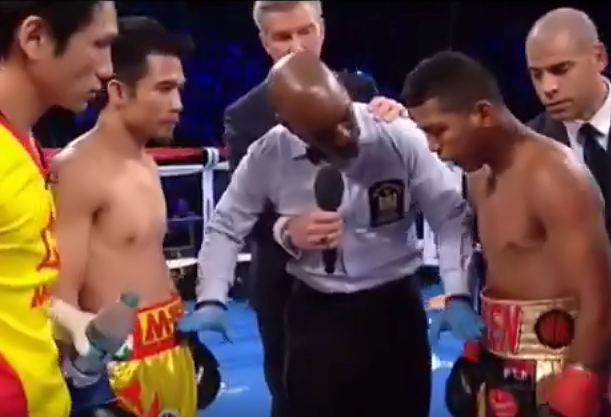
Big Fight Report: Roman Gonzalez Dethroned In The Big Apple by Hard-Headed Srisaket Sor Rungvisai


By Peter Silkov

It's been a traumatic last few months for little warrior, Roman Gonzalez (46-1, 38koes.) After winning his 4th world title last September, Gonzalez was deeply shaken by the death of his trainer, Arnulfo Obando, last November. Obando had been Gonzalez’s main trainer and mentor since 2010, and had guided him to 3 of his 4 world titles. His loss to Gonzalez was only too evident last night as ‘Chocolatito’s first defence of his WBC world super-flyweight title descended into a bloody nightmare for the pound-for-pound, number one, boxer in the world.


When Gonzalez won this title from Carlos Cuadras six months ago, there were indications that this might be a weight jump too far for Gonzalez. Unlike many modern fighters, Gonzalez does not lose a significant amount of weight for his fights, and in this, his 4th weight division, he is facing opponents who are naturally bigger than him on fight night. Although he prevailed against Cuadras in September, after a fight of the year epic battle, there remained doubts about whether he was destined to be as strong a force at super-flyweight, as he was in his previous divisions.


The man chosen to provide the answer last night, at a packed Madison Square Garden, was Thai tough man, Srisaket Sor Rungvisai, (42-4-1, 38koes.) Rungvisai, a former holder of Gonzalez’s title, came with the reputation as a hard-punching tough nut, and he was to live up to this reputation in more ways than one.


The portents of what was to come were not good, as Gonzalez looked perturbed and tense, and close to tears in the moments before the contest started, constantly looking up towards the heavens, as he seemed to thinking about his late trainer, Arnulfo Obando. It was something that he was to do throughout this fight, leading one to wonder whether he was really in the right state of mind to defend his title at all.


The match started at a quick pace with both men exchanging shots and the challenger showed from the start that he was looking to stand his ground and not allow Gonzalez to push him back. In the last minute of the round the fight produced its first shock, as a body punch dumped ’Chocolatito’ onto the canvas by the ropes. The champion seemed to be more surprised than hurt, but already Rungvisai had lived up to his heavy punching reputation.


In the second round the action speeded up, as a stung Gonzalez went to work, barrelling forwards, and throwing punching with both hands. Rungvisai stayed with the champion though and would not allow himself to be put onto the back foot. Already the fight was developing into a grueling toe-to-toe battle, with neither man willing to give away an inch. Gonzalez had the faster hands, but Rungvisai the heavier punch.


The third round saw a development that was to have a significant impact upon the rest of the fight, as a clash of heads left Gonzalez with a severe cut by the side of his right eye. The cut would became worse during the course of the fight, leaving ’Chocolatito’ battling with a mask of blood covering his face. Although it was ruled by the referee, Steve Willis, that the cut was caused by an accidental butt, developments over the rest of the fight would lead an observer to conclude that it was no accident at all.


Fueled by the cut, Gonzalez intensified his attacks in the 4th round, unleashing fierce two-fisted barrages, which started to drive the challenger back for the first time. However, just when he seemed to be on the verge of taking control of the fight, Gonzalez building rhythm was disrupted by another head butt. As would be the case in future rounds, the head butts always seemed to occur when Gonzalez was in the ascendancy.


In the 6th round, Gonzalez seemed to be taking control of the fight through sheer will power, as he forced himself forwards and out-punched his challenger, despite a now permanent flow of blood splashing down the right side of his face. Once again his attacks were disrupted by butts. This time there were two and after the second one, not far from the end of the round, Rungvisai was finally deprived of a point by referee, Willis, yet the damage has already been done. By now, not only had the cut by Gonzalez’s eye been worsened, but he also now had a cut in his hairline.


The butts in the 6th round certainly seemed to take some of the steam from Gonzalez’s attacks. Though he still came forwards for the remainder of the fight, Rungvisai was never in the same kind of trouble that he had seemed to be in parts of the 4th and 6th rounds. The size disparity was also clear as Gonzalez’s shots, so potent in the lower divisions during his career, simply bounced off Rungvisai. Yet, Gonzalez was winning rounds with the intensity of his work-rate, which was, at times, breathtaking. He also showed far better accuracy than his challenger, while also at the same time, slipping, and blocking many of the punches which were coming his way.


Despite the challenger's round tactics, and the sheer viciousness of their combat at times, this fight was fought with an admirable amount of respect on both sides, with both men touching gloves after each round. This is the way of real warriors.


Rungvisai cleaned up his act noticeably after the point deduction in the 6th round, but in the 12th and final round, he pulled out all his tricks as a seemingly fresher Gonzalez sought to close the show with a good finish. The challenger held, wrestled, and ran away from Gonzalez, and at several points tried blatantly to butt Gonzalez again, then even attempted to lift the champion off the floor at one point. While Gonzalez won the round, Rungvisai was lucky not to lose another point for his last round antics.


The judge's verdict, when it came, was not well received by the audience. The scores were 114-112 twice and 113-113.


This was a hard fought thriller, which should be an instant candidate for fight of the year. Fights like this are always subject to perception, and certainly there were rounds that could have gone either way. Despite everything that went against him in this match, Gonzalez still seemed to have done enough to retain his title. The Boxing Glove made Gonzalez the winner by a score of 114-112.


While he had to whether a significant amount of punishment himself, Gonzalez often outworked his rugged challenger, and more importantly blocked and slipped many of the challenger's own punches. It is possible that the judges were influenced by Gonzalez’s bloodied features into thinking that Rungvisai was doing more damage than he was in reality. The fact remains that the only wounds inflicted on Gonzalez by Rungvisai were caused by butts.


It is hard not to feel respect for Rungvisai, who showed commendable heart and will to win in this contest, but it has to be said that his tactics at times crossed the line from the rough to the dirty. His frequent head butts undoubtedly made Gonzalez’s task all the more difficult, and the single-point deduction, which he drew from them was simply not enough of a penalty. Referee Steve Willis deserves criticism for letting Rungvisai get away with far too much in what was otherwise a thrilling fight, that was aside from the fouls, fought in a great sporting spirit.


Despite the controversial nature the verdict, this defeat for Gonzalez will have been costly. He has not only lost his world title, but also his unbeaten record and status as pound-for-pound number one in the world. After his struggle against Carlos Cuadras in his previous fight at this weight, the indications are that Gonzalez is not the dominant figure at super-bantamweight that he was in the previous three divisions that he occupied. Should he decide to stay at this weight and seek a rematch against Rungvisai, or Cuadras, or perhaps former foe Juan Francisco Estrada, then he looks to have further grueling fights in his future. Even if Gonzalez had received the verdict last night, and retained his championship (as we at The Boxing Glove believe he deserved), the indications are still clear that Gonzalez is not the same fighter at super-flyweight that he was in the lower divisions. There remains the chance that he could move back down to flyweight, but at 29 and over a decade of fighting at the elite level, it is questionable whether he can still comfortably make 112 pounds.


The sad fact is that at 29, and after 8 years at the top, it looks as if Gonzalez’s time is on the wane. Gonzalez is still a wonderful fighter, who is likely to provide us with several more thrilling contests before his day is done. Yet, as with all great champions, he has reached the point of his career where the sheen of his peak has faded, seemingly overnight, and with it his aura of invincibility. The former number one fighter in the world is suddenly a mere mortal.


Full Fight:


>


Follow us on Twitter: @TheBoxingGlove and 


If you are an athlete and want us to follow you or tell your story, contact petersilkov@yahoo.com

If you are an author and you would like your book reviewed, contact Peter Silkov at petersilkov@yahoo.com or theboxingglove@yahoo.com
Copyright © 2017 The Boxing Glove, Inc. Peter Silkov Art. All Rights Reserved.

Big Fight Report: Gennady Golovkin’s Reputation Bruised In Big Apple Showdown As Daniel Jacobs is Robbed Of Victory


By Peter Silkov


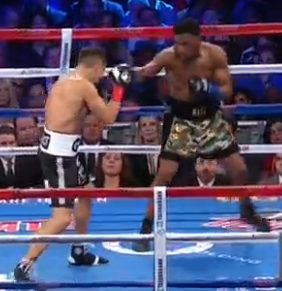
Gennady Golovkin (37-0, 33koes) always says that he loves to provide ‘a big drama show’ for the fans, but last night against Daniel Jacobs (32-2, 29koes), his performance should have cost him his title. In the belly of New York’s legendary Madison Square Garden, Gennady Golovkin retained his world middleweight titles (and won Jacobs' WBA regular belt) with a showing that will forever be used against him in future when he is measured against the division's greats. To say that Golovkin was disappointing sounds like sour grapes, and does an injustice to Jacobs' clever, and brave performance. Yet, the sharpness and fire that we have come to expect from Golovkin, was only too clear in its absence last night. He produced only flashes of the finely tuned fistic assassin that he has gained a reputation for being over the length of his title reign. One of the major questions that comes out of this fight, is was Golovkin simply that bad, or Jacobs' that good. In the end, Golovkin seemingly produced enough to secure the win, after being taken the full distance for the first time since 2008, but his aura of invincibility has been left permanently bruised.


The fight itself was not the slam-bang showdown, which many fans were hoping to see, instead we saw an intriguing tactical contest, with some smatterings of good exchanges. Perhaps the biggest surprise of the night was the caution shown by Golovkin. Often praised for being a patient assassin in the ring, against Jacobs, the GGG man’s patience often veered into the bounds of lethargy. When he did finally try to get going, Jacobs proved to be an unwilling accomplice.


The first three rounds of the contest were very quiet, as both men sized each other up, and seemed unwilling to make a mistake. However, it was Jacobs who was the more active, and seemed to do enough to win this first portion of the match, as Golovkin’s usual first round scouting mission stretched well into the 3rd stanza. Jacobs made good use of his seven inch reach advantage over GGG from the start, and his jab would prove to be a problem for Golovkin throughout the night.


In the 4th round, Golovkin seemed to finally flick the switch and go into destruction mode, as there was now purpose in his marauding pursuit of Jacobs. He managed to knockdown Jacobs in the first minute of the round, with a right-left combination, but the knockdown itself was scrappy, as too was Golovkin’s follow up. So often praised for his finishing of wounded opponents, GGG remained sluggish as he tried to finish Jacobs through the rest of the round, allowing himself to be tied up, and generally lacking the finishing spark one would expect from him.


The 5th round was a good one for Golovkin, as he pressured Jacobs, and forced him to hold, but Jacobs at times stood his ground and struck back, and Golovkin still seemed to be biding his time. By the 6th round, Jacobs had not only recovered from the knockdown, but seemed to be growing in confidence. From this point, he used more lateral movement, along with his jab, and made Golovkin look often flat-footed, and slow by comparison. The fight now settled into repetitive groove of Jacobs using movement and his jab to score steadily against the constant pursuit of GGG. There was frequent holding, which often seemed to befuddle Golovkin, whose inside work was poor throughout the fight. Strangely, against a fighter of Jacobs' height and build, GGG’s usual body attack was almost nonexistent, and his jab, so often one of his most potent weapons in past fights, was strongly nullified by Jacobs' own reach and jab.


As the rounds passed, there often seemed to be a lack of urgency from both Golovkin, and his corner. If they felt that it was just a matter of time before he caught Jacobs with a fight-ending power shot...they were sadly mistaken. Sensing that he had already withstood the best GGG had to offer, Jacobs' confidence increased with the passing of the rounds, and at times, he out-boxed GGG with comparative ease. Golovkin’s technical skills were visibly absent on this night as he seemed to struggle with some of the basics. Perhaps the advancing years, and a long run of stoppage victories, have blunted GGG’s boxing skills.


If anything, it was Jacobs who landed some of the fights best punches in the second half of the contest. Showing that he could stand and trade with GGG, as well as out-box him.


Golovkin’s corner finally seemed to wake up after the 11th round, and Golovkin was sent out to do some damage in the 12th and final round. Yet, while he won the round, the action was still close, as the game Jacobs continued to fight back, and many of GGG’s punches were missing their target.


Photo: Fight News
In the end it went to the judge's score cards for the first time in a GGG match since 2008. Scores of 115-112, twice, and 114-113 allowed GGG to retain his world title, but not his reputation as the division's destroyer. While not wanting to take anything away from Jacobs' display, which was aided greatly by his excellent corner, it looks as though at the age of 34, and after lengthy amateur and professional boxing career, GGG is in definite decline. The clues to a decline that were visible against Kell Brook six months ago, were confirmed last night. Golovkin is now two years older than Marvin Hagler was when he lost to Sugar Ray Leonard, yesterday's match was his 17th defence in a title reign going back almost seven years. It should be no surprise that the wear and tear of age and activity seems to be finally taking a toll on GGG.


Ironically, following this unification fight, the middleweight division is now more muddled than it was previously. On the evidence of last night Gennady Golovkin can no longer be considered the clear cut number one in the 160-pound division, and while there will no doubt be increased demands for a Golovkin vs. Canelo contest, the fight that really needs to happen first is a rematch between Golovkin and Jacobs. 


Full Fight:


Follow us on Twitter: @TheBoxingGlove and 


If you are an athlete and want us to follow you or tell your story, contact petersilkov@yahoo.com

If you are an author and you would like your book reviewed, contact Peter Silkov at petersilkov@yahoo.com or theboxingglove@yahoo.com
Copyright © 2017 The Boxing Glove, Inc. Peter Silkov Art. All Rights Reserved.

Saturday, April 16, 2016

TBG Book Review: Battling Bruce: The Story of the Fighting Career and rise to fame of Bruce Woodcock


The Boxing Glove Sunday Night Book Review 


Review by Peter Silkov

"Battling Bruce: The Story of the Fighting Career and Rise to Fame of Bruce Woodcock"


By Brian Hughes


This is a very interesting book on the career of Bruce Woodcock, British, European, and Commonwealth heavyweight champion of the mid to late 40s.  Hughes is a former boxing trainer and has written a series of books on the great fighters of yesterday, including Jock McAvoy, Johnny King, Jackie Brown, Peter Kane, Sugar Ray Robinson, and Willie Pep.  In this book, Hughes builds a portrait of the man whom he says was responsible for instilling within him his life long passion for the fight game.

Bruce Woodcock was born on January 18, 1920, in Doncaster, Yorkshire, into a tightly knit, but poor family. He started his professional career in 1941, and within a few years, had become one of Britain’s biggest sporting stars.  He won the British and Commonwealth heavyweight titles in 1945, and was viewed as one of the country’s greatest heavyweight prospects since the days of Bob Fitzsimmons.  Woodcock had a picture-perfect left jab, a knockout punch in his right hand, grit, and durability. He seemed to be a prime candidate to go all of the way to the World heavyweight championship, at a time when the legendary Joe Louis was aging, and coming towards the end of his amazing 12-year reign.


By the time WW2 was over, Woodcock was being hailed by many as the future world champion and every fight he was in became a huge occasion. With the country suffering from the after effects of WW2, it was sportsmen-like Woodcock who people relied upon to cheer up and brighten the dark and grey days of post-war rationing.

However things would take a disastrous turn for Woodcock, as he was pushed too far, too fast. The result was that his once promising career came to a bitter and premature end, at an age when he should have been in his prime.

Brian Hughes takes us through Woodcock’s boxing career, from its meteoric rise to the top in Britain and Europe, to the point when things started to go wrong, and eventually the brutal end of Woodcock’s boxing dreams.


After winning the British and Commonwealth titles from Jack London in 1945, Woodcock went on to defend them twice in two brutal bouts against Freddie Mills, another huge star of British boxing at that time.  But, things went wrong when Woodcock was put in with world-ranked American contenders.  The first misstep came in May 1946, when Woodcock was taken to America, and matched with the hard punching and far more experienced, Tami Mauriello, and was stopped in the 5th round. Less than a year later, after 6 impressive rebuilding victories, Woodcock was matched with the 20 pounds heavier, big punching, Joe Baksi, and brutally stopped in the 7th round.  Woodcock was never really the same after this defeat to Baksi, which left him nearly blind in his left eye.  Despite this, Woodcock was still maneuvered into a ‘world title’ fight with Lee Savold in June 1950, in which he was stopped in the 4th round.

By the time Woodcock had his final fight against Jack Gardner in November 1950, he was just a shadow of the great fighter that he had once been.  Woodcock’s story is both an uplifting tale of a poor boy making good with his fists. It is also a cautionary warning about what happens when a bright young prospect is pushed too fast by those wishing to make their money quickly, rather than things more shrewdly, and looking more to the future. 

Hughes has structured this book in an interesting fashion, with each chapter of the book focusing upon a particular fight of Woodcock’s career.  Within each chapter, Hughes gives us the build up and background of the fight, then the fight itself, followed by the fight’s aftermath.  There are interesting insights into the politics that took place in the background of Woodcock’s career and the manner in which he is mishandled by his management and promoter, and pushed too far, too soon is graphically described.  Woodcock’s story is an all-too-typical bittersweet boxing tale, which shows how a man from humble beginnings is able to fight his way to fame and riches, only to have his career ruined by his over eager manager and promoter.


Had Woodcock been given a few more years to develop, then there is little doubt that he would have had a longer, and more lucrative career as British and European champion. Eventually he would have gained a genuine shot at the World heavyweight title.  One only needs to look at the lucrative career of Henry Cooper in the 50s and 60s, to see how Woodcock’s own fighting career might have turned out had he been more patiently handled.  As it was though, the people behind Woodcock could not resist fast tracking him, even though the signs were clear that he was not yet ready for such a move.

Bruce Woodcock died on December 21, 1997, at the age of 77.  He is still fondly remembered today by those who recall his fights, as a champion whose time at the top was all too brief. 

‘Battling Bruce: The Story of the Fighting Career and Rise to Fame of Bruce Woodcock’ is a gritty, fast-moving, analysis of the fighting career of one of Britain’s great champions of the past, which shows once again why boxing is known both as the sweet science, and the hardest game.


*The book contains many photographs, the photos on this page are not from the book. 

*Book available at Brian Hughe's webpage  http://www.brianhughesmbe.co.uk/Boxingbooks.html


Copyright © 2016 The Boxing Glove, Inc. Peter Silkov Art. All Rights Reserved. Peter Silkov contributes to www.theboxingglove.com