Tuesday, February 3, 2015

Max Schmeling: The Black Uhlan of the Rhine


By Peter Silkov

Max “The Black Uhlan” Schmeling was one of the outstanding heavyweights of the 1930s, and one of the best heavyweights ever to come out of Europe. Born in Klein Luckow Meckleburg-Vorpommen, Germany, on September 28, 1905, Schmeling turned professional in 1924, at age 19, and developed into a good technical boxer, with a knockout punch. During his career, Schmeling would face top heavyweights such as Johnny Risko, Paulino Uzcudun, Jack Sharkey, Young Stribling, Mickey Walker, Max Baer, Steve Hamas, Ben foord, Walter Neusel, and Joe Louis.

Schmeling was a thinking fighter who would work our his training and fight tactics meticulously, and in many ways, he was ahead of his time training wise. Schmeling did not believe in road work, and instead opted to do most of his training on the golf course, and build his endurance up that way. On June 12, 1930, Schmeling won the World heavyweight title when he was awarded a victory via a disqualification in the 4th round after Jack Sharkey had hit him low. Although he was now world champion Schmeling cried in his dressing room afterwards, saying that this was not the way he wanted to win the title.

Schmeling held the world title for two years, making two defences, and on June 21, 1932, in his second defence, Schmeling lost his title to old foe Jack Sharkey on points.

After losing his world title, Schmeling continued to fight top contenders in an effort to gain another shot at the world title. On June 19, 1936. Schmeling scored one of the most spectacular upsets in heavyweight history when he defeated Joe Louis, knocking out “The Brown Bomber” in the 12th round. Although the victory over Louis should have gained him a shot at his old world title, which was now held by Jimmy Braddock, instead, Schmeling was frozen out, and had to wait until 1938 before he finally got a chance to regain the world title. By this time, Joe Louis was world champion, and he gained a terrible revenge for his earlier defeat to Schmeling by annihilating the German in the 1st round, with one of the most ruthless and clinical assaults ever seen.

The defeat to Louis, along with the outbreak of WW2, really signaled the end of Schmeling’s career as a top flight fighter. The war put Schmeling in a very difficult position, as he was never able to totally denounce Hitler due to his fears for the safety of his family.

After the end of the War, Schmeling made a brief comeback to the ring before retiring in 1948 at age 43. In his post boxing life he became a wealthy businessman, and one of his closest friends was Joe Louis.

Max Schmeling died on February 2, 2005, at 99 years of age. Schmeling’s final record was 56(40koes)-10-4.


Copyright © 2015 The Boxing Glove, Inc. Peter Silkov Art. All Rights Reserved. Peter Silkov contributes to www.theboxingglove.com and www.theboxingtribune.com

twitterfacebookgoogle pluslinkedinrss feedemail

Sunday, February 1, 2015

Angelo Dundee: The Great Corner Man


Philadelphia has produced some of the greatest boxers ever, but it was also the birthplace of Angelo Dundee. Born Angelo Mirena, he changed his name, like his brothers, so that their parents would not know they were in the fighting game. Dundee got his start at Stillman’s Gym in New York city after he followed his brother, Chris, who wanted to be a promoter. He worked as a ‘bucket boy’ and a ‘go-fer’ and was mentored by the likes of Charlie Goldman, Ray Arcel and Chickie Ferrera. He watched and learned to tape hands, handle cuts, and became the best ’bucket man’ around.

During the 1940s his reputation grew and he became known as one of the best corner men in the business, which put him in great demand. While in New York, Dundee worked the corner of Carmen Basilio, who was his first world champion, and Sugar Ray Robinson.

In 1950, Chris Dundee opened the 5th Street Gym in Miami, Florida, and Angelo followed his brother into a successful partnership that developed the careers of many world champions.

Undoubtedly, Dundee’s most famous partnerships were with Muhammad Ali and Sugar Ray Leonard. While working with Ali throughout his career Dundee became the most well known and respected boxing trainer in the world, and as Ali’s career was coming to an end, Dundee helped guide Sugar Ray Leonard to stardom. In later years, Dundee would work with the likes of Evander Holyfield and George Foreman, amongst many others.

Angelo Dundee’s greatest gift is that he could add that little extra to a fighters make up, whether the fighter be a youngster just starting out, or a mature and seasoned fighter who is looking for a new edge. More than anything else Dundee understood how boxers brains worked.

When people speak about Angelo Dundee, they are reminded of his great enthusiasm and motivation he brought to a corner. The record of producing 15 world champions speaks volumes of the success story that was Angelo Dundee. Considered one of the greatest boxing trainers in the history of boxing he was inducted into the International Boxing Hall of Fame in 1992.


Copyright © 2015 The Boxing Glove, Inc. Peter Silkov Art. All Rights Reserved. Peter Silkov contributes to www.theboxingglove.com and www.theboxingtribune.com

twitterfacebookgoogle pluslinkedinrss feedemail

Book Review: A Pictorial History of Boxing By Sam Andre and Nat Fleischer


The Boxing Glove Sunday Night Book Review By Peter Silkov

“A Pictorial History Of Boxing” by Sam Andre and Nat Fleischer


Here at The Boxing Glove we are going to attempt to start a regular boxing book review feature, as this seems to be something that readers may well find useful! We hope!  I’m not quite certain how regular these reviews will be, but time and energy willing, we are looking at doing at least one a week. Reviews will be varied between boxing books, both new and old.  So I will be looking at some books that have only recently come out, plus others that have been out a long time, or may even be out of print. As usual, readers feedback and comments are very welcome. 

For my first book, I thought it would be fitting to look at the first boxing book that I received, “A Pictorial History Of Boxing” by Sam Andre and Nat Fleischer.  For me, this is in many ways the book that started it all; it was the first of many hundreds of boxing books and magazines. I received this book as a present in 1982. 33 years (yikes!) and  hundreds of boxing books later, I still believe that this book is the definitive encyclopedia of boxing. At least up to the stage where boxing became muddled and flooded by multiple world champions at every weight and the champions of all sorts of titles began to out-number the contenders.

“A Pictorial History Of Boxing” looks at the history of boxing through every division, from Heavyweight through to Flyweight, with the emphasis on the original eight weight divisions. Every champion, of every division, is mentioned, with the great fighters and great fights highlighted. 

First published in 1959, "A Pictorial History Of Boxing" was written and edited by Nat Fleischer and Sam Andre. Nat Fleischer was the founder and editor of The Ring magazine, while Sam Andre was a photographer and editor. The book was updated in 1979 by English boxing historian Gilbert Odd, then again in the early and mid 1980s.


This is a book in which you can really gain a insightful view of some of the most important, exciting, and controversial moments in boxing history. The coverage of the heavyweight division , usually regarded as the most important division in boxing, is especially impressive, with detailed analysis of  the divisions great fights, going right back to the sports bare knuckle days. From Cribbs victory over Molineaux, to  Ali vs. Frazier, it is very detailed. Although boxing’s other weight divisions are not given as much space as the heavyweights, each one is still portrayed in an insightful and illuminating manner. In addition to having the respective histories of each division highlighted, this book has a huge collection of photos, many of which are very rare and cannot be seen elsewhere.


The beauty of this book is that it is just as useful and engaging for the experienced boxing fan as it is for the newcomer. Despite all of the years that have passed since I first received this book, and all the boxing books of so many descriptions which I have collected in the intervening years, this  book still hit’s the spot for me. I would recommend “A Pictorial History of Boxing” to anyone who wants to have an easy-to-access and good-on-the-eye guide to boxing’s rich and storied history.


Copyright © 2015 The Boxing Glove, Inc. Peter Silkov Art. All Rights Reserved. Peter Silkov contributes to www.theboxingglove.com and www.theboxingtribune.com

twitterfacebookgoogle pluslinkedinrss feedemail

Monday, January 19, 2015

White Collar Boxers Support Teenage Cancer Trust


Pictured: Gavin "The Power" Powell 
By Michelle Nardi
The Boxing Glove Editor

Social media has become a huge part of every day life for many people throughout the world. It does not matter the age, young and old, if you ask anyone about Facebook or Twitter they will know exactly what you are talking about. It would be hard to find a club, charity, or business that does not have a Facebook page or a Twitter account based around their interests, finding new customers, or donations. 

Social media, especially Facebook, has been criticized for feeding the self-centered egos of the ‘all about me age’ that want to fill our lives with the drama of their lives. When timelines are saturated with the politics of the day, my favourite recipe posts, and graphics with quotes about the true meaning of life and how to change your life, it can be overwhelming. Yet, it is not always feeding the ego of the Facebook user. There are charities and social organizations that reach out to the Facebook community to gain support for the charity or concerns in that moment and bring us down to Earth and reality.

A kind of bonding can occur to create a community based around a person’s interest. The sport of boxing has found a home on social media, especially Facebook. 2014 gave way to a big surge to the boxing community. Generally, boxers, current or retired, have a Facebook page. If you want to see the latest fitness craze to get in shape or who will be fighting whom for a championship belt, you will find it on Facebook.

One of those pages, Funkin Fitness, is not just another boxing enthusiast Facebook page. It has become the inspiration of the everyday man or woman who would like to get fit, and at the same time, raise money for the charity of their choice, while fulfilling their dream to step into a boxing ring. Funkin Fitness hosts White Collar Boxing events quarterly throughout the year. Club members are trained and while they are training they collect donations for their specific charity. At the end of the training period they get into the ring for their big bout. 


Pictured:Funkin Fitness Club Members


Since it’s opening 5 years ago, Steve Shewan, the operator and main trainer at Funkin Fitness says, “The club has grown from within. The lads who trained at the start are now the trainers and use the experience they gained to help the novices. I have novices of all ages, from 18 to 53. The atmosphere in the gym is second to none that I’ve experienced, as it’s a total group effort and the comradeship is brilliant, the guys train together and fight each other.”

Steve has helped give people the platform and support to not only change their lives, but also change the lives of others in need, with the funds raised from these White Collar Boxing events.

On March 28th, Funkin Fitness will be hosting another White Collar Boxing charity event at the Studio NightClub in Nantwitch, Cheshire, England. Novices take part in a 10-week vigorous training program that concludes with their opportunity to step into the ring. There are three rounds, with each round lasting two minutes.  One of Funkin Fitness’ novices, 30 year old Gavin “The Power” Powell, will make his boxing debut on this night. Gavin, who is the father of five children and has a very supportive wife, is from the Crewe area. An avid fan of boxing, he has always struggled with this weight since he was 16 years old, until he came upon the Funkin Fitness Facebook page. “I learned about white collar boxing through Steve’s Funkin Fitness page and knew in my own heart of the charity I'd like to do it for, and train to reach my goal.” 


Pictured: Gavin Powell Ready for His Debut
Gavin first heard about the Teenage Cancer Trust by listening to one of his favourite comedians, Jason Manford. In 2013, Manford became a supporter of Stephen Sutton, a teenager from Burntwood, England, who was undergoing treatment for colon cancer and was on his own mission to raise awareness and funds for the Teenage Cancer Trust. Manford and other celebrities joined Stephen Sutton on his campaign. When Stephen was hospitalized and unable to continue his mission, Manford continued efforts of awareness by starting the#thumbsupforStephen” campaign. Unfortunately, Sutton lost his battle with cancer on May 14, 2014. So far, Stephen Sutton has raised £4.96 million; his original goal was £10,000. His efforts and legacy live on through the Teenage Cancer Trust, and through people like Gavin Powell who were inspired by the selfless time and effort of this teenager to help other teenagers who are in a struggle with cancer.

Gavin recalls “I followed right til the end, sometimes feelin’ emotional, and then seeing him still smiling, inspired by him, even until his last few days.” The inspirational story of Stephen Sutton was not the only emotional catalyst that pushed Gavin to also fundraise for cancer, two years ago he lost his Aunt and a close friend’s father to cancer.

Each team member who chooses to participate in the White Collar Boxing events has to commit to raise the minimum donations of  £100 for a charity. Together, Gavin and his brother Darren joined Funkin Fitness to raise money for the charities they had in mind. “Me an my brother both started training at the same time, but I didn't feel fit enough at the time to take the fight night in December of last year.” Darren fought in the December 2013, while Gavin held back, not quite ready for his debut. It was not easy road. Both men were very unhealthy. 

Gavin remembers when he began his journey “I respect Steve as a trainer and a man. At first it was like startin’ school for the first time. I was a bit nervous cause I knew it was like makin’ new friends for the first time again. But once I got in there, everybody as a team, all showed me the ropes, hence the pun, lol, and now I always say my funkinfitness family, as we all stick together now with old and new faces."

According to head trainer, Steve Shewan, “Gavin’s brother Darren fought on the last show and raised approximately £1,450 for Muscular Dystrophy. Some over achieve, some under achieve, but as long as they make an effort then it’s fine. To give you a little bit of insight on Gavin and his brother, Darren, they are both big heavy lads. I remember the first night they started. They had to stop every 2 minutes to rest, and both said they were feelin’ a bit like spare parts as they struggled to do anything. Move forward several weeks and their persistence paid off, they now train well and help the novices out.”    


Pictured: Powell & other Funkin Fitness members
One of the intimidating factors that holds people back and stifles their motivation to get fit is the high expectations they place on themselves to join a boxing gym. Many people wish they hard started earlier in life or can’t let go of that fear they are too old, unattractive, or too unhealthy to be in a social setting while trying to get fit.  Head trainer Steve Shewan is very familiar with the insecurities of his club members. “Not everyone at the club has fought or has a desire to fight. Some train only, and if they go onto fight, then that's a personal target they set themselves. I have lads and girls there who have had absolutely no experience of boxing and even though there are several local boxing clubs, they have never been through the doors. In their own words, many have said they wished they done it as a kid and others say they found it too intimidating.”

After many weeks of training and his fundraising efforts underway, Gavin Powell feels he is making progress and almost ready for March 28th bout. “Sure my fitness was terrible. I was always stoppin’ for breathers and drinks of my water. I'm a slightly larger guy anyway, but in the past 10 weeks of me training my fitness level has improved loads. I now pretty much do the full session without stoppin!”

When asked the ridiculous question of how much money would he like to raise for Teenage Cancer Trust, Gavin laughed “I'd love to raise millions for the charity, but that is gonna be impossible. My goal is set at £100. I'm currently on £78. I'd like to hit my target and feel humbled. People have donated to the charity, but at the same time, I'd love to raise a couple of £100 more.”


Pictured: Steve Shewan &  Boxing Champion Robin Reid
Funkin Fitness has also had the support of the community, including former boxing champions Robin Reid and Steve Collins who were referees at several shows. Robin Reid participated in the last White Collar Boxing event and Steve Collins the Christmas before. Steve believes their participation was “great for the girls and guys to fight with a legend as a referee.”  

Family members, such as Gavin’s father, siblings, and wife will be there to support him as he enters the squared circle. 

Though they are aware that boxing can be a brutal sport, they are in Gavin’s corner. “I guess they respect my wishes as a man to do somethin’ for a good cause. My wife’s been really supportive throughout my training period too. I'm 30, so no spring chicken. Most boxers aren’t far of retiring by now, let alone doing it for there first time.”Gavin continued, “Even if my white collar match goes bad and I lose, I'd still love to continue fightin’ for this charity, plus other cancer ones, win or lose. I just want the real winners to be the cancer charities, but all I can do is get in the square circle and give it 110percent.”
Funkin Fitness has not only been able to reach out to the community and pull in the every day guy or gal, but they have also given people the platform to live a healthier life, while helping improve other lives. This empowerment shows in the way that they respect their head trainer Steve Shewan and other club members. There is a real sense of community when you view the videos of their work out sessions and the reviews on their Facebook page. 


Pictured: Steve Shewan & Steve Collns
When Gavin “The Power” Powell was asked how he would want to be remembered after his charity match, he responded “If I'm honest, I'm happy just to be remembered as plain old me. Just a family guy who was touched by a story and felt the need to give a little to a brilliant charity and have support is brilliant, it gives me that extra mile to push myself in training and to strive forward.”

Ever so humble, Gavin requested “Can you give Funkin Fitness Steve a big shout too?  Cause without him these charity fights wouldn't be happening!” I think we can do that Gavin!

7 young people are diagnosed with cancer everyday in the Uk. The importance of charities such as this cannot be overlooked, with the NHS in an ever more precarious state, and funding for cancer drugs being questioned due to their cost. Cancer charities offer hope, where quite often hope seems to be otherwise in short supply.

The next White Collar Boxing event will take place on Saturday, March 28, 2015, at the Studio NightClub in Nantwitch, Cheshire. 

Tickets for the boxing night cost £20 each and are available by calling 07766 644222 or by emailing Steve@funkinfitness.com or visit Funkin Fitness on Facebook https://www.facebook.com/pages/Funkin-Fitness/156921424373413

To support Gavin “The Power” Powell, please visit his JustGiving page and donate today to the Teenage Cancer Trust! https://www.justgiving.com/Gavin-Powell/

Thursday, October 30, 2014

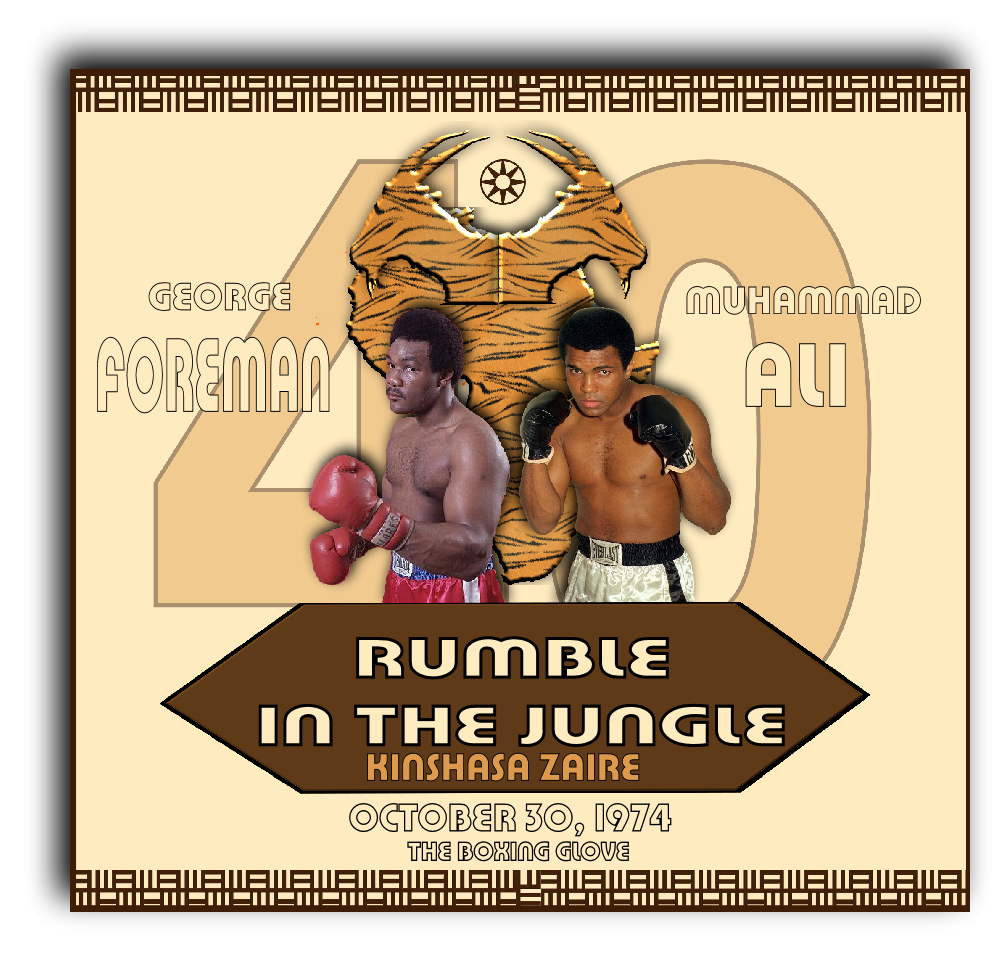
The Day Muhammad Ali Made the World Rumble


By Peter Silkov

 40 years ago today the world was witness to possibly the most bizarre, fantastic event in the long and colourful history of the sport of boxing. The event took place in a 19- foot ring, set up at the 20th of May Stadium in Kinshasa, Zaire, which was surrounded by a crowd of about 62,000. At the center of it all was Muhammad Ali, who inside that 19-foot ring square that morning, at just the break of dawn, performed the most extravagant and outrageous feat of his career, by beating a man whom most had believed would not only defeat him, but destroy him. There had been those, in the run up to Ali’s challenge of George Foreman, who had feared for Ali’s health and his life, against the rampaging destroyer that was George Foreman.

This was the fight that Ali was supposed to lose. Many watching it that night, either in the audience or in one of the numerous closed circuit theatres that were broadcasting the fight all around America and Europe fully expected this to be the last fight of Muhammad Ali’s career. Most people believed he would give it his best show his great heart, and some flashes of his former brilliance. But, then he would tire and Foreman would catch him, or else Foreman might even catch him before he tired, either way, few saw the fight lasting the distance, and that meant only one thing; a punishing knockout or stoppage defeat for “The Greatest.” 

Despite his amazing career up until that point, all expectations were that Ali was heading towards his doom in Zaire.

One of Foreman’s own trainers, Archie Moore, the former World light-heavyweight champion, who had been knocked out in 4 rounds by a young and skinny Ali (then Cassius Clay) in 1963, would later say that he had prayed for Ali’s well being before the contest, fearful that he could be killed. Foreman’s physical strength and punching power was such that he was known for wrecking punching bags in the gym, hitting them with such force that they would be torn savagely from their metal moorings.

Even Howard Cosell, the commentator with whom Ali had formed almost a double act with, and who had a genuine affection for The Greatest, gave Ali no chance against Foreman, saying on a pre-fight show that the match represented Ali’s ‘Last supper.’

Perhaps one of the biggest ironies of this contest was the similarity between Foreman and Sonny Liston, who a young Ali had won the world title from in 1964.  Liston had actually been Foreman’s idol and the two had sparred together when Foreman was just starting out on his professional career. Like Liston, Foreman was a brooding character, who built up a fearsome image both inside and out side of the ring. He was a dark force of destruction, just like Liston had been before him, and the media was already calling him unbeatable and invincible.

Yet, the comparisons between Liston and Foreman were not seen as good news for Ali. It had been a decade before when Ali had beaten Liston, with his mercurial speed and skills, when he was a fresh and a hungry 22-year-old. Those ten years included 3 and a half years when he had been banned from the ring for refusing the draft call up for Vietnam. Three and a half years in which he had lost his peak, where time and idleness had rusted up his marvelous speed and skills.

On his return, Ali was still ’great,’ but he was no longer as great as before. Joe Frazier had beaten him in 1971, as Ali struggled to jab and dance for 15 rounds, as he had been able to in the past. The speed and reflexes never came totally back for Ali and at times, he seemed to be almost an imitation of his former fighting self. 

The Greatest had racked up 13 victories in the three years since the Frazier defeat, but there was also the loss to Ken Norton. Although Ali had avenged it six months later, and followed this up with a revenge victory over Frazier, a broken jaw had accompanied the loss to Norton. The man who once had been so hard to hit was getting hit regularly now, and hard.

Ali’s victories over Norton and Frazier were almost workman-like when compared to Foreman’s own performances against the same two men. While Ali had gone 27 rounds with Joe Frazier and 24 rounds with Ken Norton, George Foreman had simply destroyed both men in 2 rounds each. When Foreman had won the world title from Frazier he had floored “Smoking Joe” six times in 2 rounds and he had knocked Norton clear of his senses also in the same time. 

So how could even The Greatest prevail against such a fighter! 

Originally scheduled for September 25, 1974, the fight was delayed for over a month when Foreman was cut beside the right eye by the elbow of sparring partner Bill McMurray. The delay just added to the anticipation and tension of the occasion. With people torn between hoping to see something truly special and historic from The Greatest, but fearing that they were about to watch his nadir.     

The fight was postponed until October 30, and Foreman seemed to be getting meaner by the day in training, his habitual beating upon his sparring partners reaching new heights. While Ali was visibly loved and feted wherever he went in Zaire, the brooding champion, Foreman, was a man apart. 

By the night of the fight the atmosphere had entered the surreal. The fighters entered the ring at around 4 am in the morning in order to facilitate American TV coverage.  Both fighters would be receiving 5 million dollars, in a promotion that had been coerced and manipulated from start to finish by Don King, in what was his first major promotional venture. He had even managed to get Zaire’s murderous president Mombuto Secko on board. Seldom has a World heavyweight title fight had a darker host. 

Almost from the start of the fight it became clear that Ali was supported by 90% of the crowd. The crowd that was made up of a large portion of native Congolese, and a selection of European and American members of the media, and celebrities who had come along for the ride.

Upon entering the ring, Muhammad Ali seemed to be the most relaxed person in the stadium that night, certainly more relaxed than his stone-faced corner and the blank- eyed world champion, whose unblinking stare spoke volumes for his intentions. 

As the anthems were played before the start of the contest, Ali mocked and taunted Foreman, whose expression never changed. Those watching Ali’s antics wondered if his humour was that of someone with real confidence or the bravery of someone heading towards the gallows.

At the first bell, Ali sprang his first surprise of the night! Instead of running, instead of moving away around the ring, he went right at Foreman, firing a right hand that seemed to surprise the champion, and then spearing Foreman with a flow of lefts that seemed to find the champion’s face with surprising ease. Foreman came forward menacingly; landing to Ali’s body and driving him into the ropes momentarily, but Ali came off the ropes and retook the center of the ring. Instead of running, Ali was taking the fight to Foreman, while moving side-to-side to avoid the punches coming back his way. Between rounds Ali winked across the ring from where he sat in his corner, with the air of a man who was just beginning to enjoy himself. Just before the start of the second round the crowd began to chant ‘Ali Bomaye’ (Ali kill him.) 

In the second round, Ali seemingly abandoned his plan of taking the center ring and allowed himself to be bulled onto the ropes by the champion, where he covered up and leaned back, as Foreman swung furiously with both arms, as if he were trying to chop down a tree.  Now and then Ali would strike back with some sharp jabs and straight right hands that would land flush in Foreman’s face, and then he would go back onto the ropes, as his corner screamed for him to move. By the third round the fight had formed a pattern, despite the exhortations of his corner, Ali was seemingly content to go onto the ropes and cover up, while Foreman belabored him with punch after punch, swing after swing.  Many punches were blocked by Ali’s arms or slipped, as he twisted and leaned back far on the ropes, but some were getting through, and when they landed, with audible thuds, those at ringside gave audible gasps.
Yet, just when things seemed to be getting totally one-sided, Ali would come back with punches of his own, sharp lefts, and heavy lead rights that were catching Foreman flush in the face.

This was the rope-a-dope, something that Ali would later say that he first developed in training when he was tired, laying on the ropes and daring his sparring partners to hit him as much as they could. It was an almost masochistic method of getting himself beat into shape. 

The fourth followed the same pattern as the third, with Ali laying on the ropes and seemingly taking punches which no other man had ever stood up to before. All the while he was talking to Foreman, ‘Is that all you got! They told me you could punch George!’ 

When struck flush, Ali would hold momentarily and wrestle with Foreman, while sharing his head at the crowd to assure them (and himself) that he wasn’t hurt. 


By the 5th round it was clear something strange was happening. Foreman’s face was starting to mark up from Ali’s punches, and more worryingly for the champion; he was starting to show visible signs of fatigue and frustration.  No one had ever taken his punches like this before, instead of destroying Ali with his punches, it was almost as if with every punch he landed or tried to land on Ali, he was losing a little more of his strength. Now, when Ali landed his own little retaliatory flurries, Foreman was visibly wobbling under the punches. And the crowd continued to cry ‘Ali Bomaye, Ali Bomaye!’

In the sixth round, Ali stayed off the ropes for much of the round, instead circling the outside of the ring and jabbing. Foreman was still in pursuit and throwing punches whenever he was in range and even when he wasn’t, but now the punches were weary and becoming more and more uncoordinated.  It was now Ali who was beginning to land the better more telling punches.

With hindsight the writing was on the wall for Foreman by the seventh round, but those watching the fight could still barely understand or believe what was unfolding before their eyes.  The seventh saw Foreman reduced to pushing out his punches, as he stumbled after Ali like an exhausted drunk. Ali’s punches were cruel and calculated, as they crashed in increasing volume into Foreman’s swelling face and head.

Ali came out with a determination to finish things in the 8th round, with added purpose in his punches, and he was now the aggressor. Foreman was still coming forward, but his attacks had been reduced to a blind stumble, by exhaustion, and the steady battering from Ali’s punches. When Ali got caught on the ropes, the punches seemed to be bouncing harmlessly off of him, and it was his own counters that were having the most effect at this moment.

The finish came in the final moments of the 8th round. A left right combination sent Foreman down with a heavy flop onto the canvas, where he lay in an exhausted daze as the referee Zack Clayton toiled out the count.  At ten, Foreman tried to rise, but his strength was gone; the butterfly had drained all the strength from the invincible giant.

Ali was the World heavyweight champion again, and he had regained his title by turning his style onto its head, from being the elusive target, to being a sitting target.  Ali’s performance must rate as one of the greatest single performances by a boxer in ring history. His ability to adapt his style and find a way to win, even when physically out-gunned, and the ability to beat his opponents both mentally and spiritually in the latter part of his career, is as much part of Muhammad Ali’s greatness as his youthful speed and skills.

Later on, even Ali would push on for too long, beguiled by his own greatness into thinking he could outbox time and the laws of nature. 

Six years after he beat Foreman in Zaire, Ali foolishly came out of a two year retirement and was battered and beaten to defeat by Larry Holmes in Las Vegas, in a fight of almost eerie sadness. 

Yet, the realization in the dying years of his career that Ali was after all only human serves only to heighten the depth of his career achievements. Here is a man who dominated the most talented heavyweight division that has ever been seen, at a time when he himself was well past his own physical peak. 

However, on one particular moonlit morning in Zaire, Muhammad Ali was indeed indestructible, superhuman, and magical.


Copyright © 2014 The Boxing Glove, Inc. Peter Silkov Art. All Rights Reserved. Peter Silkov contributes to www.theboxingglove.com and www.theboxingtribune.com

twitterfacebookgoogle pluslinkedinrss feedemail

Thursday, August 28, 2014

Bobby Chacon: Glory and Punishment


By Peter Silkov


Of all sportsmen, it is the boxer who seems to live most precariously on the edge, often both in and out of the ring. Inside the ring, they take part in what is the most basic activity known to man; using their fists to hit the opponent standing in front of them. Everyone who knows even a little about boxing understands that there is so much more to it than just what meets the eye. It is about mental strength, spirit, and courage. It is about having the ability to put yourself on the line, and face down the kind of fears and thoughts of self-preservation which keep the average man from ever stepping foot competitively between the ropes. Many fighters seem to live the same way out of the ring that they do inside it, wrapped up in a cloak of danger and drama.

This is one of the many attractions of the boxer. These are men who do not generally live their lives quietly or safely as the rest of us do. Perhaps here we have the reason why so many boxers have been the subject of biographies, and why Hollywood has always been so fascinated with the boxer in film, from “The Champ,” to the “Rocky” films.  Yet, despite all of the action that takes place inside the ring, it is the life outside of the ropes, real everyday life without gloves on, which often proves to be far more dramatic and traumatic, than anything Sylvester Stallone has dreamt up for his famed ‘Rocky’ movies. Bobby Chacon lived a kind of life that was straight out of a Stallone or Martin Scorsese film; a roller coaster ride of more ups and downs than one person should be expected too deal with and remain in one piece.

Like many that later find their way into boxing, Chacon grew up amid domestic strife. His father left when Bobby was very young, and by the time he was a teenager he was involved in a street gang and finding himself drawn into numerous street fights and petty clashes with the police. As his life descended into the chaos of the street, Chacon met Valerie, the person who would have a profound influence upon the rest of his life, an influence both hugely positive, yet, ultimately tragic. Valerie would become Bobby’s wife and a guiding light that would lead him from the street onto a path which would take him on to glory and stardom. It was Valerie who told the street fighting Chacon that he should take his fighting inclinations to a boxing gym where they could be of more legal use.  Bobby obeyed and a short, but successful amateur career ensured.

He was a natural, and like all such fighters, the armatures couldn’t satisfy his ability for long. Bobby turned professional in April of 1972, at the age of twenty-one, picking up the nickname “Schoolboy” due to his youth and baby-faced features.  Despite those youthful features and a ready smile, Chacon could fight.

The early 1970s were a time when boxing was enjoying a spectacular boom of both popularity and talent that seemed to have started with the rise of Muhammad Ali in the early 60s and slowly spread throughout every weight division within the sport.  Boxing was booming, but while it was a great time to be part of it all, it was also one of the toughest; there were few easy rides to the top. Young talented prospects had to fight it out amongst themselves. Success only came from hard work and hard fights. 

Bobby Chacon certainly had no easy ride. His first professional opponent, Jose Antonio Rosa, was unbeaten in seven fights, and Bobby knocked him out in the 5th round.  Within four months and 11 fights, Bobby was already a main event fighter.

As a boxer, Bobby had it all, along with his youthful good looks, and charismatic personality outside of the ring. Inside the ring, Chacon had a mixture of angelic boxing skills, coupled with a devilish offence. Bobby was the perfect boxer-fighter, mixing speed, technique and power, and an inclination to go toe-to-toe even when he could have played it safe and rely more on his boxing skills. Unsurprisingly, the fans loved him from the beginning. In the 1970s, the West Coast was a hotbed of activity for the lighter weight divisions, and Chacon was another talented addition to a pool, which was literally overflowing with gifted and exciting fighters.

By early 1973, after barely a year in the professional ranks, Chacon had broken into the worlds top ten, with wins over top contenders Arturo Pineda, Frankie Crawford, and former world champion Chucho Castillo.  The Schoolboy was a sensation, but on June 23, 1973, he suffered his first professional set back when he was stopped after 9 rounds by former World bantamweight champion Ruben Olivares. Looking back today it seems incredible that Chacon could be put into the same ring with the already legendary Olivares, who had a record of 71-3-1, with 63 knockouts, after only nineteen fights, and one year as a professional. Although Olivares had left his best days behind him in the bantamweight division, against Chacon, he proved that he was still a very formidable fighter at featherweight. Yet, Chacon gave the Mexican idol all he could handle for much of the contest, which turned out to be an epic toe-to-toe classic, the kind of war that would become a habit for Chacon, and a defining feature of his career. In the end, Olivares’ extra strength and experience proved to be the difference, and The Schoolboy was pulled out of the fight after the 9th round, by his trainer/manager Joe Ponce.

Back in the days when a fighter was expected to fight his way into title contention, Chacon’s loss to Olivares was a setback rather than a disaster. He bounced back almost immediately, more experienced and a little wiser, and with his trademark grin intact. Over the next nine months, Bobby put together four wins, stopping Jorge Oscar Ramos in 10 rounds, knocking out Jose Luis Martin Del Campo in 9, then halting Ramos again, this time in 5 rounds, before stopping Genzo Kursosawa in the 9th.

On May 24, 1974, Chacon came face to face between the ropes with another rising star of the featherweight division, Danny “Little Red” Lopez. It was no surprise that the red-headed Lopez with his Irish-American Indian descent, and Chacon, with his part Mexican heritage, would go together so well in the ring. This was the type of fight that would probably take years in the making today, but back in the 1970s, clashes like this were the accepted rite of passage for rising young contenders and budding future champions. Lopez entered the ring with an unbeaten record of 23-0, with 22 of his victories by knockout. If anything he had an even better punch than Chacon. For once, the fight lived up to all of the hype, with the fighters treating the Los Angeles crowd to one of the classics of the decade, as both men stood toe-to-toe and traded bombs from the start. It was an electric spectacle as each man displayed his spirit and talent, in a clash that was the fistic equivalent of two young rock guitarists dueling against one another on stage. The fight ebbed and flowed, but in a performance, which in hindsight has to be seen as one of the most outstanding of his career, Chacon’s extra speed and skill gave him a crucial edge over Lopez, wearing him down, and finally overwhelming him in the 9th round. This was a night where Bobby put it all together and displayed the kind of defensive skills and boxing technique, that few today realize he had before the all-out slugging, ‘Rocky’ incarnation of his later career.

Four months later, Chacon was a world champion, knocking out the big-punching Alfredo Marcano in the 9th round, for the vacant WBC world featherweight championship, in front of his adoring fans at the Los Angeles Olympic Auditorium.

Chacon was still only 22 years of age and had the boxing world at his feet. Even in the ultra-competitive and talent-laden 126-pound division, he looked a sure bet to be world champion for some time. The glow of greatness seemed to be shining upon him. Yet, it is a well-known irony in boxing, that for all the trials and tribulations involved with a fighter making his way to the top, it is far harder for him to stay there once the summit has been reached. Aside from all of the hungry contenders eager to pull a champion back down to earth, there are also the out of the ring factors that often come into play when a fighter finds fame and fortune; namely, the hangers-on, the late nights, the fast cars, and the faster women. Soon after winning his world title, Bobby began partying with the same enthusiasm and energy that he usually displayed inside the ring. In the midst of a gathering whirlwind of fame and success, Bobby fired Joe Ponce, the man who had guided him in the ring since his amateur days. Like so many others before and after him, Chacon was quickly losing touch with what had taken The Schoolboy to the top in the first place.

Six months after winning his world title, Chacon made his first defence on March 1, 1975, knocking out Jesus Estrada in the 2nd round. For a young champion driving ever faster in the fast lane, it was coming all too easy for Chacon at this point, but the big crash was looming. On June 20, three months after the Estrada defence, Chacon put his title on the line against his old adversary, and the only man to beat him so far in his career, Ruben Olivares.  Olivares had already won and lost the WBA version of the world featherweight title, since the pairs first encounter, and despite being a party animal himself, was still a very dangerous fighter.

Given his shot at Chacon’s WBC championship, Olivares came in as fit as he could be, while for Chacon, the party was about to end. One week before the fight The Schoolboy was 15 pounds overweight. Although he made the weight on the day of the fight, Chacon was pale and drawn, and having seen the champions condition, a confident Olivares predicted a knockout in one or two rounds. Chacon was stopped in the second round, after being floored twice; his weight weakened body defenceless.   Almost in a blink of an eye, the world title was gone. As Chacon would later say himself “I had it all and I threw it all away.”

After the big party, came the long hangover, and like most hangovers, it lasted longer than the party that preceded it. Bobby’s hangover would last for the rest of his career.  No longer a world champion, and with his reputation stained, Chacon fell almost immediately into boxing’s version of the twilight zone, fighting journeymen and rising contenders for a fraction of the money he had commanded prior to losing his title. Worse still, having moved up to the junior-lightweight division, he turned up for these fights under-trained and under-motivated. On December 7, 1975, Chacon was out-pointed by the then unknown Rafael “Bazooka” Limon, in the first of what would be four brutal wars between the two men.  Limon was a raw, face-first, southpaw, with a big punch, who was seemingly impervious to either punishment or pain, and he and Bobby would share a fistic feud of almost unmatched pugilistic savagery.

At just 24 years of age The Schoolboy was already being written off as a ‘has been’ by many observers; another of boxing’s burn out cases. The fans still loved to see him fight, that would never change, but the talent that had once flowed in such an exciting manner had been reduced to a splutter. Now, when Chacon went toe-to-toe it was not simply due to his innate love of a slugfest, but because his legs could no longer carry him like they used to do, and his reflexes were no longer as fast or as sharp. Now he was having wars against fighters that just a little while before, he would have handled with ease.

Two months following the Limon defeat, Chacon was floored twice and bloodied badly by journeyman David Sotelo. Despite gaining the decision, in his dressing room after the fight, a battered Chacon was begged by his wife Valerie to retire. It would be the first of many such scenes between Bobby and his wife. With a terrible irony, the person who had first inspired Bobby to take up boxing, couldn’t bear to see him fight anymore, especially now with his talent faded, and the fights getting harder and harder.

He managed to stay out of the ring for nine months after the Sotelo fight, but Chacon was back at the end of 1976 with two wins. By now, Chacon was filled with the pain of unfulfilled potential, but his drive to recapture what he had lost was torn between his wife’s pleas for him to retire and his ongoing penchant for the fast lane. 

Ironically, in late 1976, Chacon’s old rival Danny Lopez had won the WBC world featherweight championship and would remain champion until 1980.  His career had become a telling contrast to that of the man who had beat him just a few years before.   

In 1977, Chacon made a concerted effort to get back where he had once been, fighting six times, he won all but one, including a belated point’s victory over Ruben Olivares, himself now an ex-world champion struggling to stay in contention.  However the year ended with Chacon losing a split point's decision to Arturo Leon, and Bobby’s resurgence was halted.

After losing to Leon in November 1977, Chacon took six months out, then fought just three times in 1978, winning them all, but getting no closer to a chance at gaining a world title shot. 

Two more wins in 1979 came, along with a controversial 7th round technical draw with Rafael “Bazooka” Limon, in what was the pair’s second fight. This match served to make the pair’s rivalry more bitter than ever after the fight was ended in the 7th due to a severe cut on Limon, caused by an accidental head butt.  The controversy fanned the flames of a mutual animosity. 

Then on November 16, 1979, Chacon was granted a shot at Alexis Arguello’s WBC world Junior lightweight championship. Showing glimpses of his former brilliance, Chacon started brightly and took a point’s lead over the first five rounds. Then in 6th, an Arguello punch opened up a two-inch gash in the corner of Chacon’s right eye, and in the 7th, Arguello took control of the fight, as the bloody and tiring Chacon was forced to take a count. Between rounds, the doctor stopped the fight, and with it, Chacon’s chance of fistic redemption seemed to have gone forever.

Four months later, on March 21, 1980, Chacon met Bazooka Limon for the third time, in what turned out to be their most ferocious fight so far. Although he emerged from the brutal clash a points’ winner after ten rounds, Chacon had looked sluggish and out of sorts, and had shipped a tremendous amount of punishment. The decision was close and controversial, and at the end of the fight Chacon was battered and bloody, with his eyes swollen and cut. It was a look that he would wear with increasing regularity throughout the remainder of his career.

After the third Limon battle, Chacon stayed away from the ring for 10 months, but the temptation to recapture unfulfilled potential is irresistible, as is the urge to hear the roar of the crowds once again.  Despite Valerie’s pleas, Bobby couldn’t keep away, boxing was all he knew. So he returned again, with two wins in early 1981, and was given a shot at Cornelius Boza-Edward’s WBC world junior lightweight championship (Alexis Arguello having vacated the title and moved up to win the lightweight championship.)    

Edwards was a big-punching southpaw, who had captured the title from Chacon’s old nemesis, Rafael Bazooka Limon, after a brutal slugfest.  Boza-Edwards had been born in Uganda, and brought up in England, but had found his boxing home in America, where his own inclination for fistic warfare had gained him the nickname “Mr. Excitement” amongst the American media. 

With Boza-Edwards, the younger and fresher fighter, Chacon went into their clash as a clear underdog. Yet, seeing an unexpected chance of world championship glory within his grasp once more, Bobby shocked the so-called experts, who considered him washed up, rolled back the years, and gave Edwards a savage war. The two men stood face to face for much of the fight, breathing in each other's breaths, and exchanging physical punishment with an almost maniacal glee.  Bobby gave as good as he got for the first 10 rounds and even looked at times like he might turn back the clock completely and pull off an upset win.  It was a fight straight out of Rocky.

Chacon still had a vestige of the silky skills that had taken him to the top almost a decade earlier, the jab, the left hook, and that right hand. Bobby showed, in flashes against Boza, the fighter he had once been not so long before. However, from the 10th round onwards, Boza-Edwards youth and conditioning saw him take control of the match. By the 13th round, Chacon was bloodied and tired and taking a beating, while Boza rained punches upon him in an effort to stop him. Though he was dazed and spent, Chacon refused to go down and continued to try and fight back.

When Chacon’s corner stopped the contest after the 13th round, it looked to be the end, not only of the fight but also of The School Boy’s career. He had given it one more shot and gone down to a defeat that was glorious in all its gory violence. Chacon had lost like a warrior. Surely he would hang up his gloves for good and retreat to a quieter life with Valerie and the kids. However, never one to take the easy road, Bobby didn’t want the song to end yet. The battle with Boza had awakened something inside Chacon. Amid all of the heavy blows, the blood, and the bruises, he too had felt those flashes of past brilliance; the echoes of his lost youth and past glory. Chacon felt that if he had been better prepared physically he would have had a good shot at beating Boza-Edwards in their fight.

Six months after losing to Boza-Edwards, Chacon stopped Augustin Rivera in 6 rounds. He had reunited with Joe Ponce and at 30 years of age was talking about fighting regularly again in a final drive for one more title shot. It was too much for Valerie. Just when she had thought it was coming to an end, Bobby was starting up all over again, fighting every other month, often against men who had still been in school when he was a world champion.

During the build-up to his fight with Salvadore Ugalde, on March 16, 1982, Valerie begged Bobby not to go through with the match. As always Bobby was torn, he loved his wife and family, but the pull of the ring was undeniable and unavoidable, and as deeply embedded within him as his love for his family. On the day of the fight, Valerie took a loaded rifle, put it to her head and pulled the trigger. That same night Chacon stopped Ugalde in the 3rd round and then wept uncontrollably in the arms of his cornermen.

In a life already laden with irony, Valerie’s suicide left Bobby with far more reasons to carry on boxing, rather than stop. In many ways, Boxing was all that he had left.  He was no longer torn. Her death also pushed Bobby straight back into the spotlight; he was no longer just another ex-champion chasing the shadows of the past, but the main player in a modern tragedy.

Chacon scored two more wins, stopping Rosendo Ramirez in 8 rounds and out-pointing Arturo Leon over 10. Then on December 11, 1982, he faced Rafael Bazooka Limon for the fourth time and this time with Limon’s WBC world junior lightweight championship the prize for victory. In the months previously, Cornelius Boza-Edwards had lost the WBC title in an upset to Rolando Navarrete, who had then been beaten by Bazooka Limon.  Sylvester Stallone could not have dreamed up a better plot. Now Bobby was to have his final shot at glory and redemption, against the man who had become his arch rival over the past half-dozen years.

With an almost hysterical Sacramento crowd looking on, Chacon and Limon waged a fight that almost defies description for the drama and intensity and non-stop action that it produced. Both fighters seemed to reach deep into their own souls in a way that only boxers can sometimes achieve. While at times it seemed as if the vociferous crowd was powering both men on, at other moments it looked as if each man had become oblivious to everything surrounding them, save for the man standing in front of him in the ring. Both boxers seemed to give and receive an amount of punishment that was almost surreal. The fight had no fairytale beginning for Chacon, as the usually slow-starting Limon begun well, landing his southpaw jab and his left hooks upon The Schoolboy with alarming ease. Chacon was floored in the 3rd round, albeit briefly, as the omens seemed to point against a victory for the aging “Schoolboy.”  However, as the fight progressed, despite all of the punches he was landing upon his challenger, Chacon kept coming at Limon. As the fight passed its halfway point it was Chacon who was growing stronger, while Limon was beginning to wear the look of someone asking himself why the man in front of him is still standing.

Even when he was knocked down again in the 10th round, Chacon didn’t retreat, if anything, the knockdown seemed to make him even stronger and more determined.  Both fighters were bruised and bloody now, but it was Chacon who looked to be gaining strength, as Limon’s attacks seemed to be growing tired and desperate.  After fighting evenly through the 11th and 12 rounds, Chacon miraculously rallied over the last three rounds, as Limon began to slow under the weight of exhaustion.

Bobby was a man inspired, fighting like someone who refused to be beaten. In the 15th and final round, two overhand rights by Chacon floored Limon, and although Bazooka beat the count and made it to the round’s end, the fight had been sealed.  The point’s verdict for Chacon was 142-141, 141-140 and 143-141.

Chacon was world champion again after almost a decade in the wilderness and the fight was voted Fight of the year for 1982 by the Ring magazine. It was one of the final fights set for fifteen rounds, and one of the best examples of what a 15 round title fight could produce.

Despite his wonderful victory, and the plaudits that came his way in its aftermath, Chacon’s success was bittersweet. He had made it back to the top like he had wanted, but he had lost Valerie along the way.

Unfortunately, Chacon’s second reign as world champion was soon mired in controversy when he fell into dispute with promoter Don King over a proposed defence against rising star Hector “Macho” Comacho. King claimed he had a signed contract for Chacon to put his title on the line against Comacho, but Chacon denied the validity of the contract and when offered more money to defend against old foe Cornelius Boza-Edwards, took the Edwards’ fight instead.  Chacon defended his world title against Edwards on May 15, 1983.

It was almost two years since the pair had first met in the ring, and with Chacon now two years older and coming off the incredible war with Limon, few gave the aging champion much chance of retaining his title against the younger and seemingly stronger Boza-Edwards. Incredibly, Chacon once again dug deep into his inner reserves and produced a performance that seemed to transcend his physical limitations. The fight itself was another savage and bloody affair, one where the two fighter’s ability to punish each other and withstand punishment themselves, becomes something peculiarly artistic, like a brutal and bloody ballet.    

Chacon floored Boza in the first and second rounds but was floored himself in the 3rd round.  By the halfway mark, Bobby was badly cut over both eyes and spending much of his time on the ropes, absorbing Boza-Edwards heavy, slashing punches.  Every time it seemed that Chacon was about to be overwhelmed by his challenger, he would fight back and shake Boza with punches of his own. The champion also had to survive a number of inspections by the ring doctor of his severely lacerated eyes. Somehow the fight was allowed to carry on, and as it traveled into the late rounds, just as he had against Bazooka Limon, Bobby began to wear down Boza-Edwards. The 12th and final round was like something straight from a Rocky film, as a swollen and bloody Chacon floored the tiring Boza-Edwards, having the challenger rubber-legged and exhausted by the finish. Chacon retained his title with a point’s victory of 115-113, 115-112 and 117-111.  It was another seemingly miraculous performance from Chacon, in a fight that was voted fight of the year for 1983 by the Ring magazine, making Chacon one of the few boxers to win ‘fights of the year’ in two consecutive years.  Yet, Bobby’s triumph was soon taken away from him when the WBC sided with Don King in his contractual dispute with Chacon. On June 27, barely five weeks after his victory over Boza-Edwards, Chacon was stripped of his WBC world junior lightweight title for his failure to defend it against Hector ‘Macho’ Comacho. Despite the fact that Boza-Edwards had been rated the WBC’s number one contender, when Chacon defended against him, while Comacho had been ranked at number three. The WBC or any other boxing organization has seldom let logic or fairness stand in the way of its political or financial interests.

Shorn of his world title once again, Chacon was advised to retire by those close to him, but the cheers of the crowd are always a hard habit to break, and perhaps the greater the cheers have been, the harder it becomes to walk away for the final time. 

Eight months after the Boza-Edwards epic, Chacon moved up to the lightweight division and on January 14, 1984, challenged Ray “Boom Boom” Mancini for the WBA world lightweight championship. From some angles, this match looked to be a ‘dream fight’ with two of the game’s most popular and exciting fighters squaring off against each other in a fight that was destined to be ‘fan friendly.’ However, from the first bell, it was plain that Mancini was far too young and strong for the sluggish-looking Chacon, who suddenly betrayed every one of his 32 years. The action took place mostly in a corner, with Chacon pinned against the ropes, and while both men were firing punches at one another, Chacon’s seemed to be simply bouncing off Mancini, while Mancini’s shots were rocking the challenger to his toes. By the third round, Chacon was already battered and bloodied around the eyes, and taking repetitive blows to the head, and referee Richard Steele who had worked Chacon’s last fight with Boza-Edwards had seen enough; stepping between the boxers, and ending the fight.

The Mancini fight was the end of the big time for Chacon and should have been the final time he entered the ring, but like so many others, Bobby couldn’t say no to the call of the ring. Chacon wasn’t fighting for world titles anymore; he was just fighting for the sake of fighting.

He had remarried, but he would never get over Valerie, and the marriage ended in acrimony. Perhaps, in the end, the ring was the only place where Bobby felt safe. Over the next four years Chacon would fight seven more times, and despite his faded skills and advancing years, would win all of his fights. Incredibly, amongst those seven wins, he was able to post victories against Carlton Sparrow, Arturo Frias, Freddie Roach, and Rafael Solis.  Despite the fact that his legs and balance were just about gone, and his reflexes were just a memory, Bobby retained the instincts of a fighter right up to the end. That and his heart, and an amazing will to win.

After stopping the fancied Rafael Solis in 5 rounds on October 4, 1985, Chacon seemed to slur his words in his post-fight interview. There would be just two more fights in the ring. On June 23, 1987, in his first fight in over 18 months, Chacon was floored 3 times in the first two rounds before fighting back to stop Martin Guevara in the 3rd round. Twelve months later, Chacon swung and shuffled to a ten round point’s win over Bobby Jones. It was finally the end. The heart was still willing, but the body was no longer there. 

Since his retirement, Bobby Chacon’s life hasn’t had a happy ending. He has suffered further tragedy, with the loss of a son in the early 1990s to gang violence. Chacon has also been diagnosed with pugilistic dementia, the dark hangover of all the many ring wars for which he became so famous. He has also seen his finances dwindle away into nothing.  

Bobby Chacon’s life is a bittersweet tale of incredible achievements against the odds, alongside the tragic consequences of those same achievements. Sometimes it is hard to justify one’s fascination with boxing when even the best of this hard and unforgiving pursuit winds up with the physical cost of their profession.  

Perhaps Bobby was not born to live a safe nine-to-five life, wrapped in the cotton wool of the mundane and mediocre. Without boxing, the chances are that Chacon would have come to harm one way or another much earlier in life. Due to his boxing career, Bobby has carved out a formidable legend that will linger for as long as boxing itself does.

Today Bobby Chacon is still beloved by the boxing public, a fighter who embodied all that was dramatic and exciting within the game. His life and fighting career remain both darker and more spectacular than any film script yet created by a Stallone or Scorsese. Most importantly for his fans, Bobby Chacon was real, a fantastic fighter, with incredible gifts, but also a human being, with human failings.               

In a world of so many, Bobby Chacon is one of the comparative few to make his mark in something during his life. Perhaps, in the end, that should be enough.            


Copyright © 2014 The Boxing Glove, Inc. Peter Silkov Art. All Rights Reserved. Peter Silkov contributes to www.theboxingglove.com and www.theboxingtribune.com

twitterfacebookgoogle pluslinkedinrss feedemail

Friday, August 1, 2014

Sergey Kovalev vs. Blake Caparello: Kovalev Aiming to Krush Caparello

By Peter Silkov

 WBO world light heavyweight champion Sergey Kovalev (24-0-1, 22koes) returns to the ring this Saturday, to defend his title against Australian challenger Blake Caparello (19-0-1, 6koes) at the Revel Resort in Atlantic City, New Jersey.  

This will be Kovalev’s third defence of the title, which he ripped from the head of Nathan Cleverly, in four rounds last July. Sergey Kovalev had entered that match a bit of a mystery man to the general boxing public, but already rumoured to be a puncher of serious note. What transpired that night served to show why Kovalev has been given the nickname of ‘The Krusher.’ The Russian’s performances since winning the title have marked him out as one of the most destructive punchers in the world, pound-for-pound, alongside fellow Eastern European wrecking machine Gennady Golovkin. 

‘The Krusher’ shares a number of parallels with the WBA world middleweight champion Golovkin.  As with Golovkin, although he is primarily known for his powerful punching, Kovalev is also well schooled in the finer points of boxing.  Kovalev sets his opponents up with a good jab and is an excellent body puncher. His punches, like Golovkin’s, are also short and swiftly delivered, with pinpoint accuracy.  ‘The Krusher’ makes every punch count, and despite the brevity of the majority of his fights, performs his destructive work with impressive patience. 

This strong foundation of technique makes Kovalev a much more formidable all- round fighter.  He is not the stereotypical knockout artist who can simply be out-boxed by a fighter with a bit of speed and ring technique.

While Gennady Golovkin is seen as one of the most explosive punchers pound-for- pound in the world, Kovalev’s own punching prowess seems to be, if anything, even more explosive, to a point where it may well be in a class of its own. In his 24 victories, Kovalev has only had to go past the 3rd round five times.

Another thing which Kovalev shares with Golovkin since winning his world title, is a difficulty enticing the other big names of his division, especially the division’s other ’world champions’ to enter the ring with him.  At one point, a showdown with Adonis Stevenson (who holds the WBC and lineal titles) in what would have been a big unification fight, seemed to have been agreed by all parties, only for Stevenson to then turn around and move to rival network Showtime.  As well as generating a lawsuit, which is still in its early stages, this move by Stevenson has denied Kovalev of what would have been a defining fight. The other big name at 175 pounds is the remarkable Bernard Hopkins, who at the tender age of 49 years old, holds the WBA and IBF titles. Unfortunately for ’The Krusher,’ Hopkins has recently seemed far more interested in facing Stevenson in the ring, although some recent comments from ’The Alien’ may be cause for hope. Hopkin’s has said that he may be open to tackling Kovalev before he facing Stevenson. Then again, this statement could be an example of Hopkins’ mind games and a method of coaxing Stevenson to come to a decision in their negotiations.   

With the other ‘world champions’ avoiding him, Kovalev has had to take the challenges from the fighters that are willing to face him. Consequently, Kovalev has had the quality of his opposition questioned (another dilemma of Gennady Golovkin.) While Kovalev’s challengers so far may not include the names of elite level fighters, it’s worth noting that out of his past five opponents, three of them, (including Caparello) have been undefeated, and that the five fighters combined records come to (113-2-1, 78koes.)

The Australian challenger comes into Saturday’s contest unbeaten in 20 fights, with the only ’blot’ on his record being a 10 round draw in his 6th fight.   The challenger is a cagey southpaw, who stands six feet one and a half inches, and is a rangy boxer, who fights mostly off the back foot, and likes to counterpunch his opponents. Caparello’s most notable wins have come in his last two fights, with point’s decisions over Elvir Muriqi and Allan Green.  While long time solid contenders at 175, both fighters are notably past their peaks, at this point in their careers. 

One of Caparello’s biggest problems in facing ’The Krusher’, is that it is a huge leap up in competition for the Australian, and he is unlikely to appreciate just how high a leap it is until he actually feels the first punch land from Kovalev.

Another problem that the challenger has is that he is only a moderate puncher himself, with just 6 stoppage wins in his career so far.

Without a discernable punch to trouble Kovalev, the 27 -year old challenger’s only chance of victory in this fight is to employ his boxing skills, make himself an elusive target, and attempt to outbox the champion. Although Caparello is a good all-round boxer, he is not exceptional in any area.  He looks slower and less mobile than Ismayl Sillah, whom Kovalev made his first defence against last November, and dispatched in 2 rounds, and he does not have the solid defence of the champion’s last challenger Cedric Agnew, who managed to take Kovalev into the 7th round in April.

The biggest thing that Caparello has in his favour is that no one is giving him a chance, and that can sometimes prove dangerous for a defending champion.

However, ‘The Krusher’ has shown himself, up until now, to be an extremely focused and single-minded individual. He would seem unlikely to lose that hunger and intensity now, at the point of his career where he is poised to break into the elite level.

All-in-all, this looks like a straightforward ’keep busy’ defence for ’The Krusher’ with the main question being how long can the challenger survive. 

Kovalev will study his challenger early on, which will probably see him having to hunt down the Australian from behind his jab, and soften him up with his body attack.  The challenger’s apparent toughness and boxing style should see him through the early rounds, but by the 5th or 6th round Kovalev’s attacks would have taken their toll and Caparello will be slowed down enough for ’The Krusher’ to deliver the finisher.

With a possible high profile unification fight with Bernard Hopkins waiting in the near future for him, it is important for Kovalev to look impressive in this defence, and deliver what is becoming one his trademark spectacular knockouts.  The chances are that this is exactly what ’The Krusher’ will do, as he shows once more why he is fast becoming the most feared puncher, pound-for-pound, in boxing today.      


Copyright © 2014 The Boxing Glove, Inc. Peter Silkov Art. All Rights Reserved. Peter Silkov contributes to www.theboxingglove.com and www.theboxingtribune.com

twitterfacebookgoogle pluslinkedinrss feedemail