Showing posts with label champion.. Show all posts

Saturday, September 23, 2017

On This Day: Elky Clark Remembered


By Peter


Elky Clark was a tough and game fighter, who achieved a lot in his comparatively short, whirlwind career.

Born William Clark, on January 4, 1898, in Bridgeton, Scotland. Clark worked as a riveter, and also earned money playing the accordion.

He began fighting as a professional in 1921, and was put into the deep end right from the start, with his first professional fight being scheduled for 15 rounds. Clark lost his debut on a 3rd round knockout to Alec Boyes, but would fight Boyes again 3 times in succession, drawing once, and winning twice on points over 10 rounds. Clark would compile a record of 5-7-5 in his first 19 contests, but this was a time when a loss was just part of the learning curve for a boxer, and Clark was learning his trade and honing his busy style of fighting.

On May 15, 1923, Clark challenged Willie Woods for the Scottish area Flyweight title, but was beaten on points over 20 rounds.

Six months later, Clark challenged Harry McConnell for the Scottish Area Bantamweight title, and won on a 13th round retirement.

On March 31, 1924, Clark stopped Kid Kelly in 20 rounds to win the vacant British flyweight title. Six months later, Clark added the Commonwealth Flyweight title title to his collection, with a 10th round stoppage of Jim Hanna.

Clark was out-pointed over 20 rounds by Michel Montreuil, for the European flyweight title on November 21, but in a rematch two months later, Clark emerged the winner, and new European champion, after out-pointing Montreuil over 20 stanzas.

Elky retained his titles through a number of defences over the next few years, then on January 21, he travelled to America to meet American Flyweight champion, Fidel Labarba, in a fight that was billed as the vacant world flyweight championship. The fight was a disaster for Clark. He injured his eye, and was beaten badly, being floored 5 times, with only his courage helping him last the 12 rounds distance, to lose on points.

This was Clark’s final fight, as his eye injury was too severe to allow him to continue his career. Elky Clark’s final record was (30-12-5, 20koes).


Follow us on Twitter: @TheBoxingGlove and  

If you are an athlete and want us to follow you or tell your story, contact petersilkov@yahoo.com   or theboxingglove@yahoo.com

If you are an author and you would like your book reviewed, contact Peter Silkov at petersilkov@yahoo.com or theboxingglove@yahoo.com

Sunday, July 17, 2016

Big Fight Report: Deontay Wilder vs. Chris Arreola: The Bronze Bomber Picks Apart the Nightmare


photo: www.commdiginews.com
 

By Peter Silkov


Photo; boxingjunkie.usatoday.com
Deontay Wilder (37-0, 36koes) retained his WBC world heavyweight championship against Chris Arreola (36-5-1, 31koes) last night, July 16th. It was a clinical and at times brutal display, which showed that Wilder is maturing and improving as a boxer.

Fighting at the aptly named Legacy Arena, in Birmingham, Alabama, in front of his home fans, Wilder never let Arreola get into the fight. Wilder weighed 226 and a quarter pounds, to Arreola’s 246 and a quarter pounds. From the start, ’The Bronze Bomber’ used his snakelike jab to slowly pick his challenger apart, and constantly frustrate ’The Nightmare’s’ attempts to get on the inside, and turn the fight into a brawl.

Arreola started slowly, visibly conscious of running into the champion’s big bombs, but as the rounds went by, it became clear that either on the inside or the outside, ’The Nightmare’ had no answer to the champion’s speed and power.  The few time that Arreola did manage to get off any punches, they seemed to lack any sharpness, and bounced off Wilder harmlessly.  Wilder’s punches however, seemed to sting and shake Arreola every time he landed.

photo: www.mirror.co.uk
Arreola was floored heavily in the 4th round by a cluster of shots, and did well to last the round, as Wilder seemed to be going for the finish. At the end of the round, Arreola staggered back to his corner, and the fight could easily have been stopped at this point.  However no one has ever questioned Arreola’s heart, and he bravely carried on, although now Wilder was using him for target practice with the left hand.  After the fight it would be revealed that Wilder had broken his right hand in the 4th round, and torn his right bicep during his 4th round assault upon Arreola.  From the 5th to the 8th round Wilder relied almost exclusively on his left hand, pounding it repeatedly into the brave Arreola’s increasingly battered face. By the end of the 8th round Arreola was becoming a gruesome sight, with his face bloody and swollen, and his left eye almost closed. Even Wilder himself seemed hesitant to inflict much more damage upon his challenger, and it was a relief to all when Arreola’s corner pulled him out of the fight after the conclusion of the 8th round.

It was a impressive and dominating display from Wilder.  While there are those who questioned Arreola’s credentials for gaining a world title shot at this point in his career, his experience and toughness over the years is unquestioned.  This was one of those fights where Wilder was expected to win, and needed to win well to impress and over all he did just that.  While the fight went longer than most people had predicted, Arreola has never been the kind of fighter who is blown out early.  Wilder took his time in this fight and would most likely have ended things earlier if he hadn’t injured his right hand and arm in the 4th round.

photo: http://cdn.newsapi.com.au
The Bronze Bomber won every round against a challenger who was outclassed, but showed his usual heart and toughness, before he was stopped.  Unfortunately Arreola looks like a fighter who at 35 years of age, and many blood and guts ring wars, has reached the end of the road as far as being a viable world title contender is concerned.  That said, with his recognizable name and big-hearted brawling style, it is unlikely we have seen the end of ’The Nightmare,’ even though he should probably walk away right now. 

What was most impressive about this performance was the technical improvements by Wilder.  He has an unorthodox style and does a lot of things ’wrong’, but at the same time, he has showed that he is learning how to use his height and reach to its full potential. Many of his previous crudeness has disappeared, and has been replaced by a much smoother more educated boxer, whose mixture of size, speed and power, will make him a tough match for any of the other top heavyweights. At this point Wilder does seem to be the 2nd best Heavyweight in the world behind Tyson Fury, and a unification fight between those two next year, is something that the Heavyweight division really needs.

photo: http://www.boxingnews24.com
Fight of the night was the bruising battle between two welterweight southpaws, Sammy Vasquez (21-1, 15koes) and Felix Diaz (18-1, 8koes). This match was a good mix of styles, with the bull like aggression of Diaz, pitted against the more refined style of Vasquez.  The fight ebbed and flowed though out the 10 rounds, with frequent meaty exchanges.  Despite coming in as the favourite, Vasquez showed some serious defensive flaws as the match progressed, and Diaz slowly emerged as the stronger and more ring wise fighter of the two. Vasquez showed a lot of heart to keep coming back every time Diaz looked to be on the point of overpowering him, and he also had to deal with a nasty looking cut mouth.  Diaz looked to be unlucky not to have come away with a win after 10 rounds, with the scores of 96-94 (Diaz), and two 95-95s rendering the bout a draw.  However bearing in mind that Vasquez had two points, rather harshly deducted, due to his mouth piece coming out of his mouth twice, because of severely his cut lip, a draw was perhaps the fairest result after what had been a close fight.  Cue perhaps a rematch, which would be no bad thing, at least for the fans.

One fighter who definitely needs to walk away from the ring is Vic Darchinyan (42-9-1, 31koes.)  The former flyweight, and super-flyweight world champion is now 40 years old, which is ancient for a little guy, and has been knocked out in 3 of his last 6 fights.  Now fighting at super-bantamweight Darchinyan faced Sergio ‘Finito’ Frias (18-6-2, 9koes) and after a quiet 1st round, Frias landed a tremendous right hand in the 2nd round, which put Darchinyan down and out.  Hopefully Darchinyan will not be yet another boxer who continues to fight long after the lights have gone out for him.


Copyright © 2016 The Boxing Glove, Inc. Peter Silkov Art. All Rights Reserved. Peter Silkov contributes to www.theboxingglove.com

Thursday, June 23, 2016

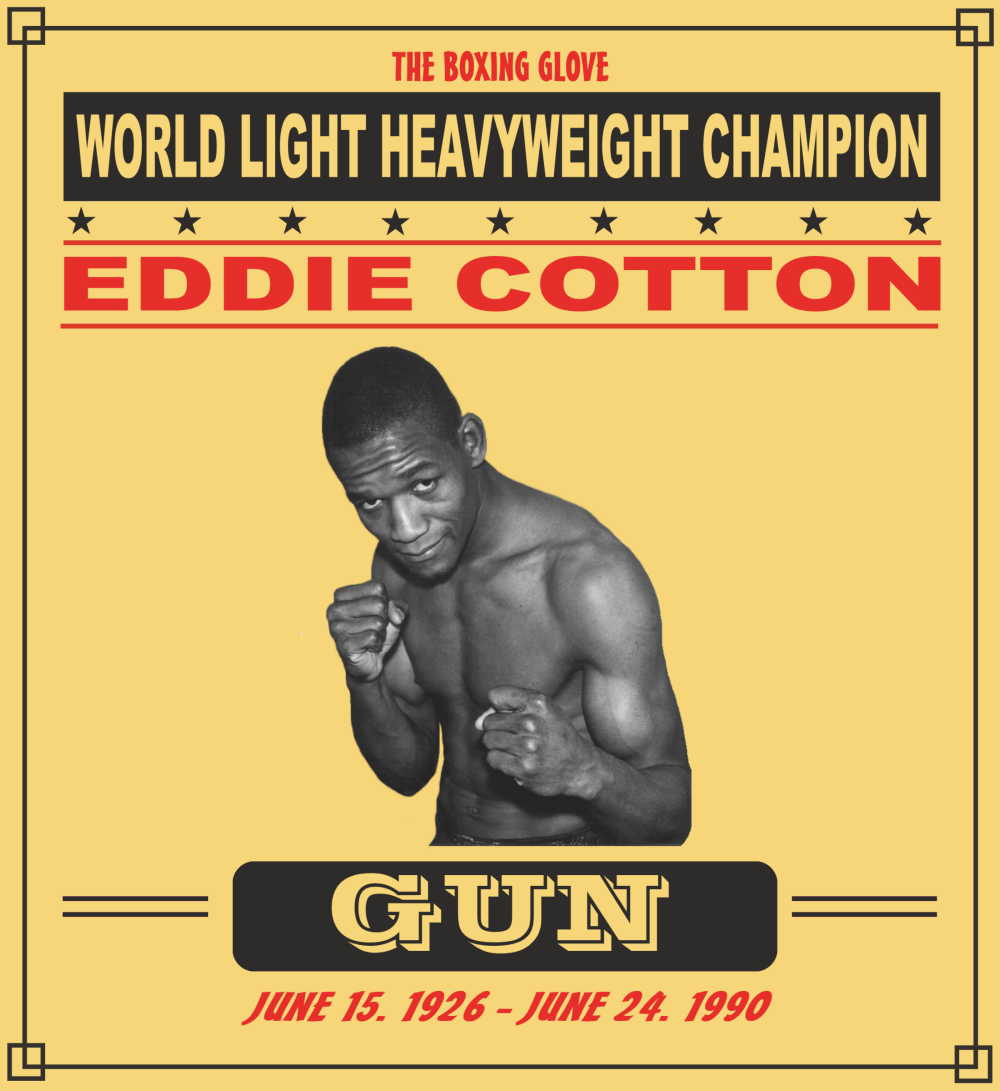
On This Day: Remembering Eddie Cotton: The Uncrowned Light Heavyweight Champion of the World


By Peter Silkov


Eddie Cotton was a slick boxer, with great technical ability, who could also punch when he needed, and he was a top contender at 175 pounds from the mid 50’s to the late 60s.  Born in Muskogee, Oklahoma, on June 15, 1926, Cotton turned professional in 1947, at the age of 21.  During his career, Cotton would fight top names such as Rusty Payne, Henry Hall, Dave Whitlock, Archie Moore, Sonny Ray, Hank Casey, Rory Calhoun, Sixto Rodriguez, Harold Johnson, Von Clay, Mauro Mina, Chic Calderwood, Henry Hank, Johnny Persol, Wayne Thornton, Roger Rouse, Jose Torres, and Bob Foster.

Cotton had to wait until 1961 before he finally received a shot at the World light-heavyweight title, when he challenged Harold Johnson on August 29, 1961, for the NBA version of the World light-heavyweight title.  Cotton lost on a split decision to Johnson after a hard fought contest between two excellent technicians.  After their contest, Johnson, himself recognized as one of the best ring mechanics of that time, said of Cotton, ‘He’s one of the smartest boxers I’ve met.’

On October 29, 1963, Cotton out-pointed Henry Hank over 15 rounds, to win the Michigan version of the World light-heavyweight title, after the state of Michigan went into dispute with the WBA.  Cotton did not gain general recognition as world champion with the Michigan title, and never defended the title.

Cotton received a final shot at the World light-heavyweight title on August 15, 1966, when at the age of 40, he challenged the 30 year old champion, Jose Torres, but found himself losing a controversial point’s decision after 15 rounds, with many spectators believing he had done enough to win the title against Torres.  The Ring magazine voted this match the fight of the year for 1966.

Cotton carried on fighting until 1967, but his hopes of another shot at the world title were finally ended on May 8, 1967, when future world champion, Bob Foster, knocked him out in the 3rd round.  After one more fight, on August 2, 1967, after he knocked out Ernie Gipson in the 1st round, Cotton retired with a final record of 56(33koes)-23-2.

After he retired from boxing, Cotton would open a restaurant on East Madison street in Seattle, which was also was named after him. He also worked for Boeing Aircraft Company and was a member of the Washington State Boxing Commission.

Eddie Cotton died on June 24, 1990, aged 64, after succumbing to an infection, following a 2nd liver transplant.  


Copyright © 2016 The Boxing Glove, Inc. Peter Silkov Art. All Rights Reserved. Peter Silkov contributes to www.theboxingglove.com

Wednesday, February 24, 2016

Boxing History: The Night When the Hands of Stone Dulled The Blade


By Peter Silkov


Twenty seven years ago today, Roberto Duran performed his last act of greatness within the roped square.  He had been an all-time great World lightweight champion during most of the '70s, then crowned his greatness by moving up in weight, and beating Sugar Ray Leonard, for the World welterweight title. At that point, after he had become the first man to defeat Leonard (he would be the only man to ever beat the 'peak' Leonard) Duran was untouchable, a living legend already, and undisputedly, the best fighter pound-4-pound in the world, bar none.  But, it didn't last.

Barely 5 months later, an ill-prepared Duran lost the welterweight title back to Leonard, in the now infamous 'no mas' fight.  Duran was forsaken overnight by many supposed friends and followers. The fighter, who many regarded as a God, was insulted, and ridiculed. His reputation and legacy was a tattered ruin.  Losses to Wilfred Benitez and Kirkland Laing continued his slide, and he was labelled a has been, and much worse, some even questioned whether he had ever been as great as they once thought. Then a funny thing happened, Duran was a champion again. 

Duran won a third world championship against the very talented, but inexperienced, Davey Moore, with a performance that made people remember the fighter he had been in the 70s and in his first clash with Sugar Ray Leonard.  Then Duran took on the new pound-4-pound, number one in the world, undisputed World middleweight champion, Marvin Hagler. Although Roberto was beaten, Duran became the first challenger to take Hagler the distance, in what was such a close fight, that Hagler needed to rally in the last 3 rounds to keep his title.  He had made Hagler look human. Suddenly Duran was great again, and most people now looked at 'No Mas' as an aberration. After his great performance against Hagler, in his next fight, Duran was knocked out in 2 rounds by Thomas Hearns, but few could hold it against 'Hands Of Stone.  After all he was now 32 and even great fighters don't last forever. Duran retired, after the Hearns loss, with his greatness unquestioned. 
 However, Duran would rival Frank Sinatra, for the number of retirements and comebacks he would make during his boxing career.  Two years after losing to Hearns, Roberto was back, again, fighting a series of contests against a range of opponents. The best fighter that Duran faced during his early comeback fights was Robbie Sims, Marvin Hagler's half brother.  Sims beat Duran on a split decision, and although many thought Duran had done enough to win, the fight and Duran's performance, seemed to underline that his championship days were now well and truly over.

When Duran was given a shot at Iran Barkley's WBC world middleweight championship on February 24, 1989, most thought 'Hands of Stone' had little chance of victory against 'The Blade.' The 'Stone Hands' were 37 years old now, the spark and dynamite were gone, and the speed was just a memory.  Then came the night of the fight, and corny though it may sound, the spectators at the Atlantic City Convention Center, and the audience watching the fight on TV, saw a sporting miracle. It was the kind of performance that happens very rarely in sport. Duran was young again. Duran, the shorter, older, smaller man, went toe-to-toe with Barkley, and using all the wily skills and experience he had gathered during his career. He summoned up an almost otherworldly level of fitness and determination, Duran out-thought and out-fought Barkley in one of the best World middleweight title fights ever seen. The spark was back, there was venom in his punches, and a speed and sharpness in his movement. At 37 years old, Roberto fought like a man in his 20s; like the Duran of 10 years ago.  'Stone hands' clinched his victory by flooring, a by now battered and bloodied, Barkley in the 11th round. By the 12th round, even Barkley's body language seemed to signal that he knew he had been beaten.

Duran won by a split decision, but anyone watching that night would tell you that there could only have been one winner that night. It was a night when a short, slightly pudgy, and bearded ex-world lightweight champion, became the first Latin American to win 4 world titles. Duran was great again. Duran's reign as WBC world middleweight champion would be short, he vacated the title in order to take a 3rd match with Sugar Ray Leonard, but it didn't matter, he had done more than enough on that night of February 24, 1989. Some fighters’ greatness can be seen encapsulated in one fight. They are fights where the fighter in question has to reach into and display nearly all those aspects of himself that go into making him a great fighter. They are fights, when watched, you will say to yourself, “yes I can see it.”  For Muhammad Ali, it was his first fight with Liston.  The no. 3 meeting of Foreman and Frazier it was there.  For Roberto Duran, watch Dejesus 2 and 3, Leonard 1,  Hagler,  and Barkley.


Copyright © 2016 The Boxing Glove, Inc. Peter Silkov Art. All Rights Reserved. Peter Silkov contributes to www.theboxingglove.com

Sunday, January 3, 2016

The 2015 Boxing Glove Awards: Upset of the Year: Tyson Fury W12 Wladimir Klitschko


The Boxing Glove Upset Of The Year 2015
Tyson Fury W12 Wladimir Klitschko
November 28, 2015, Espirit Arena, Dusseldorf, Germany.
Won IBF, WBO, WBA World Heavyweight Championships

No one gave Tyson Fury a chance of unseating Wladimir Klitschko and becoming Heavyweight champion of the world, no one that is save for a small collection of fans, Fury’s family, and Fury himself.  Tyson had actually spent the past few years telling people that he would beat Klitschko, and not just that he would beat him, but that it would be one of his easiest fights.  In the end, that’s just what it was for Fury, who didn’t just win, but won with ease over the long-reigning Klitschko in what was the biggest upset in the heavyweight division since Buster Douglas beat Mike Tyson.

Watch the fight:


Кличко - Фьюри полный бой - Vladimir Klitschko... by smotrinas

Copyright © 2016 The Boxing Glove, Inc. Peter Silkov Art. All Rights Reserved. Peter Silkov contributes to www.theboxingglove.com

Sunday, May 3, 2015

Book Review: Fighting the Demons: The Lester Ellis Story

The Boxing Glove Sunday Night Book Review by Peter Silkov

Fighting the Demons: The Lester Ellis Story

As told to Robert Drano.


First published in 2007, “Fighting The Demons: The Lester Ellis Story” is the searing autobiography of Lester Ellis, former IBF World junior lightweight champion, who also held multiple belts in different divisions in his career. To say that Ellis had a meteoric career would be an understatement. He won the world championship in 1985, one month before his 20th birthday, after just 15 fights, and barely two years as a professional fighter. In the end, it was too much too soon for Ellis. He lost the world title after just five months to friend and archrival, Barry Michael, and although he would carry on fighting until 1996, and win other titles, he would never again win a major world championship.

In fact, when reading this book one can see that in many ways Ellis’s life started a slow spiral downwards from the moment he lost his world title to Barry Michael.  “Fighting the Demons” is more than just a story about boxing; it is a story about a man struggling to cope with a life that is slowly spinning out of control. By the time Ellis retired from boxing in 1996 (although he made an ill-fated one-fight comeback in 2002 against Anthony Mundine) he was in the grip of depression, obsessive compulsive disorder, and alcoholism. Things would get much worse before he hit rock bottom and started to fight back.

In many ways, “Fighting the Demons” was a catalyst for the beginning of Ellis’s recovery. He says in the introduction that he was still in denial about the extent of his drinking problem during the writing of the first 10 chapters of the book, then in an incident, which made the news nationwide in Australia in 2006, Ellis tried to commit suicide. From the 11th chapter on, “Fighting The Demons” focuses on Lester’s fight against alcoholism, and his return from a rock bottom that saw him at one point drinking 200 cans of beer a week. 

Ellis was born in Blackpool, Lancashire, on March 15, 1965.  He was born premature weighing only three pounds and two ounces, with under developed lungs.  When he was five years old, the Ellis family relocated to Melbourne Australia, partly because of young Lester’s asthma. Not long after their move to Australia Lester’s parents marriage broke up. This would turn out to be a huge life changing event for young Lester, who went from being happy, and well adjusted to being a troubled, and angry.  Boxing would turn out to be his salvation and a focus and outlet for his rage.

As a fighter, Ellis was, at his best, a very hyper fighter. He could both box, and slug it out, and fought at a pace that seemed to be close to perpetual motion. His trademark two-fisted attacks, with blinding hand speed and knockout power, gained him the nickname “The Master Blaster.”  Ellis was a great in-fighter and vicious body puncher. Ellis describes himself as an angry fighter, someone who fought with emotion and anger, rather than a cool head, which you are supposed to do inside a boxing ring. Despite what the experts might say, this approach certainly worked for Ellis, and for a time he was simply overwhelming his opponents. This is one of the reasons why he got a world title fight so quickly; because many fighter were refused to fight him and so he was fast-tracked to the very top.
  
This is an extremely vivid book, written as if Ellis is talking to you. Overall, the book is captivating, entertaining, moving, and disturbing. Despite some of the harrowing subject matter, there is a lot of humour within the book. Ellis comes across as having a good line in black humour. There are also fascinating insights into the world of boxing, and the whole merry-go-round of fame and success, which young boxers can experience so suddenly during their careers, and then just as suddenly, have taken away.

“Fighting The Demons” gives a fascinating insight into the pressures that come with success and the fickleness of many of the so called ’friends’ whom befriend fighters when they are at the top, only to abandon them when they start to lose.

Like many of the best boxing autobiographies, “Fighting The Demons” is far more than just a book about boxing. It is a fascinating story of a life lived on the edge, in fast forward, which eventually spins into self destruction.  It also shows the courage that is needed to turn away from the brink.

Lester Ellis’s autobiography resembles the way in which he fought in the ring, exciting, fast paced, and hard hitting. This was one of the most moving autobiographies I have ever read and made me admire Ellis even more both as a man and a fighter. 


Copyright © 2015 The Boxing Glove, Inc. Peter Silkov Art. All Rights Reserved. Peter Silkov contributes to www.theboxingglove.com and www.theboxingtribune.com


twitterfacebookgoogle pluslinkedinrss feedemail

Sunday, February 8, 2015

Ad Wolgast: The Michigan Wild Cat


 By Peter Silkov

Ad Wolgast stands in boxing history as one of the bravest and toughest individuals to ever lace on a glove.  Nicknamed the “Michigan Wild Cat,” Wolgast lived up to his name as one of the wildest and ferocious of fighters, during an era when life was hard and boxers were altogether a harder and tougher breed when compared to the fighters of today. 

Born Adolphus Wolgast, on February 8, 1882, in Cadillac Michigan, Wolgast turned professional in 1906, and almost immediately began mowing through the lightweight class with an almost frightening violence. Wolgast quickly earned himself the reputation of an ultra-tough man of the ring at a time when boxing was over flowing with hard bitten tough guys.  However, Wolgast  took his toughness to almost hitherto unparalleled levels.  He seemed impervious to both pain and punishment, while at the same time, being able to dish out a devastating amount of punishment himself.  Wolgast had a good punch in both fists, and his body attacks alone could wreck a man. 

There was just one man in his division who could rival Wolgast in toughness and ferocity, and that was Battling Nelson.  It was fitting then that after fighting his way up the ranks of contenders, and leaving few standing in his wake, Wolgast eventually came face-to-face with Nelson in 1910 to battle for Nelson’s World lightweight crown.  The two men had actually fought a non-title 10-rounder the previous year, which Wolgast had won on points, but that fight was just a preliminary warm up compared to their world title fight on February 22, 1910.  The fight has been described as the most savage battle ever fought in modern times, and its mixture of violence and endurance is unrivalled in modern boxing history.  Both men did their best to tear each other to shreds for 40 rounds, before the referee finally stopped the contest in favour of Wolgast, with Nelson having been rendered helpless and blind by the beating he had endured, but still defiantly on his feet. 

Wolgast was to hold onto his world title for a little over two years, but there is little doubt that the war with Nelson left a permanent mark on him, and it is interesting to note that he would lose 3 of his next 5 fights, albeit in non-title bouts.

On November 28, 1912, Wolgast lost his World lightweight title to Willie Richie, when he was disqualified in the 16th round for a foul blow. It would be the beginning of a long slide downhill. During his peak years Wolgast had earned £240,000 from his fights and vaudeville appearances on stage, but as he stubbornly continued to fight on, despite an obvious slippage in form, Wolgast’s life began to fall apart.

After losing his title to Richie, Wolgast went a sad 19-25-10 in his final fights. 
The terrific punishment which he had absorbed in so many of his fights had taken a terrible toll, and in 1917 he was admitted to a sanatorium having suffered a mental breakdown.  Eventually he was discharged, but by then his wife was taking steps to divorce him and he soon found himself stripped of most of his assets.  Ad returned to the only thing he knew and continued fighting until September 6, 1920, when he was held to a 4-round draw by Lee Morrissey. 

By this time Ad’s mental decline had become so acute that he was put into the care of boxing promoter Jack Doyle, who housed Wolgast in a cottage on the  grounds of his house and allowed him to spend his days training in the gym that was just a few steps away from the little cottage.  Ad trained diligently everyday believing that he was getting ready for a comeback which would make him champion of the world once more.  Everyday Ad asked Doyle when was he going to get his fight, and every day Doyle answered ‘Tomorrow.’  Eventually in 1927, Wolgast became too much for Doyle to handle and was committed to the first of a number of mental institutions where he would spend the rest of his life.  The stories of Ad Wolgast’s final years are not pretty, he spent his final years still training for the fights that now existed only inside his battered mind, yet, his behaviour and illness apparently made him a easy target for many of the orderlies who were supposed to take care of him, and he is said to have endured frequent beatings. Ad Wolgast  passed away on April 14, 1955, leaving behind a story of triumph and glory won at a terrible price. Wolgast's final record was 59(40koes)-13-17 and newspaper decisiom record 22-21-6.


Copyright © 2015 The Boxing Glove, Inc. Peter Silkov Art. All Rights Reserved. Peter Silkov contributes to www.theboxingglove.com and www.theboxingtribune.com

twitterfacebookgoogle pluslinkedinrss feedemail

Sunday, February 1, 2015

Angelo Dundee: The Great Corner Man


Philadelphia has produced some of the greatest boxers ever, but it was also the birthplace of Angelo Dundee. Born Angelo Mirena, he changed his name, like his brothers, so that their parents would not know they were in the fighting game. Dundee got his start at Stillman’s Gym in New York city after he followed his brother, Chris, who wanted to be a promoter. He worked as a ‘bucket boy’ and a ‘go-fer’ and was mentored by the likes of Charlie Goldman, Ray Arcel and Chickie Ferrera. He watched and learned to tape hands, handle cuts, and became the best ’bucket man’ around.

During the 1940s his reputation grew and he became known as one of the best corner men in the business, which put him in great demand. While in New York, Dundee worked the corner of Carmen Basilio, who was his first world champion, and Sugar Ray Robinson.

In 1950, Chris Dundee opened the 5th Street Gym in Miami, Florida, and Angelo followed his brother into a successful partnership that developed the careers of many world champions.

Undoubtedly, Dundee’s most famous partnerships were with Muhammad Ali and Sugar Ray Leonard. While working with Ali throughout his career Dundee became the most well known and respected boxing trainer in the world, and as Ali’s career was coming to an end, Dundee helped guide Sugar Ray Leonard to stardom. In later years, Dundee would work with the likes of Evander Holyfield and George Foreman, amongst many others.

Angelo Dundee’s greatest gift is that he could add that little extra to a fighters make up, whether the fighter be a youngster just starting out, or a mature and seasoned fighter who is looking for a new edge. More than anything else Dundee understood how boxers brains worked.

When people speak about Angelo Dundee, they are reminded of his great enthusiasm and motivation he brought to a corner. The record of producing 15 world champions speaks volumes of the success story that was Angelo Dundee. Considered one of the greatest boxing trainers in the history of boxing he was inducted into the International Boxing Hall of Fame in 1992.


Copyright © 2015 The Boxing Glove, Inc. Peter Silkov Art. All Rights Reserved. Peter Silkov contributes to www.theboxingglove.com and www.theboxingtribune.com

twitterfacebookgoogle pluslinkedinrss feedemail

Wednesday, May 21, 2014

Rocky Graziano: Hey, Ma, your bad boy did good!

By Peter Silkov

Rocky Graziano’s life story is the classic tale of a bad boy who makes good through boxing. Born Rocco Barbella in New York, on January 1, 1922, Graziano was a tearaway as a youngster and in constant trouble with the Police. He seemingly was on the road to a life of crime and jail, until he discovered that his inner anger and fire could be used successfully inside a boxing ring. After a short amateur career, Graziano turned professional in 1942. There was nothing subtle about Graziano’s fighting style, he was an embodiment of what any fighter named ‘Rocky’ is expected be; a crude and savage brawler with a huge heart and a knockout punch in each fist.

Graziano quickly became a huge favourite with the fans in the mid-1940s. When the World middleweight champion Tony Zale returned from duty in WW2, a contest between him and the division’s newest sensation, Graziano, was a natural. 
In all, the two men fought three times in what has been celebrated as one of boxing’s greatest ever rivalries. The first two fights between Graziano and Zale are considered two of the greatest and most savage title contests of modern times. In their first meeting on September 27, 1946,  Graziano rose from a 1st round knockdown, to floor Zale in the 2nd, and then savagely pummel him over the next few round before being overwhelmed in the 6th round by a vicious right to the body, and left hook to the jaw. 

The rematch took place ten months later on July 16, 1947, this time, it was Zale who had the upper hand early on, flooring Graziano in the 3rd, and looking at times to be only a punch or two from victory, only to be overcome by a desperate fight back from Graziano.  Despite being badly punished by Zale, with a bloody left eye, and a closing right eye, Graziano threw everything that he had left at Zale in the 5th and 6th rounds, in an astonishingly brutal and relentless attack, that ended with Zale draped exhausted and battered, through the middle ropes in the 6th round. At that point, the referee waved the fight off and declared Rocky Graziano the new World middleweight champion.  Graziano’s first words after his spectacular victory were ‘Mama, the bad boy done it!’

Rocky made the first defence of his Middleweight world championship 11 months later, on June 10, 1948, in what was his 3rd and last fight with Tony Zale. This time, it was more straightforward, as Zale overwhelmed Graziano from the start, flooring him in the first and then again in the third, before finally knocking out Rocky in the 3rd round, and regaining the middleweight crown from Graziano.

After losing his world title, Rocky came back with a string of twenty wins and one draw over the next four years, including exciting victories over Charlie Fusari, Gene Burton, and two wins and a draw over fellow crowd favourite Tony Janiro.  On April 16, 1952, Graziano tried to regain the World middleweight title against the great Sugar Ray Robinson, but after scoring a brief knockdown of Robinson, Graziano was then put down fro the full count in the 3rd round.

Rocky had one more fight after this, being out-pointed by the clever, but light fisted Chuck Davey. Graziano retired in 1952 with a final record of 67(52koes)-10-6.
In his retirement Graziano became a popular TV personality, actor, and his life story was made into a film starring Paul Newman.  As he often liked to say… somebody up there liked him. 

twitterfacebookgoogle pluslinkedinrss feedemail