

By Peter Silkov

Ace Hudkins was one of the most colourful and feared fighters of the 1920s, an aggressive, all-action, snarling, two-fisted, beast of a fighter, who asked for, nor gave any mercy in the ring. He wasn’t given the nick name “The Nebraska Wild Cat” for being dull. If he was a wild cat inside the ring, Hudkins was no less formidable out side the roped square. Hudkins was a full-blown hell raiser who seemed to create a storm wherever he went. He was a throwback to the days of the Wild West when lawless gunslingers challenged each other on the streets to decide who was the quickest on the draw. Perhaps it will come as no surprise that Ace often got into trouble with the authorities for roaming the streets armed with a gun.
Ace Hudkins was born Asa Hudkins on August 30, 1905, in Valparaiso, Nebraska. He soon showed he was good with his hands almost from the moment he learned how to make fists with them. By the age of 12, he was working as a ‘newsboy’ and proved to be very adept at defending his patch.
It is likely that by the time he hit his teens, Hudkins was fighting for pay in the unofficial ’bootleg’ fights that used to take place in various back rooms of small bars and clubs in those days.
“The Nebraska Wild Cat” started his official boxing career in 1922, at the age of 17, and from the start he fought just as he had when defending his pitch on the street. He would bore into his opponents with both arms swinging and he didn’t care much where his punches landed. Ace was rough and tough with seemingly unlimited endurance and impervious to pain, in fact if anything, getting hit seemed only to strengthen the Wild Cat. He would fight with a snarl on his face and a maniacal glint in his eyes, which would become ever more fierce as his fights wore on. With his two brothers Art and Clyde working his corner, Ace set about making himself the terror of the lightweight division and by 1925, he was rated by The Ring magazine amongst the top lightweights in the world.
Ace Hudkins was born Asa Hudkins on August 30, 1905, in Valparaiso, Nebraska. He soon showed he was good with his hands almost from the moment he learned how to make fists with them. By the age of 12, he was working as a ‘newsboy’ and proved to be very adept at defending his patch.
It is likely that by the time he hit his teens, Hudkins was fighting for pay in the unofficial ’bootleg’ fights that used to take place in various back rooms of small bars and clubs in those days.
“The Nebraska Wild Cat” started his official boxing career in 1922, at the age of 17, and from the start he fought just as he had when defending his pitch on the street. He would bore into his opponents with both arms swinging and he didn’t care much where his punches landed. Ace was rough and tough with seemingly unlimited endurance and impervious to pain, in fact if anything, getting hit seemed only to strengthen the Wild Cat. He would fight with a snarl on his face and a maniacal glint in his eyes, which would become ever more fierce as his fights wore on. With his two brothers Art and Clyde working his corner, Ace set about making himself the terror of the lightweight division and by 1925, he was rated by The Ring magazine amongst the top lightweights in the world.

But, Ace hadn’t really arrived yet, with most of his fights having taken place in his own backyard of Nebraska, or in California. He was still relatively unknown in New York, and this is perhaps the reason why he was picked as an opponent for the unbeaten 19-year old prodigy Ruby Goldstein. 20 years before he would gain fame, as boxing’s premier referee; “The Rube” was an unbeaten lightweight who was being hailed as the new Benny Leonard. Goldstein was 23-0 and on verge of a world title shot when Ace was brought in as a final ‘warm up’ before Goldstein’s expected world title challenge. Goldstein’s management had been warned to keep Ruby away from Hudkins, by a former Hudkins’ opponent Sid Terris. Although Terris had out-pointed Hudkins, he knew only too well what an opponent had to go through against The Wild Cat. Hudkins never bothered to learn the ‘sweet science’ of boxing, and could be out-boxed, but it took a special kind of person to stand up to Hudkins’ savage fury, and outbox him. Also, at this point of his career Hudkins, at the age of 21-years old, was still improving, growing stronger, and gaining more experience. Goldstein was the heavy favourite in New York, he had boxing skill and a dynamite punch, and his Jewish fans believed that he was set for greatness. All those dreams were shattered on the night of June 26 1926, when Ruby entered the ring against The Nebraska Wildcat. Goldstein dropped Hudkins in the first minute of the 1st round with one of his best punches, but the Wild Cat rose from the canvas with a snarl before the count of ten, and from then on “The Jewel of The Ghetto” was fighting for his life. Goldstein had never experienced anything like Hudkins before and was forced to go toe-to-toe with him in a desperate effort of survival. It all ended in the 4th round, when a savage left hook laid Goldstein out upon the bottom rope, unconscious to the world, but with his eyes wide open. Ace Hudkins had arrived and his decimation of Goldstein made him a sensation. Meanwhile, Goldstein never recovered from the savage beating The Wild Cat had given him, and although he fought for another decade, he was just going through the motions.

Following his victory over Goldstein, Ace clamoured for a shot at the World lightweight championship, but to no avail. He then added some pounds to his muscular frame and went after the welterweight title, only to find he was avoided once more by the division’s titleholder. By 1928, Hudkins had moved up to the middleweight division, and it was here that he finally received a world title shot, on June 21, 1928, challenging “The Toy Bull Dog” Mickey Walker for Walker’s World middleweight title. Walker and Hudkins were in many ways mirror images of each other, both in the ring and out of it; two men who were known to raise as much hell outside of the ring as they did inside of it. Their fight was brutal and bloody, with Walker retaining his world title on a split decision after ten blood splattered rounds. The referee had voted for Hudkins, while both judges went for The Toy Bulldog.
16 months later on October 29, 1929, Hudkins was granted a rematch against Walker for the World middleweight title, but came up short again, losing on points once more, after another barnstormer. The two world title fights with Walker would represent a peak; it was all down hill from then on for Ace Hudkins. He would fight 8 more times over the next 3 years, with his weight rising to light-heavyweight proportions, he began fighting light heavyweights and heavyweights, but not with the success of old. The wild ways and wild life, both in and outside the ring, had finally taken a toll, and Ace’s thirst for fighting was now being overwhelmed by his thirst for liquor.
16 months later on October 29, 1929, Hudkins was granted a rematch against Walker for the World middleweight title, but came up short again, losing on points once more, after another barnstormer. The two world title fights with Walker would represent a peak; it was all down hill from then on for Ace Hudkins. He would fight 8 more times over the next 3 years, with his weight rising to light-heavyweight proportions, he began fighting light heavyweights and heavyweights, but not with the success of old. The wild ways and wild life, both in and outside the ring, had finally taken a toll, and Ace’s thirst for fighting was now being overwhelmed by his thirst for liquor.

Hudkins was 4-4 in his last eight fights. His last good win was a 10-round point’s victory over heavyweight contender King Levinsky in 1931. The Wild Cat hung up his gloves in 1932 after losing on points to Lee Ramage and then Wesley Ketchell, with displays that showed he was becoming little more than a punching bag.
Retiring with a record of 64(25koes)-16-12, for a while it seemed that Hudkins was determined to die with his boots on. On an alcohol fuelled rampage, life for him became one bar room brawl after another. Ace’s rap sheet grew, and he was lucky not to end up being killed or killing someone else, although he certainly came close to getting killed.
In August 1933, Hudkins had two bullets fired into him, and only survived due to two blood transfusions, and his own stubborn spirit. From this point on, Hudkins changed, he married, brought some land, and started to train and breed horses with great success. Many of Ace’s horses were used in Hollywood westerns. Roy Rogers brought his famous horse “Trigger” from Ace, while the Lone Ranger and Annie Oakley both rode horses provided by Ace. In addition, Hudkins became a Hollywood stuntman, a career that would last until the late 1960s.
Retiring with a record of 64(25koes)-16-12, for a while it seemed that Hudkins was determined to die with his boots on. On an alcohol fuelled rampage, life for him became one bar room brawl after another. Ace’s rap sheet grew, and he was lucky not to end up being killed or killing someone else, although he certainly came close to getting killed.
In August 1933, Hudkins had two bullets fired into him, and only survived due to two blood transfusions, and his own stubborn spirit. From this point on, Hudkins changed, he married, brought some land, and started to train and breed horses with great success. Many of Ace’s horses were used in Hollywood westerns. Roy Rogers brought his famous horse “Trigger” from Ace, while the Lone Ranger and Annie Oakley both rode horses provided by Ace. In addition, Hudkins became a Hollywood stuntman, a career that would last until the late 1960s.
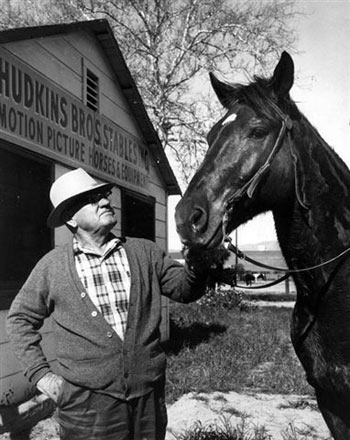
Hudkins was finally counted out on April 17, (some sources claim April 9 or April 18) 1973. It was the only time in his life that he had heard the ten count.
Hudkins might not have been a world champion during his career, but its not hard to imagine him winning a world title in most other era. Were he fighting today, Hudkins would no doubt be a sensation, a lightweight who would finish his career as a heavyweight, it’s hard to imagine Ace Hudkins ever ducking anyone.
Hudkins might not have been a world champion during his career, but its not hard to imagine him winning a world title in most other era. Were he fighting today, Hudkins would no doubt be a sensation, a lightweight who would finish his career as a heavyweight, it’s hard to imagine Ace Hudkins ever ducking anyone.


