Saturday, April 23, 2016

On This Day: Ruby Goldstein: The Jewel of the Ghetto Remembered


By Peter Silkov

Ruby Goldstein was for a while one of the most popular boxers in the ring. He was an idol for many boxing fans, especially the Jewish boxing community, and much was expected of him.  He was seen by many as a future Lightweight champion of the world.

 ‘The Jewel of the Ghetto’ was a gifted boxer, with speed and technique, and a knockout punch, and seemed to be destined for the very top.  Born on October 7, 1907, in New York, New York, as an amateur he compiled a record of 19-0 with 9 knockouts, before turning professional in 1924, at the age of 17.   He quickly became a sensation with the fans, and put together a run of 23-0 (13koes) before being put in with top contender Ace Hudkins on June 25, 1926.  With hindsight it would turn out to be a disastrous mistake to match Ruby, who was still three months shy of being 19 years old, with the ferocious, battle-hardened Ace Hudkins.  ’The Jewel of the Ghetto’ was brutally wrecked at the hands of Hudkins. He was knocked out in the 4th round by a monstrous left-hook, which was described by the New York Times, as “apparently coming from the floor, and landing clean to the point of Goldstein’s chin, stretched Ruby on his back over the lower ring rope, where he swung to and fro for a space, his eyes gazing upward, but seeing nothing.”

The defeat to Hudkin’s was a set back from which Goldstein never fully recovered and he was never the same boxer again.  Three months later in his f upon his return to the ring since the Hudkin’s defeat, Goldstein was stopped in the 6th round by the unheralded Billy Alger, after injuring his ankle. Ruby did come back with a 6 fight winning streak, including a 6-rounds point’s victory over Jimmy Goodrich, that gave his fans hope that perhaps he would still live up to his promise.  Then on June 15, 1927, Sid Terris knocked out Goldstein in the 1st round.  Goldstein had put Terris down for a count of nine, but then been caught himself, and counted out.  It was clear now that Ruby had that fatal flaw that is dreaded by all boxers, and would-be champions a glass chin.
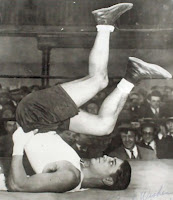

Ruby put together a 10 fight winning streak in the 3 years following the defeat to Terris, but on December 13, 1929, a second round knockout defeat, to Jimmy McLarnin, finally put an end to any remaining hopes of Ruby ever making it to the top.

Ruby would carry on fighting for another 8 years, but only sporadically, going 16-2, against most mediocre opposition. He was still a draw for the fans, although they were only too aware now of his flawed talent.  Goldstein won his last 12 bouts, before retiring in 1937, with a final record of 55(39koes)-6. 

After he retired from fighting, Goldstein a boxing referee.  By the 1950s he was one of the most respected, and popular referees in the sport, and still displaying the nimble footwork that had once made him one of the most talented boxers of his time.  Goldstein’s career as a referee ended on a tragic note on March 24, 1962, when he refereed the World welterweight title fight between Benny Paret and Emile Griffith, that ended with Griffith punching the defending champion Paret into unconsciousness in the 12th round, from which he would never awake.  Paret would lapse into a coma and die on April 3rd.


Although he had stepped in at the end, and stopped the fight when it became clear that Paret was laying on the ropes unconscious, and it was only Griffith’s punches that were keeping him up, Goldstein would face harsh criticism for not stopping the fight sooner.  The reality is that Goldstein was beaten by the speed of Griffith’s final fusillade of punches, some 25 of them, that landed before Goldstein was able to get between the two fighters, and stop the contest.

Goldstein would only work one more fight as a referee, when almost 2 years to the day; he was the 3rd official in the Luis Manuel Rodriguez vs. Holly Mims middleweight contest.  Goldstein would work two fights as a judge in late 1968, before he retired into a quieter life away from boxing. 


Watch Ruby Goldstein officiate Robinson Vs. Fullmer (1st meeting) January 2, 1957:


Copyright © 2016 The Boxing Glove, Inc. Peter Silkov Art. All Rights Reserved. Peter Silkov contributes to www.theboxingglove.com

Friday, April 22, 2016

On This Day: Remembering Jack Kid Berg: The Whitechapel Whirlwind


By Peter Silkov


Jack ‘Kid’ Berg was one of the most exciting, all-action fighters ever to come out of Britain.  Born Judah Bergman, he was inspired to become a boxer by the ring exploits of Ted ‘Kid’ Lewis. Berg turned professional at the age of fifteen, in 1924, and soon became a top attraction in London due to his relentless, non-stop, windmill-style of fighting, which gained him the nickname ‘The Whitechapel Windmill.’ In 1928, Berg moved to America to fight, where he was trained by Ray Arcel. Berg’s style and out-of-the-ring charisma made him an instant hit in America, and he was soon fighting the top lightweights in the world, including Tony Canzoneri, Billy Petrolle, Mushy Callaghan, Joe Glick, Buster Brown, Sammy Fuller and Kid Chocolate. 

On February 18, 1930, Berg won the World light-welterweight championship when he out-pointed Mushy Callahan in London. Over the next 14 months, Berg defended the world title successfully nine times, before losing his championship to Tony Canzoneri, when he was knocked out in the 3rd round.  Berg’s defeat to Canzoneri was controversial, as Canzoneri’s World lightweight championship was also at stake. Both men scaled under the lightweight limit, so Berg argued that his light-welterweight title was not at stake in the fight. However, according to Berg, his light welterweight title was not supposed to be at stake, but it was, so Berg lost his championship.

Five months later, Berg and Canzoneri fought again, with both Lightweight and Light-welterweight world titles at stake once more, and this time Canzoneri won a narrow 15 rounds point’s decision.  Berg returned to London to fight in 1933, and won the British lightweight title on October 29, 1934, when he knocked out Harry Mizler in 10 rounds; a title he held for two years.  Berg would return to fight in America in 1938 to 1939, although he failed to secure another world title shot. Berg carried on fighting until 1945, when he finally retired with a record of 157(57koes)-26-9.

After he retired Berg had a new career as a movie stuntman in various films, and remained a well known character in the boxing scene until his death in 1991 at the age of 82. 


Watch Jack 'Kid' Berg "This is your Life":


Copyright © 2016 The Boxing Glove, Inc. Peter Silkov Art. All Rights Reserved. Peter Silkov contributes to www.theboxingglove.com

#‎OnThisDay‬ ‪#‎BoxingHistory‬ ‪#‎BoxingNews‬ ‪#‎TheBoxingGlove‬ ‪#‎TheBoxingGloveNews‬ ‪#‎BornOnThisDay‬ ‪#‎Boxing‬ ‪#‎Boxeo‬ 

On This Day: The Alabama Kid the Boxer Who Had a Knock Out Punch Remembered


By Peter Silkov

Alabama Kid was one of the toughest and most dangerous fighters of his era, being one of the most formidable middleweight and light-heavyweight contenders of the 1930s and 40s.  The Alabama Kid scored a prodigious 108 knockouts during his career, a career in which he started as a flyweight, and fought in every division up to heavyweight.

Born Clarence Reeves on January 1, 1914, in Concord, Georgia, the Alabama Kid turned professional in 1928, fighting as a flyweight. By 1931, Alabama Kid had grown into a middleweight and was an established crowd favourite.  He often had to give away weight in matches, fighting men who were naturally bigger than him, as those of his own size often avoided him.  Ironically, despite his name, the Alabama Kid did not have very strong connections with Alabama. He never lived in Alabama and there are no verified records of him ever fighting in Alabama, (although that doesn’t mean that he did not fight there), but he took on the name so that his parents would not know that he was boxing.

During his career, Alabama Kid met top fighters such as Ko Kelly, Frankie Palmo, Paul Pirrone, Tommy Freeman, Sammy Slaughter, Joe Sekyra, Buddy Knox, George Nichols, Gus Lesnevich, Gorilla Jones,  Buddy Walker, Bob Amos, Dave Sands, Lee Q Murray, Arturo Godoy, Archie Moore, and Sid Peaks.

In 1938, Alabama traveled to Australia for some fights. Originally he planned to have just two fights there, but he found himself so popular with the Aussies that he ended up staying for over two years, before he decided to head home.  When he did decide to head back to America in 1940, fate took a hand when Alabama’s ship hit a mine, and sunk within half an hour.  Luckily all the passengers on board, including Alabama, were saved and put into lifeboats.  Instead of returning to America, Alabama went to New Zealand for a couple of fights, and then returned once more to Australia.

In a twist of fate, which would turn out to be tragic, Alabama Kid met a white Australian woman, whom he soon married.  This should have been a happy turn of events, especially when Alabama’s wife gave birth to two children.  For a while everything went well for Alabama, he continued to fight regularly, both in the ring, and also toured Australia with ’tent’ troupes, which were ran by his manager, Harry Johns. It is said that when Alabama tried to leave Harry Johns' Boxing Troupe over poor working conditions and low wages, he was threatened by Johns that he would turn Alabama into the immigration department. Ironically when he did leave the tent shows it was shortly there after that the Australian authorities caught up with Alabama and swiftly deported him.

However in 1947, Alabama Kid was told by immigration that he would have to leave Australia, as his marriage violated the ‘white Australian’ rule, which was intended to guard against white Australians marrying black partners.  Alabama Kid protested at being deported and underlined his love for both his wife and babe’s and Australia. even though his wife begged and pleaded to the authorities to allow her husband to stay in the country. “She said to the court “We are without a bread winner in a strange city and I do not want to die,” said Mrs. Reeves in Sydney following the arrest of her husband on a deportation order. The Alabama Kid, whose real name is Clarence Olin Reeves, burst into tears when he was arrested after having been beaten in a boxing bout.’"

But despite this and the outcry that his deportation raised amongst many Australians, especially within the boxing community, Alabama Kid was detained in April of 1948 at the Long Bay Jail and deported from Australia within a week, leaving his wife and children behind.  He would never see them again. They didn’t even allow his wife and children to say goodbye to him. He was placed on the ship Marine Phoenix' on April 16th, heading to San Francisco. He tried many times over the following years to get back to Australia. 

Once he returned to America, Alabama Kid continued to fight for a while, but he was a pale shadow of the fighter that he had been previously.  The Alabama Kid had his final fight on March 8, 1950, when O’Dell stopped him in 3 rounds.

The Alabama Kid’s final record is 178(108koes)-59-20.

After his retirement from boxing, the Alabama Kid worked as a trainer, and also ran a liquor store. Alabama would write Harry Johns in 1952 and said “he was managing a beer, wine, and food saloon in his hometown of Columbus, Ohio. The Kid sends his regards to his many fans.”

Clarence ‘Alabama Kid’ died on April 22, 1970. 


Copyright © 2016 The Boxing Glove, Inc. Peter Silkov Art. All Rights Reserved. Peter Silkov contributes to www.theboxingglove.com

On This Day: Johnny Dundee: The First of the Great Italian-American Fighters Remembered


By Peter Silkov

Johnny Dundee, the ’Scotch Wop,’ is recognized by many as the first great Italian-American boxer. He was one of the cleverest and most durable fighters ever, with great stamina, footwork, and ring guile. In a career lasting over 20 years, Dundee fought the best of his era, from featherweight to lightweight. He would also be one of the busiest and most prolific boxers of all time.
Born Giuseppe Carrora, on November 22, 1893, in Sciacca, Sicilia, Italy, Dundee emigrated to America in 1898 with his family, and was eventually naturalized in 1919.

Dundee’s professional career began in 1910, and was soon facing name fighters. Dundee would face an amazing array of top fighters, and it is a tribute to both his ability and determination that he eventually forced his way to a world title shot, after many years of being avoided. Some of the outstanding fighters whom Dundee fought include Paddy Callahan, Charlie White, Joe Shugrue, Johnny Kilbane, Freddie Welsh, Rocky Kansas, Matty Baldwin, George ‘Ko’ Chaney, Joe Mandot, Grover Hayes, Willie Richie, Mexican Joe Rivers, Benny Leonard, Leach Cross, Ever Hammer, Lew Tendler, Jack Bernstein, Sid Terris, Joe Glick, Tod Morgan, Tony Canzoneri, and Al Foreman. 

Dundee’s first shot at a world title came in 87th contest, when on April 29, 1913, he challenged Johnny Kilbane for the World Featherweight title, but was held to a draw. 

He would have to wait another 8 years before he got a second chance at a world title. On November 18, 1921, in his 260th fight, he beat George ‘Ko’ Chaney on a 5th round disqualification, to win the World Junior-lightweight championship. Dundee would defend this title 6 times, and on August 15, 1922, he added the New York State world featherweight title to his collection, when he knocked out Danny Frush in the 9th round. On July 26, 1923 Dundee gained recognition as undisputed World Featherweight champion, when he out-pointed Eugene Criqui.

On June 20, 1924, Dundee lost his World Junior-lightweight title when he was out- pointed over 10 rounds by Steve ‘Kid’ Sullivan. Two months later, Dundee vacated the world featherweight title.

Dundee had one last shot at a world title on October 24, 1927, when he challenged Tony Canzoneri for his old World featherweight title, but was out-pointed over 15 rounds.
Johnny Dundee carried on fighting until 1932, with his last contest being a 6 rounds point’ win over Mickey Greb, on December 5, 1932. It was Dundee’s 333th contest.
Dundee’s final record, was 200(22koes)-59-31 (and 32 no decisions) There are different versions of Dundee’s record , this is Nat Fleischer’s version of Dundee’s professional record.


Copyright © 2016 The Boxing Glove, Inc. Peter Silkov Art. All Rights Reserved. Peter Silkov contributes to www.theboxingglove.com

Saturday, April 16, 2016

TBG Book Review: Battling Bruce: The Story of the Fighting Career and rise to fame of Bruce Woodcock


The Boxing Glove Sunday Night Book Review 


Review by Peter Silkov

"Battling Bruce: The Story of the Fighting Career and Rise to Fame of Bruce Woodcock"


By Brian Hughes


This is a very interesting book on the career of Bruce Woodcock, British, European, and Commonwealth heavyweight champion of the mid to late 40s.  Hughes is a former boxing trainer and has written a series of books on the great fighters of yesterday, including Jock McAvoy, Johnny King, Jackie Brown, Peter Kane, Sugar Ray Robinson, and Willie Pep.  In this book, Hughes builds a portrait of the man whom he says was responsible for instilling within him his life long passion for the fight game.

Bruce Woodcock was born on January 18, 1920, in Doncaster, Yorkshire, into a tightly knit, but poor family. He started his professional career in 1941, and within a few years, had become one of Britain’s biggest sporting stars.  He won the British and Commonwealth heavyweight titles in 1945, and was viewed as one of the country’s greatest heavyweight prospects since the days of Bob Fitzsimmons.  Woodcock had a picture-perfect left jab, a knockout punch in his right hand, grit, and durability. He seemed to be a prime candidate to go all of the way to the World heavyweight championship, at a time when the legendary Joe Louis was aging, and coming towards the end of his amazing 12-year reign.


By the time WW2 was over, Woodcock was being hailed by many as the future world champion and every fight he was in became a huge occasion. With the country suffering from the after effects of WW2, it was sportsmen-like Woodcock who people relied upon to cheer up and brighten the dark and grey days of post-war rationing.

However things would take a disastrous turn for Woodcock, as he was pushed too far, too fast. The result was that his once promising career came to a bitter and premature end, at an age when he should have been in his prime.

Brian Hughes takes us through Woodcock’s boxing career, from its meteoric rise to the top in Britain and Europe, to the point when things started to go wrong, and eventually the brutal end of Woodcock’s boxing dreams.


After winning the British and Commonwealth titles from Jack London in 1945, Woodcock went on to defend them twice in two brutal bouts against Freddie Mills, another huge star of British boxing at that time.  But, things went wrong when Woodcock was put in with world-ranked American contenders.  The first misstep came in May 1946, when Woodcock was taken to America, and matched with the hard punching and far more experienced, Tami Mauriello, and was stopped in the 5th round. Less than a year later, after 6 impressive rebuilding victories, Woodcock was matched with the 20 pounds heavier, big punching, Joe Baksi, and brutally stopped in the 7th round.  Woodcock was never really the same after this defeat to Baksi, which left him nearly blind in his left eye.  Despite this, Woodcock was still maneuvered into a ‘world title’ fight with Lee Savold in June 1950, in which he was stopped in the 4th round.

By the time Woodcock had his final fight against Jack Gardner in November 1950, he was just a shadow of the great fighter that he had once been.  Woodcock’s story is both an uplifting tale of a poor boy making good with his fists. It is also a cautionary warning about what happens when a bright young prospect is pushed too fast by those wishing to make their money quickly, rather than things more shrewdly, and looking more to the future. 

Hughes has structured this book in an interesting fashion, with each chapter of the book focusing upon a particular fight of Woodcock’s career.  Within each chapter, Hughes gives us the build up and background of the fight, then the fight itself, followed by the fight’s aftermath.  There are interesting insights into the politics that took place in the background of Woodcock’s career and the manner in which he is mishandled by his management and promoter, and pushed too far, too soon is graphically described.  Woodcock’s story is an all-too-typical bittersweet boxing tale, which shows how a man from humble beginnings is able to fight his way to fame and riches, only to have his career ruined by his over eager manager and promoter.


Had Woodcock been given a few more years to develop, then there is little doubt that he would have had a longer, and more lucrative career as British and European champion. Eventually he would have gained a genuine shot at the World heavyweight title.  One only needs to look at the lucrative career of Henry Cooper in the 50s and 60s, to see how Woodcock’s own fighting career might have turned out had he been more patiently handled.  As it was though, the people behind Woodcock could not resist fast tracking him, even though the signs were clear that he was not yet ready for such a move.

Bruce Woodcock died on December 21, 1997, at the age of 77.  He is still fondly remembered today by those who recall his fights, as a champion whose time at the top was all too brief. 

‘Battling Bruce: The Story of the Fighting Career and Rise to Fame of Bruce Woodcock’ is a gritty, fast-moving, analysis of the fighting career of one of Britain’s great champions of the past, which shows once again why boxing is known both as the sweet science, and the hardest game.


*The book contains many photographs, the photos on this page are not from the book. 

*Book available at Brian Hughe's webpage  http://www.brianhughesmbe.co.uk/Boxingbooks.html


Copyright © 2016 The Boxing Glove, Inc. Peter Silkov Art. All Rights Reserved. Peter Silkov contributes to www.theboxingglove.com

Sunday, April 10, 2016

TBG Book Review: Ringmasters: Great Boxing Trainers Talk About Their Art


The Boxing Glove Sunday Night Book Review

Review by Peter Silkov

“Ringmasters: Great Boxing Trainers Talk About Their Art”

By Dave Anderson


Boxing isn’t what it used to be in so many ways. There are the multiple world champions in every weight division and the lack of genuinely satisfying big fights.  With boxing now being faced with the situation of having more world champions than outstanding contenders, there is a severe talent shortage in every division.  Fighters who would have struggled to get into the top ten world rankings, 20 or 30 years ago, are now winning world titles.  In some cases, even multiple world titles.

One of the deeper problems has been the decline in the general skills of boxers over the past two decades. Though there are some highly skilled boxers active today, they are an ever-decreasing minority.

There are a number of reasons for this decline in the skills of today’s fighters, one is the general dilution of the sport, which has been caused by the multiple titles and the top fighters often avoiding fighting each other. Another reason is the increasing lack of outstanding, well-schooled trainers to guide and develop young fighters. In ’Ringmasters’ Dave Anderson talks to 12 veteran trainers, about their art, which is training their fighters in the art of boxing.  Whether a fighter is a natural slugger or fancy-Dan, boxing is a science, which they need to be schooled into.  ‘Ringmasters’ was first published in 1991, and the trainers interviewed are a lost link to boxing’s golden past, when the sport was brimming full of talented, colourful, fighters who were trained by wily trainers, who knew every trick and angle, in the ring and out.

The trainers interviewed here by Anderson are Kevin Rooney, Goody Petronelli, Angelo Dundee, George Benton, Jackie McCoy, Ray Arcel, Bill Slayton, Lou Duva, Emanuel Steward, Gil Clancy, Eddie Futch, and Richie Giachetti.

Each trainer talks about a certain aspect of their life and work as a boxing trainer, whether it be a recollection of the experiences that made them the trainer they became, or memories about the fighters who they have worked with and trained.  It becomes clear that, for most of these trainers, boxing is not simply a 9 to 5 job, it is a vocation, a calling almost, which dominates their lives from the time that they wake until the time they go to sleep.  They lived for boxing and their fighters. 

It’s a sobering thought that all the trainers interviewed in this book, with the exception of Kevin Rooney, have now passed away. Although there are some good trainers around today, they are a disappearing race, a dying breed.

Some of the highlights in the book are Kevin Rooney talking about his time with Cus D’Amato, and training Mike Tyson. He also seems to predict Tyson’s cataclysmic spiral into self-destruction.

Angelo Dundee takes us behind the scenes with Muhammad Ali, looking at Ali’s fights with Frazier and Foreman, and his complex relationship with Ali.

One of the oldest and most experienced trainers is Ray Arcel, who takes us back to the 1920s, 30s and 40s, and the days of Benny Leonard, Jack Kid Berg, and Joe Louis.  Arcel talks about how money has changed boxing for the worst, and how trainers and fighters no longer have the bond that they had in the days of Joe Louis.

George Benton recalls his time with Leon Spinks, and how he trained Spinks for his win over Muhammad Ali, and then saw Spinks overwhelmed by the championship after beating Ali. 

Emanuel Steward talks about his greatest fighter, Thomas Hearns, and goes into the background of Hearn’s fights with Sugar Ray Leonard and Marvin Hagler. 

Gil Clancy tells us about his time training George Foreman, and Emile Griffith, and recalls how Griffith dealt with the death of Benny Paret after their third fight.

Eddie Futch reminisces about training with Joe Louis and training, both Joe Frazier and Ken Norton, for their fights with Muhammad Ali.

This book is full of fascinating insights into the relationship between the boxer and his trainer, and how training and preparing a fighter for a fight, is as much an art as what happens once the two boxers get into the ring.  It is an art, which has been steadily eroded over the years, as boxing has become ever more a business, and many of the old ways of the trainers of the past have been lost or discarded in the money to make quick money.

‘Ringmasters’ is a look back at a time when boxing really could be considered an art, and trainers helped their fighters create their masterpieces in the ring.


*Available at Amazon:

http://www.amazon.co.uk/gp/offer-listing/0860517543/ref=tmm_other_meta_binding_used_olp_sr?ie=UTF8&condition=used&qid=&sr=

Copyright © 2016 The Boxing Glove, Inc. Peter Silkov Art. All Rights Reserved. Peter Silkov contributes to www.theboxingglove.com

Sunday, April 3, 2016

TBG Book Review: The Impossible Dream: An Autobiography by Larry Gains


Review by Peter Silkov

'The Impossible Dream: An Autobiography by Larry Gains'

By Larry Gains and Foreward by Max Schmeling


Larry Gains was a heavyweight fighter in the 1920s and 30s, and in terms of physical attributes and pugilistic skills, it could be said that he had all of the tools needed to take him to the ultimate prize in boxing, the Heavyweight Championship of the World.  He stood just less than 6’ feet 3” inches, and in his prime, weighed around 200 pounds.  Most importantly, Gains was fast and mobile for a big man, with a razor sharp jab, and knockout power in his right hand. Add this to a sturdy chin, and high degree of ring ’smarts’, and you have a fighter who could have been designed to rule the heavyweight division.  Yet, Gains had one huge drawback going against him. He was coloured, and to be a coloured fighter in the 1920s and early 30s, was a formidable hurdle for a fighter, especially if he was a heavyweight.  Although a few black fighters had been able to win world championships during the 1920s in the lighter weight divisions, ever since Jack Johnson had lost the heavyweight crown to Jess Willard in 1915, the heavyweight crown had been jealously guarded against the challenge of any coloured man.

Larry Gains & Family
In his autobiography, “The Impossible Dream,” Larry recalls a long and eventful ring career and his quest to win the Heavyweight Championship of the World.  In the end, Gains would be ultimately frustrated, as the powers that ran boxing at this time and especially, the heavyweight division would not allow Gains even a chance at the World heavyweight title.  Gains was a popular fighter worldwide, but his access to the heavyweight crown was always barred.  In this respect, Gains was tremendously unlucky. His career overlapped that of Joe Louis, who was destined to become the first coloured World heavyweight champion since Jack Johnson, and like Johnson, one of the greatest to ever wear the heavyweight crown.  Louis would win the title in 1937 and by this time, Gains’ own boxing career was winding down. Had he been given the same chance as Louis, when he was in his prime during the early 1930s, Larry Gains’ life might have been changed vastly. He would be remembered today as much more than just one of the best heavyweight contenders never to get a shot at the title.

However for Larry Gains, such dreams would prove to be just that, and nothing more.

Peter Jackson's 1888 World Coloured Trophy
The fact that the boxing authorities of that time devised the “Coloured Heavyweight Championship of the World” as a devise to try and keep the top coloured fighters occupied, and therefore, safely at a distance from the ‘real’ world titles, says an awful lot about the bigotry of the day.

Lawrence "Larry" Gains was born in Toronto, Canada, on December 12, 1901, and began his professional boxing career in 1923, after a very short time in the amateurs.  Gains did not start boxing until he was past 20, and this late start showed in his career, as he proved to be a late developer, hitting his prime in his early 30s.  

Larry Gains grew up in a poor, but happy family.  As a 12 year old, he would meet the then World heavyweight champion, Jack Johnson, who was both idolized and vilified, for being the first coloured fighter to wear the heavyweight title.  It was a deeply moving encounter for Gains, and would spark his earnest quest to emulate his idol, Johnson, and rule the heavyweight division.

Gains Vs. McCorkindale
The fighters that Gains fought during his career included Frank Moody, George Cook, Max Schmeling, George Godfrey, Mike McTigue, Charley Berlanger, Don McCorkingdale, Primo Carnera, Walter Neusel, Len Harvey, Jack Peterson, Obi Walker, Ben Foord, Tommy Farr, and Len Harvey.

Despite the racial atmosphere of the times, Gains was a great traveler, who fought all around the world, from Canada, to America, England,  France, and Germany.  Furthermore, due to his personable nature, Gains was popular wherever he went.

Larry proved to be popular in Europe, especially France and England, where many of his most important, and memorable fights would take place.  Although the World heavyweight title would be kept away from him, Gains did win the Commonwealth, Canadian, and the World Coloured Heavyweight titles during his career.  Later in his life he would settle and live in England and Germany.

Tommy Farr & Larry Gains
Gains’ recollections show him to be an extremely cosmopolitan person, who had the knack of being able to mix with talented people from many diverse backgrounds, from fellow boxers such as Jack Dempsey and Sam Langford, to writers, including a young Ernest Hemingway, to musicians, such as Cab Calloway. Gains comes across as a man who enjoyed life, and was interested in the world and the people in it.  There are many lively anecdotes about the places Gains travels and fights in, and the colourful people that he meets.

One of the charms of this autobiography is the lack of bitterness that Larry seems to hold over what might have been, if the infamous ‘coloured bar’ had not deprived him of a shot at his ultimate dream.  Shot through with a nice helping of rare photos, “The Impossible Dream” is a bittersweet tale of Gains’ crusade to overcome the racial prejudices of his times, and gives the reader a fascinating insight into the boxing world of the 20s, and 30s.  While he was destined never to reach the ultimate prize himself, Larry Gains’ popularity during his own career did much to pave the way for Joe Louis being allowed to enter the sport’s most jealously guarded peak.

*The book contains many photographs, the photos on this page are not from the book. 

*First published in 1976, although rare, copies are still available here:

http://www.abebooks.co.uk/book-search/title/the-impossible-dream/author/larry-gains/ 

http://www.amazon.co.uk/The-Impossible-Dream-Larry-Gains/dp/B002USJUOW


Copyright © 2016 The Boxing Glove, Inc. Peter Silkov Art. All Rights Reserved. Peter Silkov contributes to www.theboxingglove.com