Showing posts with label Cassius Clay. Show all posts

Thursday, October 19, 2017

On This Day: Willi Besmanoff Remembered


By Peter Silkov


Willi Besmanoff was a tough and game heavyweight boxer, who fought many of the division's top fighters during the 1950s and 60s. Born William David Besmanoff, on October, 4, 1932, in Munich, Bayen, Germany. Besmanoff was of Jewish heritage, and at the age of 11 years old, he was imprisoned in a concentration camp in Buchenwald, Germany. His salvation was that his mother renounced her Jewish faith and converted to protestant. At 13 years old, Willi worked at a bakery, where his boss suggested he take up boxing.

Besmanoff turned professional in 1952, beginning his career as a light-heavyweight, but moving up to heavyweight by the late 50s. In 1956, Besmanoff would move to America, where he would have many of his fights. Besmanoff fought fighters such as Alex Buxton, Bob Baker, Archie Mcbride, Alex Miteff, Yvon Durelle, Roy Harris, Willie Pastrano, Pat McMurty, Archie Moore, Harold Carter, Mike Dejohn, Zora Folley, Eddie Machen, Sonny Liston, Tom McNeely, Marty Marshall, Howard King, Pete Rademacher, Alejandro Lavorante, Muhammad Ali, Bob Foster, Amos Johnson, Dave Zyglewicz and George Chuvalo.

Willi never became a top contender or gained a world title shot, but he had the reputation as a very tough, value for money fringe contender, who always gave his all in every fight.

Besmanoff’s final fight came on August 1, 1967, when he was stopped in 3 rounds by Dave Zyglewicz. Besmanoff retired with a final record of (51-34-8, 19koes).

Besmanoff, who learned to bake when he apprenticed at a bakery, would go on and open several bakeries around the U.S.

Willie Besmanoff died on October 20, 2010, aged 78 years old.


Follow us on Twitter: @TheBoxingGlove and  
Facebook: www.facebook.com/theboxingglove

If you are an boxer, amateur or professional, and want us to follow you or tell your story, contact petersilkov@yahoo.com   or theboxingglove@yahoo.com

If you are an author and you would like your book reviewed, contact Peter Silkov at petersilkov@yahoo.com or theboxingglove@yahoo.com

Sunday, June 4, 2017

Muhammad Ali’s 15 Greatest Fights


By Peter Silkov 


Few will argue that Muhammad Ali was the greatest heavyweight world champion of all time. There were a number of things, which made him ‘The Greatest.’ In his fighting youth, he had blinding speed, the kind that has never been seen before or since in a heavyweight. Some other heavyweight champions were fast, Larry Holmes for example, but none had the sheer speed of the young Ali. On top of this, Ali had deceptive strength, and carried a better punch than he is usually credited for having.  Later in his career, when his speed and reflexes had dimmed, Ali had to rely much more on his physical strength, a great chin (again another aspect which is often overlooked with Ali) and a steely willpower. In his declining years as a fighter these attributes were able to get him victories against fighters who were younger, fresher, and physically superior to him. The fact that Ali dominated the heavyweight division during a time when it was at its most talented and competitive, is the underlying testament to his greatness. His greatest moments during the 70s came largely when he had already passed his athletic peak by some way. Looking at Ali’s career its fair to say that he was in more ‘classic’ matches than just about any other heavyweight champion, again, just one more reason why he can claim the mantle of ‘The Greatest.’  Here is my top 15, greatest fights of ‘The Greatest.’  They have been chosen for a number of reasons. Some were simply great fights; others were great performances by Ali rather than great competitive fights.  Part of Ali’s magic was that he could make the most mundane contest compelling, just as a great film star can lift a film from the mediocre to something special. From the beginning to the end of his career, whenever Ali entered the ring you were bound to see something out of the ordinary. 


1. Muhammad Ali Vs George Foreman:  Oct 30, 1974, Stade du 20 Mai, Kinshasa, Democratic Republic Of The Congo.


In his greatest achievement in the ring, Muhammad Ali regained the World heavyweight title by out-lasting and out-psyching George Foreman. Just as he had against Sonny Liston ten years previously, Ali entered the ring a heavy underdog against a champion believed by many to be invincible. While he had been perceived as a fragile youngster against Liston, against Foreman Ali was considered to be too old and past his prime, to beat the destroyer which was Foreman.  Yet again, Ali proved everyone wrong. With his rope-a-dope, tremendous will power, and almost superhuman durability on this night, Ali allowed Foreman to punch himself out, before coming back to knock out an exhausted Foreman in the 8th round.   


2. Muhammad Ali Vs Cleveland Williams:  November 14, 1966, Astrodome, Houston, Texas.


Making the 7th defence of his World heavyweight title during his first title reign, Muhammad Ali produced a display against big-punching Cleveland Williams, which many today perceive, as his masterpiece. Ali was like a cruel artist in this fight, as he mixed his blinding speed with destructive punching power, with spectacular results.  Williams was floored 3 times in the 2nd round, then again in the 3rd, before the slaughter was ended.  This mix of speed and power gave us an indication of the kind of fighter Ali would have developed into if he hadn’t been banned from boxing a few months later in 1967, due to his refusal to fight in Vietnam. 
This was also the fight where Ali used the ‘Ali shuffle’ for the first time.


3. Muhammad Ali Vs Sonny Liston 1:  February 25, 1964, Convention Center, Miami Beach, Florida.


In a fight that was named ‘Fight of The Year’ by The Ring magazine, and later 'Fight of Decade', and 'Upset of The Decade', Muhammad Ali won the World heavyweight title, in one of the rings biggest upsets. In just his 20th professional contest, Muhammad Ali (then named Cassius Clay) stepped into the ring a huge underdog against the feared champion, Sonny Liston. The 22-year old challenger was expected by many to be blown out of the ring by Liston, but instead, Ali stunned the boxing world with a sensational display. Liston was out-boxed and then out-punched, and finally retired after the 6th round. After the fight, Ali declared to the shocked media at ringside “I am the Greatest! I shook up the world!” 

After this fight, the new champion changed his name from Cassius Clay to Muhammad Ali, and announced that he had converted to the Nation of Islam. It was the start of what would be a legendary reign.  


4. Muhammad Ali Vs Joe Frazier 3:  October 1, 1975, Quezon City, Metro Manila, Philippines. 


This was Muhammad Ali’s 4th defence of the world title, in his second reign, and nicknamed ‘The Thriller in Manila’ this fight pitted Ali against his archival Joe Frazier for the 3rd and final time. Hailed by many as the perhaps the greatest heavyweight fight of all time, this was a savage contest, which saw both men standing toe-to-toe and ripping merciless punches at each other. While neither man was the athlete that he was in their first contest, with both men a little heavier, and a little slower than in 1971, for sheer non-stop action, courage and intensity this fight has never been surpassed.  After starting fast and confidently, believing that he was in for an easy night with Frazier, Ali tired, and the fight became a battle of endurance and wills, until the 13th and 14th rounds, when Ali suddenly found a new reservoir of energy and battered Frazier round the ring, forcing trainer Eddie Futch to pull Frazier out before the 15th and final round.  Ali was never the same fighter after this match, and after the match, described it as being ‘the closest thing to dying’ he had ever experienced. 


5. Muhammad Ali Vs Joe Frazier 1:  March 8, 1971,  Madison Square Garden, New York, New York. 


This match was called the ‘Fight of The Century’ and was one of the most eagerly awaited fights in boxing history. Ali was having just his 3rd fight in nearly 4 years after being banned from boxing for 3 years due to his refusal to enter the Viet Nam war. In Ali’s absence, Frazier had won the vacant world title, and Ali was desperate to reclaim it as his own. The fight had been built up even further by the needle between the two men, which had intensified during the matches’ build up.

The fight itself was the epic contest, which had been expected, with both men fighting at a pace and intensity that seemed almost superhuman at times. Ali showed the marks of his 3 years out of the ring, as he struggled to find his previous form, and flagged after the first 6 rounds. Yet despite his tiredness in the face of Frazier’s incessant attacks, Ali displayed a fortitude, and courage that he had never needed to call on before, standing with Frazier and fighting back. In the 15th and final round, Ali was floored by Frazier, yet got up, with his jaw swollen, and managed to fight it out to the end of the round. This was Ali’s first defeat as a professional, yet in an ironic twist, his valiant effort in losing served only to enhance his popularity. For Frazier, this was to be his greatest night and his greatest victory, yet he paid a heavy physical price for his win, and had to spend several weeks in hospital recovering. 


For many, the first and third fights between Ali and Frazier, are the greatest heavyweight fights of all time. 


6.  Muhammad Ali Vs Ernie Terrell:  February 6, 1967,  Astrodome, Houston, Texas.


In what was his second to last contest before his infamous ‘exile’ from boxing, Muhammad Ali made the 8th defence of his title against the hulking Ernie Terrell. Ali gave a beautiful exhibition of his boxing skills against the awkward and rangy Terrell, showing the kind of speed and reflexes never seen before from a heavyweight champion, either previously, or since. This was a grudge fight, as Terrell had tried to out-psyche Ali by continually calling him by his ‘slave name’ Cassius Clay. However, this ploy backfired badly on Terrell, as Ali gave him a slow and punishing boxing lesson. Terrell was the holder of the WBA version of the heavyweight title, but from the first bell it was clear who the real world champion was out of the two of them.  The fight went the full 15 rounds, even though it looked as if Ali could have stopped Terrell inside the distance, had he wanted.


7. Muhammad Ali Vs Ken Norton 1:  March 31, 1973, Sports Arena, San Diego, California.


Now an ex-world champion, after his loss to Joe Frazier in their first fight, Ali entered this match with Norton while in the midst of a campaign to gain another shot at the world title, and overlooked the then unknown Norton. Ali entered the ring wearing a robe that had been given to him by Elvis Presley, which had ‘The People's Champion’ embroidered on the back of it. He also weighed a heavy 221 pounds.

From the beginning, Ali found Norton’s crab-like style tough to break, and his long jabs tough to avoid. Added to this, Ali had his jaw broken, perhaps as early as the second round. Lacking the old energy and bounce in his legs, and in constant pain from his jaw, Ali once more showed great courage, despite going down to his second professional defeat. After a dramatic contest, Norton won a split 12 rounds point's decision.  He also won Ali’s NABF heavyweight title.
After this fight many people wrote Ali off as a top-flight fighter, but of course he would return.


8. Muhammad Ali Vs Ernie Shavers:  September 29th, 1977,  Madison Square Garden, New York, New York. 


Deep into his second reign as world champion, Ali made his 10th defence against the huge-punching Ernie Shavers. By this point in his career Ali had little left in the tank, and Shavers was one the biggest punchers in the heavyweight division.  Yet, Ali won this fight with a mixture of guile and courage, allied with his remaining boxing skills, and still formidable durability. This fight is at times painful to watch, as Ali takes punches that he would have avoided a few years previously. It is also a testament to Ali’s greatness, that he was able to retain his title against such a dangerous challenger, at this point in his career. Ali won on points after 15 often hard fought rounds.  Despite his decline as a fighter, it was Ali who finished the fight the stronger man, and at times looked like he could even stop Shavers in the last round.


9. Muhammad Ali Vs Oscar Bonavena:  December 7th, 1970, Madison Square Garden, New York, New York.


In what was his second comeback fight since his 3 year ‘exile’ from boxing, Muhammad Ali took on the strong, and aggressive, Oscar Bonavena. Ali had boxed barely 3 rounds in his previous comeback contest when he stopped Jerry Quarry on cuts, and the rust of almost 4 years of inactivity showed clearly in this fight. Ali was no longer the fleet-footed boxer he had been in the 60s before his exile. He was flat-footed and his reactions and reflexes were considerably slower. This was the fight, that clearly showed  the price that Ali had paid for his ban from boxing. Rather than being able to out-box Bonavena, Ali was forced to go toe-to-toe with him as he was dragged into a brawl. The fight developed into a hard fought contest with both men exchanging big shots, and Ali showing for the first time that he could still beat top fighters even though he had lost much of his old speed and skills. After being hurt several times in the fight, and taking more punches than he ever took in the past, Ali roared back in the 15th and final round to floor Bonavena 3 times and score a technical knockout victory. This was the first and only time that the rock-chinned Bonavena was stopped in his 68 fight boxing career.

Ali would improve in later fights as he got rid of his ring rust, but he would never again be the boxer that he had been before his exile.


10.  Muhammad Ali Vs Ken Norton 2:  September 10, 1973.  Forum, Inglewood, California.


Six months after their first contest, Ali and Norton met for a second time. This time Ali was in prime condition, weighing 9 pounds less than he did in the first fight, and armed with a grim determination to avenge his previous defeat to Norton. Once again it was a very tough fight, with Ali starting fast, and showing a lot of his old speed in the early rounds, but then fading after the first 6 rounds. After Norton took over in the middle rounds, Ali staged a strong finish in the last two rounds to capture a split, 12 rounds point's decision victory. Ali would fight Norton once more in 1976, and win again via a split decision. All three Ali Vs Norton fights were close and for some, controversial decisions.   


11.  Muhammad Ali vs George Chuvalo 1:  March 29, 1966, Maple Leaf Gardens, Toronto, Ontario, Canada. 


In what was the third defence of his first reign as world champion, Ali was taken the 15 rounds distance for the first time in his career, as he beat Canadian iron man, George Chuvalo, on points. Although for most of the fight, Ali out-boxed Chuvalo with ease, he could not stop or floor Chuvalo. The match was one-sided yet entertaining, as Chuvalo bravely kept the pressure on Ali and landed more punches than previous opponents. Ali showed his speed and reflexes, but he also displayed his strength and durability, as he at times chose to go toe to toe with Chuvalo. This fight answered many critics who had doubted whether Ali could fight at his fast pace for a full 15 rounds.


12. Muhammad Ali Vs Henry Cooper 1:  June 18th, 1963, Wembley Stadium, Wembley, London. 
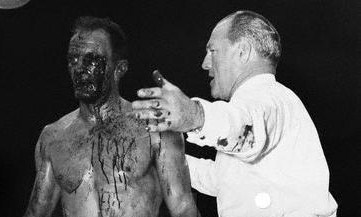


This was Ali’s last fight before he challenged Sonny Liston for the World heavyweight title. Facing the determined British champion, Henry Cooper, Ali  (who was still calling himself Cassius Clay at this point.) Ali toyed with Cooper for much of this fight, cutting him badly in the 3rd round, but then near the end of the 4th, a Cooper left-hook caught Ali and dropped him to the canvas by the ropes. Ali beat the count, but was visibly groggy, only to be saved by the bell. When the bell rang for the 5th the crowd was in uproar, believing that Cooper was on verge of a huge upset win over the young sensation. However Ali showed his tremendous powers of recuperation, and launched a vicious assault upon Cooper, sending several punches into the already badly cut Cooper left eye, until it was pouring blood all over the ring.   With Cooper blinded by his own blood and on the verge of being defenceless, the referee was left with little choice but to stop the fight in Ali’s favour, giving Ali a 5th round TKO win. Prior to the fight Ali had predicted that he would beat Cooper in 5 rounds.  


13. Muhammad Ali Vs Karl Mildenberger:  September 10, 1966, Wladstadion, Frankfurt, Hessen, Germany.


Making the 6th defence of his world title, in his first reign, Ali found the tough and clever Mildenberger to be a tricky opponent. The German was the first southpaw to challenge for the World heavyweight title, and made good use of his awkward stance.  Ali, who was approaching his physical peak at this point, showed an impressive mix of speed and physical strength and slowly broke down his determined challenger.  Mildenberger was floored in the 5th, 8th and 10th rounds, and the referee finally stopped the contest in the 12th round to save the German from further punishment.


14. Muhammad Ali Vs Zora Folley: March 22, 1967, Madison Square Garden, New York, New York. 


In what was to be his final fight before he was stripped of his world title and banned from boxing for over 3 years, Muhammad Ali made the 9th defence of his world title against the clever and experienced Zora Folley. Having been carefully avoided by previous world champions, Folley tried to make the most of his chance against Ali, and started their fight well, landing some good right hands on Ali, while also making Ali miss with his own punches. Yet the champion was taking his time rather than struggling, and when he opened up in the 3rd round, his superiority in strength and speed was visible. In the 4th round, Ali floored Folley heavily and the challenger barely beat the count. After playing a bit more with his challenger in the 5th, Ali finished things in the 6th round with two short rights. This fight showed Ali becoming increasingly stronger as he matured, and this rare mix of speed and power already had people comparing him to the all time heavyweight greats of the past.


15. Muhammad Ali Vs Doug Jones:  March 13, 1963, Madison Square Garden, New York, New York.


Having just his 18th professional contest, Ali faced the toughest opponent of his career so far in the tough and experienced Doug Jones. In a fight, which was one of the toughest of his career, Ali found Jones to be a very tough nut to crack. Ali was caught and rocked by Jones several times in the fight, but replied with hard jabs and lightning combinations. At times, Ali showed his inexperience in this fight and his speed based fighting style was still not fully realised. Jones seemed the stronger fighter at times and on occasions bullied Ali, but Ali showed that he had grit and durability by standing up to the more mature Jones and fighting back. With the fight poised Ali as (he would so often in his career) staged a brilliant finish, out-punching Jones over the last couple of rounds to come out a clear winner after 10 exciting rounds.  This fight would prove to be valuable experience for the still developing Ali.


Follow us on Twitter: @TheBoxingGlove and  


If you are an athlete and want us to follow you or tell your story, contact petersilkov@yahoo.com   or theboxingglove@yahoo.com
If you are an author and you would like your book reviewed, contact Peter Silkov at petersilkov@yahoo.com or theboxingglove@yahoo.com


Thursday, June 9, 2016

Muhammad Ali Funeral: Saying Goodbye to the Greatest


Today the world said goodbye to what many believe was the greatest boxer to ever fight in the squared circle, Muhammad Ali. Muhammad Ali’s funeral was held in Louisville, Kentucky.
 

The procession started later than scheduled and traveled through Louisville. Crowds gathered along the streets and blanketed the funeral procession with flowers and chats of "Ali, Ali, Ali!" The young, to the old, lined the streets of his hometown, sending off The Champ in a display of love and gratitude that left the observer speechless. Family, friends, and fans gathered at the KFC Yum! Center in Louisville, which holds 22,000, at 3:00 p.m ET for a memorial service. Billy Crystal, President Bill Clinton, and Bryant Gumbel delivered the eulogies. Lonnie Ali and daughters, Maryum, and Rasheda spoke for the family. There were clergy from many religions who spoke at the very inspirational and stirring memorial to Muhammad. Especially moving was Rabbi Michael Lerner who brought the crowd to their feet with a fiery speech:

"That means us, everyone here and Everyone listening. It’s up to us to continue that Ability to speak truth to power. We must speak out, refuse to Follow a path of conformity to The rules of the game in life. We must refuse to follow the Path of conformity. Tell the 1% who own 80% of the Wealth of this country that it’s Time to share that wealth. Tell the politicians who use Violence worldwide and then Preach nonviolence to the Oppressed that it’s time for Them to end their drone warfare And every other kind of warfare, To close our military bases Around the world, to bring the Troops home. Tell those who invented mass Incarceration that it’s time to Create an — a living income for Everyone in our E.E.O. Tell judges to let out of prison The many African-americans swept Up by racist police and Imprisoned by racist judges."

Read full sermon here:  http://screengrabber.deadspin.com/rabbi-michael-lerner-brings-down-the-house-at-muhammad-1781776788

The collective lesson that can be learned from watching  Muhammad Ali's memorial is that....we all need to be Ali now.


Watch Funeral Procession Here:  


The Beginning

Muhammad Ali, who was born Cassius Marcellus Clay, Jr.  named after his Father Cassius Marcellus Clay, in Louisville, Kentucky, on January 17, 1942. He grew up in a time of racial segregation. His experience, along with his brother, Rahmon, and other family would shape Muhammad’s controversial life forever. At  12-years-old, the young Clay would have a chance meeting with a man that would change his life forever.

Joe Elsby Martin Sr. was the man who started Muhammad Ali on his path to fame, glory, and as one of the greatest fighters that the ring has ever seen.  Martin was a Louisville, Kentucky police officer who coached amateur boxing at Louisville’s Columbia Gym.  Muhammad Ali’s first encounter with Martin has become legendary. It happened when he was 12 years old and went to Martin to report the theft of his new bicycle.  When Ali (then just Cassius Clay) said that he wanted to “Whup” whoever had stole his bike, Martin suggested that Clay come down to gym and learn how to fight properly. The rest is history. Joe Martin guided Ali’s amateur career all the way to him gaining a gold medal in the 1960 Olympic games. 

Although Angelo Dundee would coach Ali during his professional career, he would stay in contact with Joe Martin for the rest of Martin’s life.
Despite all of his personality and talent, Ali was also blessed to appear at just around the right time to become a star in boxing and the sporting world in general. When he first emerged during the early 1960s boxing, especially the heavyweight division was crying out for a new star; a dash of lightning to light up both the heavyweight division, and the sport itself.  Ali became that star, as he amused, amazed, fascinated, and outraged both the fans and the media in equal measure. Then, after he had been banned from fighting for almost 4 years, due to his refusal to go to Vietnam, Ali came back to the ring in the early 70s to discover a heavyweight division that was enjoying an explosion of talent that was unprecedented in the history of the division.  With the return of Ali, the heavyweight division enjoyed what is fondly referred to as a ‘golden age’ for the rest of the 1970s.

Pro Debut 


On October 29, 1960, Muhammad Ali had his first professional fight. Then known as Cassius Marcellus Clay, Ali was already on the road that would lead him to become in many peoples eyes, not only the greatest heavyweight boxer of all time, but the greatest sportsman, and sports personality of the 20th century. The press was already noticing Ali. He had been a brilliant amateur, and had won the Light-Heavyweight Gold Medal at the 1960 Olympic Games, but he was also gaining attention for his charismatic character, which included reciting his own poetry, and telling anyone who would listen that he was destined for greatness.

Ali’s opponent for his 1st professional contest was a Tunney Hunsaker, a tough 30 year old journeyman who had recently gone the distance with top contenders like Bert Whitehurst, and Ernie Terrell. Hunsaker was chosen as someone who would give Ali some rounds to show what he could do in his debut, without posing too much of a threat for the still only 18 year old Ali. The fight was staged in Ali’s hometown of Louisville, Kentucky, at the Freedom Hall State Fairground. Ali got his work out. Weighing 186 pounds to Hunsaker’s 192 pounds, Ali was taken the full 6 rounds by Hunsaker. Ali dazzled spectators with his speed and mobility, as he danced around the ring, and fired combinations that displayed his blazing hand speed. By the end of the 6 rounds, he had bloodied Hunsaker’s nose and cut his eye, which was almost swollen shut. 

“He’s awfully good for an 18 year old and as fast as a middleweight” said the battered Hunsaker after the fight.

It was just the beginning of a long road for Ali, a road which would lead him to becoming a legend. Tunney Hunsaker became the first step upon that road, and his name will forever be part of boxing history because of it.


Tunney Hunsaker did make the national news once more during his boxing career.  In April 1962, just 16 months after he had fought Ali, Hunsaker was knocked out in the 10th round by Joe Shelton, and after being knocked out he collapsed into a coma. This fight took place barely two weeks after the tragic Emile Griffith vs Benny Paret World welterweight title fight, which ended with Paret collapsing into a coma.  Paret had died just 3 days before Hunsaker’s fight with Shelton. For a while, it looked as if Hunsaker would be following Paret. After having a number of operations to remove a blood clot from his brain, and ease the pressure in his head, Hunsaker finally pulled through and began to make full recovery, though his boxing career was now over.

In time, Hunsaker was able to return to his job as a police chief in Fayetteville, West Virginia, and lived a normal productive life until he was struck down with dementia sometime before his death in 2005 at 75 years old.

In later years, Hunsaker would meet up regularly with Ali, when ‘The Greatest’.was in town for personal appearances.  Ali always remembered the first man to cross gloves with him as a professional.

World Heavyweight Championship
When Muhammad Ali defeated Sonny Liston for the World heavyweight championship, and almost over night, changed the whole fabric of the boxing game.  No one had ever seen anything quite like Cassius Clay, as he was known then.  He was brash and arrogant in a manner akin only to the legendary Jack Johnson, the first coloured Heavyweight champion of the world, who reigned from 1908 to 1915. Johnson was somehow lucky enough to avoid assassination along the way, despite the depth of animosity felt towards him by white America.

Cassius Clay was no Joe Louis, who was quiet and thoughtful verbally, careful not to antagonize or put a foot wrong in public.  Clay never stopped talking. Unlike Johnson, Cassius had the gift of making people laugh.  He was able to launch into a diatribe of what he would do to his next opponent and in what round, and yet, say it with a twinkle in his eye and a smile not far from his face.  Then there was the poetry, delivered with a deadpan solemnity, which would have done many a comedian proud.

“The Louisville Lip” could walk the tightrope between outrageous arrogance and ridiculous clowning, while making people both laugh and admire him at the same time. Perhaps most important of all, was that as his professional career progressed this lippy young man showed that he could walk-the-walk along with all of his talk.
     
Sonny Liston was different and the general opinion within the boxing world was that the former convict, now World Heavyweight Champion, was invincible.  While views on Liston ranged from, a kind of righteous repugnance to outright awe, all agreed that the hulking champion was a human wrecking machine who would reign as World Heavyweight Champion for a long time.  Clay’s own management didn’t believe he could win and only agreed to let him go ahead with the fight at his continued insistence.  Cassius had been floored in previous fights by Sonny Banks and Henry Cooper, so the general consensus was how could he possibly survive the bombs delivered by Sonny’s huge hands?  The same bombs that had blitzed Floyd Patterson twice in the one round!

On fight night, when the forty-six attending sportswriters were polled on whom they picked to win, forty-three picked Sonny.  Considering the atmosphere surrounding the match, perhaps the surprise should be that three writers actually picked Cassius to win.


Clay had tried to get inside the champions head in the run up to their match, constantly taunting and ridiculing Sonny in the manner which would become Muhammad Ali’s trademark in later years.  It was good publicity, but Clay also felt it was good psychology. Clay knew that Liston wasn’t afraid of him, but believed he might be afraid of ‘a nut’. At the medical and weigh-in for the fight, with just hours to go before their clash, Clay worked himself into a frenzy.  His blood pressure when taken was 200 over 100 and his heart rate was 120 per minute.  The doctor examining him declared that the young man was ‘scared to death’. Years later Ali would say that the scene was just another part of his act and a ploy to make Liston believe that he was going into the ring with the most unpredictable of opponents…a crazy man.

When the two men stepped into the ring that night on February 25, 1964, at the Miami Convention Centre, both seemed to be calm and Liston had his normal baleful expressionless look upon his face.  Perhaps after a life often walked upon the dark side it would take more than Clay's comical histrionics to shake Sonny from his solemn belief that he was about to give this upstart the beating of his life.

Over the years many have gained the mistaken belief that Sonny Liston was a lumbering muscle bound plodder of a fighter, with great power but little speed or technique. A fighter who was rendered ridiculous on the night he lost his title to Cassius Clay.  The truth is that Liston was a smooth and fluid mover in the ring and had remarkable hand speed for a fighter of his size and build.  He also had one of the best and most powerful jabs ever seen in the division’s history.  Sonny’s jab was swift and accurate, and numbing.  It was these attributes, allied with his innate strength and power that helped make Liston such a formidable and frightening destroyer in the ring. On this night however, Liston was facing a man with freakish speed for a heavyweight.  Cassius was akin to being a 210 pound Sugar Ray Robinson.  Furthermore, in addition to his speed, Liston would find that Cassius could also match him for strength.


As the dethroned ex-champion sat slouched on his corner stool, the new champion Cassius Clay, soon to be Muhammad Ali, did a victory dance in mid ring. He rushed round from corner to corner, his mouth wide open, proclaiming “I am the greatest, I am the greatest, I shook up the world, I shook up the world!” Cassius Clay proved that night that he was no joke or fraud and gave us the first glimpse of the greatness to come.  He was to be an extraordinary champion who would achieve some of his greatest victories when he was already losing the fantastic speed and reflexes that helped him defeat the ‘invincible’ Sonny Liston.  That night he told us he was great and for the first time, we began to listen.

Rumbled In The Jungle
 
The world was witness to possibly the most bizarre, fantastic event in the long and colourful history of the sport of boxing. The event took place in a 19- foot ring, set up at the 20th of May Stadium in Kinshasa, Zaire, which was surrounded by a crowd of about 62,000. At the center of it all was Muhammad Ali, who inside that 19-foot ring square that morning, at just the break of dawn, performed the most extravagant and outrageous feat of his career, by beating a man whom most had believed would not only defeat him, but destroy him. There had been those, in the run up to Ali’s challenge of George Foreman, who had feared for Ali’s health and his life, against the rampaging destroyer that was George Foreman.


This was the fight that Ali was supposed to lose. Many watching it that night, either in the audience or in one of the numerous closed circuit theatres that were broadcasting the fight all around America and Europe fully expected this to be the last fight of Muhammad Ali’s career. Most people believed he would give it his best show his great heart, and some flashes of his former brilliance. But, then he would tire and Foreman would catch him, or else Foreman might even catch him before he tired, either way, few saw the fight lasting the distance, and that meant only one thing; a punishing knockout or stoppage defeat for “The Greatest.” 

Despite his amazing career up until that point, all expectations were that Ali was heading towards his doom in Zaire.

One of Foreman’s own trainers, Archie Moore, the former World light-heavyweight champion, who had been knocked out in 4 rounds by a young and skinny Ali (then Cassius Clay) in 1963, would later say that he had prayed for Ali’s well being before the contest, fearful that he could be killed. Foreman’s physical strength and punching power was such that he was known for wrecking punching bags in the gym, hitting them with such force that they would be torn savagely from their metal moorings.

Even Howard Cosell, the commentator with whom Ali had formed almost a double act with, and who had a genuine affection for The Greatest, gave Ali no chance against Foreman, saying on a pre-fight show that the match represented Ali’s ‘Last supper.’

Perhaps one of the biggest ironies of this contest was the similarity between Foreman and Sonny Liston, who a young Ali had won the world title from in 1964.  Liston had actually been Foreman’s idol and the two had sparred together when Foreman was just starting out on his professional career. Like Liston, Foreman was a brooding character, who built up a fearsome image both inside and out side of the ring. He was a dark force of destruction, just like Liston had been before him, and the media was already calling him unbeatable and invincible.

Yet, the comparisons between Liston and Foreman were not seen as good news for Ali. It had been a decade before when Ali had beaten Liston, with his mercurial speed and skills, when he was a fresh and a hungry 22-year-old. Those ten years included 3 and a half years when he had been banned from the ring for refusing the draft call up for Vietnam. Three and a half years in which he had lost his peak, where time and idleness had rusted up his marvelous speed and skills.

On his return, Ali was still ’great,’ but he was no longer as great as before. Joe Frazier had beaten him in 1971, as Ali struggled to jab and dance for 15 rounds, as he had been able to in the past. The speed and reflexes never came totally back for Ali and at times, he seemed to be almost an imitation of his former fighting self. 

The Greatest had racked up 13 victories in the three years since the Frazier defeat, but there was also the loss to Ken Norton. Although Ali had avenged it six months later, and followed this up with a revenge victory over Frazier, a broken jaw had accompanied the loss to Norton. The man who once had been so hard to hit was getting hit regularly now, and hard.

Ali’s victories over Norton and Frazier were almost workman-like when compared to Foreman’s own performances against the same two men. While Ali had gone 27 rounds with Joe Frazier and 24 rounds with Ken Norton, George Foreman had simply destroyed both men in 2 rounds each. When Foreman had won the world title from Frazier he had floored “Smoking Joe” six times in 2 rounds and he had knocked Norton clear of his senses also in the same time. 

So how could even “The Greatest” prevail against such a fighter! 

Originally scheduled for September 25, 1974, the fight was delayed for over a month when Foreman was cut beside the right eye by the elbow of sparring partner Bill McMurray. The delay just added to the anticipation and tension of the occasion. With people torn between hoping to see something truly special and historic from The Greatest, but fearing that they were about to watch his nadir.


The fight was postponed until October 30th, and Foreman seemed to be getting meaner by the day in training, his habitual beating upon his sparring partners reaching new heights. While Ali was visibly loved and feted wherever he went in Zaire, the brooding champion, Foreman, was a man apart. 

By the night of the fight the atmosphere had entered the surreal. The fighters entered the ring at around 4 am in the morning in order to facilitate American TV coverage.  Both fighters would be receiving 5 million dollars, in a promotion that had been coerced and manipulated from start to finish by Don King, in what was his first major promotional venture. He had even managed to get Zaire’s murderous president Mombuto Secko on board. Seldom has a World heavyweight title fight had a darker host.


Almost from the start of the fight it became clear that Ali was supported by 90% of the crowd. The crowd that was made up of a large portion of native Congolese, and a selection of European and American members of the media, and celebrities who had come along for the ride.

Upon entering the ring, Muhammad Ali seemed to be the most relaxed person in the stadium that night, certainly more relaxed than his stone-faced corner and the blank- eyed world champion, whose unblinking stare spoke volumes for his intentions. 

As the anthems were played before the start of the contest, Ali mocked and taunted Foreman, whose expression never changed. Those watching Ali’s antics wondered if his humour was that of someone with real confidence or the bravery of someone heading towards the gallows.

At the first bell, Ali sprang his first surprise of the night! Instead of running, instead of moving away around the ring, he went right at Foreman, firing a right hand that seemed to surprise the champion, and then spearing Foreman with a flow of lefts that seemed to find the champion’s face with surprising ease. Foreman came forward menacingly; landing to Ali’s body and driving him into the ropes momentarily, but Ali came off the ropes and retook the center of the ring. Instead of running, Ali was taking the fight to Foreman, while moving side-to-side to avoid the punches coming back his way. Between rounds Ali winked across the ring from where he sat in his corner, with the air of a man who was just beginning to enjoy himself. Just before the start of the second round the crowd began to chant ‘Ali Bomaye’ (Ali kill him.) 

In the second round, Ali seemingly abandoned his plan of taking the center ring and allowed himself to be bulled onto the ropes by the champion, where he covered up and leaned back, as Foreman swung furiously with both arms, as if he were trying to chop down a tree.  Now and then Ali would strike back with some sharp jabs and straight right hands that would land flush in Foreman’s face, and then he would go back onto the ropes, as his corner screamed for him to move. By the third round the fight had formed a pattern, despite the exhortations of his corner, Ali was seemingly content to go onto the ropes and cover up, while Foreman belabored him with punch after punch, swing after swing.  Many punches were blocked by Ali’s arms or slipped, as he twisted and leaned back far on the ropes, but some were getting through, and when they landed, with audible thuds, those at ringside gave audible gasps.
Yet, just when things seemed to be getting totally one-sided, Ali would come back with punches of his own, sharp lefts, and heavy lead rights that were catching Foreman flush in the face.

This was the rope-a-dope, something that Ali would later say that he first developed in training when he was tired, laying on the ropes and daring his sparring partners to hit him as much as they could. It was an almost masochistic method of getting himself beat into shap.


The fourth followed the same pattern as the third, with Ali laying on the ropes and seemingly taking punches which no other man had ever stood up to before. All the while he was talking to Foreman, ‘Is that all you got! They told me you could punch George!’ 

When struck flush, Ali would hold momentarily and wrestle with Foreman, while sharing his head at the crowd to assure them (and himself) that he wasn’t hurt. 

By the 5th round it was clear something strange was happening. Foreman’s face was starting to mark up from Ali’s punches, and more worryingly for the champion; he was starting to show visible signs of fatigue and frustration.  No one had ever taken his punches like this before, instead of destroying Ali with his punches, it was almost as if with every punch he landed or tried to land on Ali, he was losing a little more of his strength. Now, when Ali landed his own little retaliatory flurries, Foreman was visibly wobbling under the punches. And the crowd continued to cry “Ali Bomaye, Ali Bomaye!”

In the sixth round, Ali stayed off the ropes for much of the round, instead circling the outside of the ring and jabbing. Foreman was still in pursuit and throwing punches whenever he was in range and even when he wasn’t, but now the punches were weary and becoming more and more uncoordinated.  It was now Ali who was beginning to land the better more telling punches.

With hindsight the writing was on the wall for Foreman by the seventh round, but those watching the fight could still barely understand or believe what was unfolding before their eyes.  The seventh saw Foreman reduced to pushing out his punches, as he stumbled after Ali like an exhausted drunk. Ali’s punches were cruel and calculated, as they crashed in increasing volume into Foreman’s swelling face and head.

Ali came out with a determination to finish things in the 8th round, with added purpose in his punches, and he was now the aggressor. Foreman was still coming forward, but his attacks had been reduced to a blind stumble, by exhaustion, and the steady battering from Ali’s punches. When Ali got caught on the ropes, the punches seemed to be bouncing harmlessly off of him, and it was his own counters that were having the most effect at this moment.


The finish came in the final moments of the 8th round. A left right combination sent Foreman down with a heavy flop onto the canvas, where he lay in an exhausted daze as the referee Zack Clayton toiled out the count.  At ten, Foreman tried to rise, but his strength was gone; the butterfly had drained all the strength from the invincible giant

Ali was the World heavyweight champion again, and he had regained his title by turning his style onto its head, from being the elusive target, to being a sitting target.  Ali’s performance must rate as one of the greatest single performances by a boxer in ring history. His ability to adapt his style and find a way to win, even when physically out-gunned, and the ability to beat his opponents both mentally and spiritually in the latter part of his career, is as much part of Muhammad Ali’s greatness as his youthful speed and skills.

Later on, even Ali would push on for too long, beguiled by his own greatness into thinking he could outbox time and the laws of nature. 

Six years after he beat Foreman in Zaire, Ali foolishly came out of a two year retirement and was battered and beaten to defeat by Larry Holmes in Las Vegas, in a fight of almost eerie sadness. 

Yet, the realization in the dying years of his career that Ali was after all only human serves only to heighten the depth of his career achievements. Here is a man who dominated the most talented heavyweight division that has ever been seen, at a time when he himself was well past his own physical peak. 

However, on one particular moonlit morning in Zaire, Muhammad Ali was indeed indestructible, superhuman, and magical.

Muhammad Ali will be buried at Cave Hill Cemetary in Louisville.


Muhammad Ali Funeral - Janazah (Jenazah) Muslim Prayer Service in Louisville, KY. June 9th.


Copyright © 2016 The Boxing Glove, Inc. Peter Silkov Art. All Rights Reserved.
  ‪
#‎BoxingNews‬ ‪#‎TheBoxingGlove‬ ‪#‎TheBoxingGloveNews‬ ‪#AliFuneral #MuhammadAli ‪#‎Boxing‬ ‪#‎Boxeo‬   #TheBoxingGlove  @TheBoxingGlove #CassiusClay  @TheGreatest