Showing posts with label ali. Show all posts

Thursday, October 19, 2017

On This Day: Willi Besmanoff Remembered


By Peter Silkov


Willi Besmanoff was a tough and game heavyweight boxer, who fought many of the division's top fighters during the 1950s and 60s. Born William David Besmanoff, on October, 4, 1932, in Munich, Bayen, Germany. Besmanoff was of Jewish heritage, and at the age of 11 years old, he was imprisoned in a concentration camp in Buchenwald, Germany. His salvation was that his mother renounced her Jewish faith and converted to protestant. At 13 years old, Willi worked at a bakery, where his boss suggested he take up boxing.

Besmanoff turned professional in 1952, beginning his career as a light-heavyweight, but moving up to heavyweight by the late 50s. In 1956, Besmanoff would move to America, where he would have many of his fights. Besmanoff fought fighters such as Alex Buxton, Bob Baker, Archie Mcbride, Alex Miteff, Yvon Durelle, Roy Harris, Willie Pastrano, Pat McMurty, Archie Moore, Harold Carter, Mike Dejohn, Zora Folley, Eddie Machen, Sonny Liston, Tom McNeely, Marty Marshall, Howard King, Pete Rademacher, Alejandro Lavorante, Muhammad Ali, Bob Foster, Amos Johnson, Dave Zyglewicz and George Chuvalo.

Willi never became a top contender or gained a world title shot, but he had the reputation as a very tough, value for money fringe contender, who always gave his all in every fight.

Besmanoff’s final fight came on August 1, 1967, when he was stopped in 3 rounds by Dave Zyglewicz. Besmanoff retired with a final record of (51-34-8, 19koes).

Besmanoff, who learned to bake when he apprenticed at a bakery, would go on and open several bakeries around the U.S.

Willie Besmanoff died on October 20, 2010, aged 78 years old.


Follow us on Twitter: @TheBoxingGlove and  
Facebook: www.facebook.com/theboxingglove

If you are an boxer, amateur or professional, and want us to follow you or tell your story, contact petersilkov@yahoo.com   or theboxingglove@yahoo.com

If you are an author and you would like your book reviewed, contact Peter Silkov at petersilkov@yahoo.com or theboxingglove@yahoo.com

Sunday, March 12, 2017

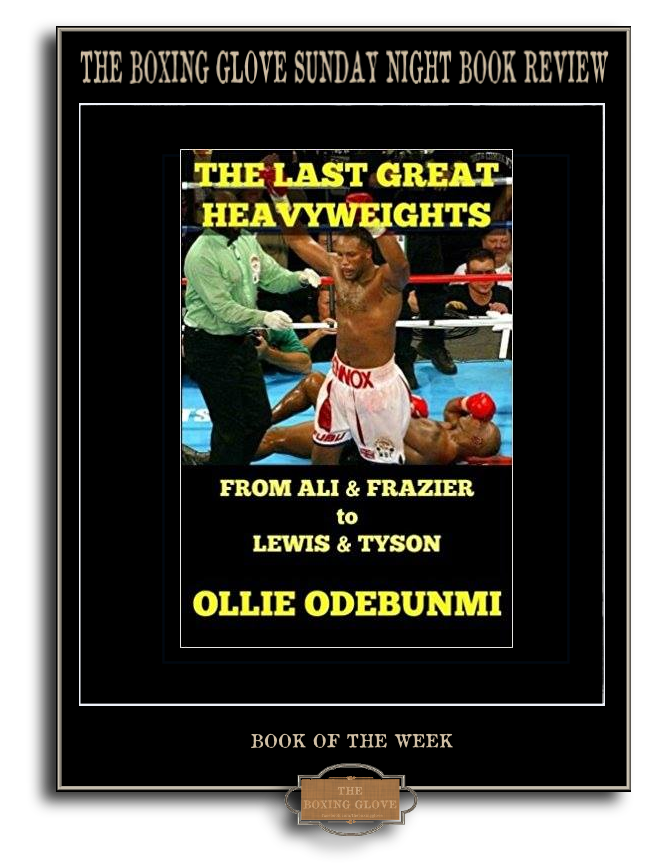
TBG Book Review: The Last Great Heavyweights

The Boxing Glove Sunday Night Book Review

By Peter Silkov

"The Last Great Heavyweights: From Ali & Frazier to Lewis & Tyson 

Written By Ollie Odebunmi 


It’s fair to say that no other weight division in boxing carries such a weight of historical significance and mythology as does the heavyweight division. From both, the physical to the spiritual level, the heavyweights have always held the greatest allure for the sporting public. In years gone by, the heavyweight champion of the world was an instantly recognizable figure, even amongst those who did not follow the sport of boxing. While it might be true that the fighters of the lighter weights are the better boxers, pound-for-pound, compared their larger counterparts, and often provide the better action between the ropes, it is the heavyweights who have always held the highest profile within the sport. In it’s greatest moments, the heavyweight division’s champion has held the highest profile of all sportsmen, and the world heavyweight championship was recognized as one of the most prestigious titles throughout all sport.

Sadly, though, things aren’t what they used to be. Over the past two decades’ multiple world titles, combined with a drought of talent, and a lack of competitive big fights, have seen the heavyweight division’s aura as the most important division in boxing slowly fade. The champions who were once so visible have become more and more obscure and unknown. In America, formerly the home of the division throughout most of the 20th century, the heavyweight boxer has been on the verge of extinction. Part of this is due to the division being steadily taken over by Europeans and Eastern Europeans since the mid-90s. Since the retirement of England’s Lennox Lewis in 2004, the division has largely been ruled by Vitali and Wladimir Klitschko, both of whom, despite their undoubted athletic and technical gifts, largely failed to capture the imagination of the boxing public, outside of their adopted country of Germany. 

The result is that the heavyweight division, once the most magnetic in boxing, has become a hollow entity, operating to a growing indifference of the public, and even the die-hards of the boxing establishment.

Photo: Skysports
However, there was a glimpse of hope in the past couple of years with the retirement of Vitali Klitschko, and the rise of a new generation. In America, Deontay Wilder has sparked a new flicker of interest in what was formerly the countries favourite division. In England, Tyson Fury and Anthony Joshua, two very different men, and very different fighters, have led what might still be the beginnings of a new and brighter era for the division. When Fury defeated Wladimir Klitschko in November 2015, it seemed as if the division had found a new champion whose quirky, and sometimes controversial charisma, could bring more attention and excitement to the moribund division. Unfortunately, Tyson’s subsequent out-of-the-ring issues have seen him give up his world titles, as his career has gone off the rails. The result of Fury’s problems has been that the World heavyweight title has once again become a fragmented and devalued article, with several fighters claiming a ‘world’ title at the weight. While the upcoming match between Anthony Joshua and Wladimir Klitschko is undoubtedly a move in the right direction, the fact remains that the heavyweights of today have a long way to go before they can restore the division to anything like it was in the glory years.


Photo: Ali instagram
In “The Last Great Heavyweights: From Ali & Frazier to Lewis & Tyson," Ollie Odebunmi takes us back to when the heavyweight division still carried its weight in excitement and talent, and produced epic world class encounters on a regular basis. Fights that have become part of boxing history. Perhaps the measure of how hypnotic the sport’s heaviest division has been, at its best, can be seen in how the history so easily intertwines with the lives of those following it. Ollie takes us on a journey from the heavyweight division’s greatest era of the 1970s, down to the close of Lennox Lewis‘ career. Ollie’s own fascination with boxing, and primarily the heavyweights, began in 1971, when he watched Joe Frazier defeat Muhammad Ali, in their never to be forgotten first encounter. This fight sparked a fascination with both the sport of boxing, and especially the heavyweight division, which has stayed with Ollie Odebunmi to this day.

The 70s have often been called the division’s golden era, and Odebunmi illustrates why with a deft recollection of the rivalries between Muhammad Ali, Joe Frazier, George Foreman, and Ken Norton; as well as a host of other names from that time.  This is a very personal book, with Odebunmi placing the classic encounters of these great fighters into the context of his own life at that time. We experience, through Ollie’s eyes, as these great fighters defend, lose, or regain the richest prize in the sport. 

As well as reliving his own personal circumstances when witnessing these often-epic encounters, Odebunmi gives some great insights into the inner world of these various fighters, including his views on what is happening beneath the surface in these fights.  We are reminded that boxing is as much a mental endeavor as it is physical. Ollie is a man who understands fighters and has a good feel for both, the athletic and psychological aspects, of the sport.


As the era of Ali and Frazier fades, we meet Larry Holmes, and then, Mike Tyson.  ’Iron Mikes’ rise and fall is expertly recollected by Odebunmi. As is the rise of Evander Holyfield, Riddick Bowe, and Lennox Lewis. As we enter the late 80s, and then the 90s, we can see the gradual tarnishing of the sport’s most valuable prize. The world title begins to regularly splinter into multiple champions and top level showdowns become an increasing rare event.

Photo:Newsday
Odebunmi does a good job of intertwining the stories of Tyson, Holyfield, Bowe, and Lewis. We have Tyson’s almost Shakespearian story of triumph and defeat, his rise and fall in the 80s and early 90s, followed by his return and then yet another, even more devastating, fall from the top. Then there is the indomitable Evander Holyfield, defying expectations again and again, and the brief brilliance, and wasted promise of Riddick Bowe. Lennox Lewis’s determined rise to the top is told with some good insight from Odebunmi, as we see Lewis develop from a seemingly unremarkable young professional, into the undisputed world champion. 

Photo: Boxrec
The climatic fight of “The Last Great Heavyweights: From Ali & Frazier to Lewis & Tyson"  is Lewis’s demolition of a faded Mike Tyson, in what was to be the pinnacle of his career. Lewis would have one more fight, his brutal and bloody victory over Vitali Klitschko, before he chose to walk away from the sport while still undisputed champion. What has followed in the division since has, unfortunately, been largely forgettable. This is illustrated by Odebunmi’s brief sketch of the decade following the retirement of Lewis.

Odebunmi does mention Anthony Joshua briefly in the closing pages of this book.  At this point, Joshua had only just turned professional. Armed with an Olympic gold medal, and had fought only once, but already had shown the kind of raw promise, which followers of boxing’s one time greatest division are always searching to find.

Weighing in with 302 pages, “The Last Great Heavyweights: is a fast-moving and entertaining read by someone who has a great ability to transfer his insight and enthusiasm for the subject into his writing. While some photos would have been nice, their absence should not be a deal breaker. This is an excellent book for anyone who has any interest in the golden days of the heavyweight division, whether you want to read about Ali, Frazier, Foreman, Tyson, and Holyfield for the first time, or else relive the past through Odebunmi’s own personal experiences. Don’t be surprised if you find yourself digging out your old copies (or going to You Tube) to re-watch some of the great encounters that occurred between these fighters. Odebunmi has recalled an era that is unlikely ever to be matched, let alone surpassed. It was a time when the heavyweight division genuinely was the ’heaviest’ division in boxing. Alas today, it is the heaviest only in physical weight, rather than world class substance. 

Yet, we can always hope for a better future.


Ollie Odebunmi has his own website:  www.ollieodebunmi.com and can also be reached on two face book pages.  www.facebook.com/ollieodebunmiauthor and www.facebook.com/fightgamelegends  


Follow us on Twitter: @TheBoxiongGlove and 


If you are an author and you would like your book reviewed, contact Peter Silkov at petersilkov@yahoo.com or theboxingglove@yahoo.com


Copyright © 2017 The Boxing Glove, Inc. Peter Silkov Art. All Rights Reserved.


Wednesday, September 30, 2015

A Thrilla In Manila: A Fight of a Lifetime...40 Years Later


 A Thrilla In Manila: A Fight of a Lifetime...40 Years Later
By Peter Silkov


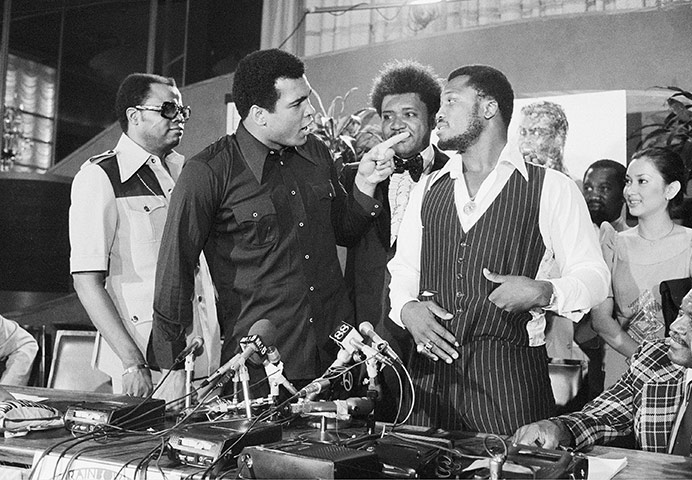
The history of boxing is colorfully littered with a multitude of rivalries between fighters who have fought each other numerous times. This is the lifeblood of boxing, the point where the hardest game reaches its boiling point. No other sport can match boxing for the intensity that is produced between two boxers who are about to fight.  Only boxing creates that unique mixture of soap opera and brutal theatre. It is the most brutal and real drama in sport. 40 years ago today saw the third and final installment of perhaps the most acidic and explosive rivalry that has ever graced the heavyweight division. The final clash between Muhammad Ali and Joe Frazier displayed boxing at both its most beautiful, and its most brutal.

Often called the sweet science, there was nothing sweet about the fights between Ali and Frazier, especially fights 1 and 3. The violence of the blows, which both men exchanged throughout their trilogy, echoed the depths to which their personal rivalry had reached. In the course of 5 years, Ali and Frazier had gone from having a respectful friendship, to one of the bitterest feuds ever seen in boxing. Ali was a master of taunting his opponents, but with Frazier it was different. Perhaps it was because Frazier had taken his world title while he had been banned for his refusal to go to Vietnam.  Perhaps it was because Frazier became the first man to beat Ali in their classic 1st fight on March 8, 1971. Whatever the reason, there’s little denying that Ali saved some of his sharpest and most hurtful insults for Joe Frazier. 

For his part, Frazier, after playing the game at first, began to simmer, stew, and build a genuine anger and hatred towards Ali for the things he had said about him. It was an anger that did not subside, even after he beat Ali in their 1st contest.  With that victory, after a fight that could rightly be declared as the greatest heavyweight contest of all time, Frazier had proved himself to be the rightful world champion. He had beaten the returning king. Yet it was not enough, for either Frazier or the fans. After his greatest career performance, and his greatest victory, Frazier could only watch, as Ali became even more popular with the public in defeat. The bitterness deepened when Ali won their rematch on January 28, 1974, in a fight that while very good, was almost mediocre compared to the two wars within which it was sandwiched on both sides. By their 2nd fight, Frazier was an ex-world champion himself, having lost his crown the previous year to George Foreman.  After he had lost to Ali in their second fight, many people wrote off Frazier as a fighting force.

Ali meanwhile regained the world title in late 1974, with his magical destruction of George Foreman in Zaire. Ali’s and Frazier’s careers seemed to be going in opposite directions now, with Ali enjoying a new lease of life, while Frazier was viewed as a mere shadow of the man who had beaten Ali in 1971.  But, the feud was still burning, and a third fight between the pair was a natural, if only to tie up the loose ends. A boxing rivalry, which ends with one victory for each man is always somehow unsatisfactory, with something unfinished, like a soap opera that had the plug pulled on it before the final episode.

With Ali and Frazier, the final episode of their joint drama would be the most hard-bitten, which is what boxing fans had hoped for, and even more.  It would reach heights of physical violence that would make fans feel both enraptured and disturbed, in equal measure.

The fight was set for October 1, 1975, in Manila, Philippines, before a crowd of 25,000, which would include the Philippine president Ferdinand Marcos. The build up to the fight found Ali firing up more jokes at Frazier’s expense.

“It’ll be a killa, a chilla, a thrilla, when I get the gorilla in Manila” cried Ali numerous times during the build up. 

Frazier on the other hand, was quietly seething with his bitterness against Ali, saying in one interview prior to the fight:

“No question about it, it’s real hatred, I want to hurt him. If I knock him down, I’ll stand back, give him breathing room.  I don’t want to knock him out in Manila; I want to take his heart out."

Behind all the ballyhoo and bluster, Ali and his team really believed that this time around Frazier would be an easy touch. Ali was enjoying the fruits of being world champion once again, and being the most recognized man in the world, and his focus on his training had unsurprisingly suffered. Some of the fruits that become available with success can be bittersweet.  Ali’s focus on the fight was further shaken when his estranged wife Belinda flew over from America to confront him about his mistress Veronica Porsche, whom he was staying with in Manila, and who would soon become his third wife. But, if Ali went into his third fight with Joe Frazier distracted, ‘Smokin’ Joe soon got his attention.

From the start of the 1st round, it was clear that both men meant business. Ali came out flat-footed, throwing bombs, and looking for an early stoppage victory. Both men were a little heavier and slower than in their first fight. As the fight progressed, all pretense of science and skill would be discarded. This was a fight, with each man throwing and landing as much and as often as they could, and each man unable and to a certain extent, unwilling to get out of the way of the other man’s punches.

Standing flat-footed, Ali won the early rounds by landing his bombs on Frazier at will. Frazier was being out-punched and was visibly shaken in the 1st and 2nd rounds.  As the fight wore on Joe kept on coming in, boring his way onto the inside of Ali, where he would realize punches of his own onto Ali’s body, and then switch quickly to his head. With a maniacal grin on his face, Frazier seemed to welcome the punches that Ali was landing upon him, almost as if they were giving him energy to build up his own assault.

By the middle rounds, Frazier was indeed ‘Smokin’, as Ali visibly tired, found himself pressed back against the ropes, and forced to exchange bombs toe-to-toe with a Frazier who was showing that on this night, he was by no means a washed up fighter.     

In the 7th round, Ali tried to get on his toes and fire his jab, but the heat of Manila, along with his 33 year old legs, made it difficult for ‘the Greatest’ to keep away from Frazier’s relentless assaults.

“Old Joe Frazier, why I thought you were washed up” declared Ali during the round.  To which Frazier replied, grimly between punches, “Somebody told you all wrong pretty boy.”

The middle rounds belonged to Frazier, now it was ‘Smoking’ Joe who was out- punching Ali, who was now spending too much of his time pinned onto the ropes, and trying to cover up against punches he couldn’t block or dodge. Frazier was still eating clean shots as he bored into Ali, firing his punches almost frantically at Ali’s body and head. In the 10th and 11th rounds, it looked as if Ali might be through, as he struggled to trade leather with Frazier, and seemed so leg-weary that he was just about to topple over to the canvas under the savagery of Frazier’s attacks. Then in the 12th round, Ali showed why he is very possibly the one and only ‘Greatest’ of all time, certainly at heavyweight. The ability to turn the tide of a fight through sheer guts and strength of spirit, the same kind of spirit that took him to his improbable victory over Foreman. 

In the 12th round, Ali opened up on Frazier with both hands. It was a brutal assault in which Frazier took punch after punch. By the end of the round, his mouth poured out blood and his left eye was closing. In rounds 13 and 14, it was Frazier who looked ready to topple over onto the canvas. Ali was out-punching Frazier once more, somehow finding the strength to fire blistering combinations upon ‘Smokin’ Joe, who despite his continued efforts to fight back, began to look more helpless and more gruesome a figure, with every passing minute.

The 14th round was especially brutal, as Ali landed, at will, upon an opponent who could no longer see the punches coming at him. When the bell rang ending the 14th round, the referee Carlos Padilla had to guide Joe to his corner. Then it was all over.  With just three minutes to go, Frazier’s trainer, Eddie Futch did what he knew Frazier would never do himself. Convinced that his fighter was on the point of being seriously hurt, or perhaps something worse, he threw in the towel, despite Frazier’s protests. Ali, who had at times been at the point of quitting himself during the brutal fight, was the winner, victorious in what must go down as probably the most grueling and savage contest ever waged for the World heavyweight championship. While their first fight featured more skill and speed, mixed with a thrilling violence of its own, their third fight took the gloved violence to a whole new height.

Later, at the post-fight press conference, a battered Ali said of his opponent,

“I have nothing bad to say about Joe Frazier. Without him I couldn’t be who I am and without me he couldn’t be who he is. We’ve been a pretty good team for four, five years.”


Frazier for his part said of his conqueror,

“I’ve seen walls tumble under shots like I gave him.  He’s a great champ.”


It was to be the last great night of both men’s careers, an explosion of superhuman effort from both boxers that afterwards left them both depleted. Frazier would fight just twice more, losing again to Foreman, in an almost surreal fight 8 months later. He then struggled to a draw with Jumbo Cummings in a one off comeback fight 5 years later. Ali would reign as World heavyweight champion for almost another 3 years, but his skills eroded with every fight. But, like his millions of fans around the world, Ali didn’t want the ride to end, and so he stuck around too long and came back too much.

Sadly, the feud with Frazier simmered on, long after both men had finally said goodbye to the ring. After all the punches that Ali landed upon Frazier in their three fights against each other, it was the words that he landed upon Joe that hurt the most. They had the deepest and most lasting effect. Despite efforts by Ali to apologize for some of the things that he said about Frazier and called Frazier, during the height of their rivalry, ‘Smoking’ Joe remained bitter towards Ali until his death in 2011.

It is an unfortunate postscript to a great fight. Sometimes life is not as forgiving as we would like it to be, and wounds collected in the ring can remain with a fighter for the rest of his lifetime. Ali and Frazier created something special with their trilogy, something that will endure perhaps even beyond the survival of the sport from which it emerged. They created something that will endure, but they also lost some parts of themselves along the way.  Perhaps that is the price of greatness.


Copyright © 2015 The Boxing Glove, Inc. Peter Silkov Art. All Rights Reserved. Peter Silkov contributes to www.theboxingglove.com and www.theboxingtribune.com
twitterfacebookgoogle pluslinkedinrss feedemail

Saturday, September 5, 2015

TBG Book Review: Facing Ali: 15 Fighters, 15 Stories


The Boxing Glove Sunday Night Book Review by Peter Silkov
Facing Ali by Stephen Brunt


There can be little argument that Muhammad Ali, in addition to being the greatest heavyweight champion of all time, is also the most famous sportsman of all time. 34 years since his last fight, Muhammad Ali is still the most easily recognized sportsman around the world, even by people who were born long after he had finally retired.

Despite all of his personality and talent, Ali was also blessed to appear at just around the right time to become a star in boxing and the sporting world in general. When he first emerged during the early 1960s boxing, especially the heavyweight division was crying out for a new star; a dash of lightning to light up both the heavyweight division, and the sport itself.  Ali became that star, as he amused, amazed, fascinated, and outraged both the fans and the media in equal measure. Then, after he had been banned from fighting for almost 4 years, due to his refusal to go to Vietnam, Ali came back to the ring in the early 70s to discover a heavyweight division that was enjoying an explosion of talent that was unprecedented in the history of the division.  With the return of Ali, the heavyweight division enjoyed what is fondly referred to as a ‘golden age’ for the rest of the 1970s.

From the start of his professional career, Muhammad Ali’s fights became real life drama’s, that became larger, and more important as his career progressed.  But, while Ali was always the hero of his fights, his opponents would also find themselves thrust into the limelight when facing ‘The Greatest.’  For Most of Ali’s opponents, fighting the most famous man in boxing would become the high-point of their boxing careers. Usually it would be the most financially profitable too, with the aura of Ali guaranteeing most of those he faced during his career the best paydays of their own careers.

There have been innumerable books written about Ali, many of them outstanding. Muhammad Ali has always been an inspirational figure and has inspired some fascinating books dedicated to him.  After all of these years, it might be thought that the material on Ali might have started to run dry. Considering that the present day Ali has been debilitated by his lengthy battle with Parkinson’s disease, and is a much quieter, and less visible figure than he was in his fighting prime.

And yet, the Ali of the past, in his prime, is in many ways as loud and as visible as ever.  Ali and his career is still talked about, analyzed, and reminisced over every day amongst the boxing community.  At a time when most boxing fans cannot name most many of today’s so called ‘world champions’ Muhammad Ali is still a name that sparks recognition and wonder.

In “Facing Ali: 15 fighters, 15 stories” Stephen Brunt takes a new angle in analyzing the career of Muhammad Ali.  Instead of the traditional analysis of Ali, instead, Brunt looks at Ali through the eyes of 15 of Ali’s opponents.  Interviewing each man about his experience both as an Ali opponent, but also as a fighter in general.  The opponents chosen in this book vary from those who achieved a greatness of there own during their careers, to those whose main claim to fame was their fights with Ali.

The opponents of Ali included in this book are Tunney Hunsaker, Henry Cooper, George Chuvalo, Brian London, Karl Mildenberger, Joe Frazier, Jugen Blin, Joe Bugner, Ken Norton, George Foreman, Chuck Wepner, Ron Lyle, Jean-Pierre Coopman, Earnie Shavers, and Larry Homes.

Brunt examines each fighter’s own career, both before, and after their confrontation with Ali, and how their fights with one of the most famous sportsmen in the world affected their own lives and careers.  It is interesting to see the often fascinating stories of these men’s own lives, and how Muhammad Ali has made an indelible mark upon each of them, both as fighters and as men.  A few of these men have fought Ali more than once in the ring, such as Cooper (2 times) Chuvalo (2 times) Joe Frazier (3 times) Joe Bugner (2 times) and Ken Norton (3 times.)

Each man in here has a story to tell, and they are all interesting stories in their own right, some, like Chuvalo’s, are tragic.  Brunt gives his subjects plenty of space to show the true depth of their personalities, and experiences, rather than simply making them into one dimensional cutouts of people, whose only point of interest is the night (or nights) that they crossed swords with Muhammad Ali.

Every fighter here has his own set of memories and views upon Ali. It is a curious aspect of Muhammad Ali’s character that, while he was renowned throughout his career for his often merciless taunting and clowning of his opponents, he did keep in contact, and in many cases, become friends with these men.  Save for the case of Joe Frazier, where a genuine case of animosity seemed to have developed from their meetings as opponents in the ring.

This book is recommended for those who are interested in seeing the boxing career of ‘The Greatest’ from a different and often thought provoking angle.
The most admirable aspect of this book is that Brunt allows these men to express their life stories in various ways that are not simply beholden to their fights with Ali.

First published in 2002, “Facing Ali” is another illustration of the inexhaustible material that exists about the life and fighting career of Muhammad Ali.  This is a new and fascinating angle, which shows us Ali from the perspective of his opposition, and gives us some enlightening anecdotes upon ‘The Greatest.’


Since the publication of this book, Lyle, Cooper, Norton, and Frazier have all passed away, making their contributions all the more poignant.  Once again Ali has upstaged his opponents, by surviving them.

Copyright © 2015 The Boxing Glove, Inc. Peter Silkov Art. All Rights Reserved. Peter Silkov contributes to www.theboxingglove.com and www.theboxingtribune.com
twitterfacebookgoogle pluslinkedinrss feedemail

Sunday, May 10, 2015

The Boxing Glove Book Review: One Punch From The Promised Land

The Boxing Glove Sunday Night Book Review by Peter Silkov
"One Punch From The Promised Land: Leon Spinks, Michael Spinks, and the Myth of the Heavyweight Title"  By John Florio and Ouisie Shapiro

“One Punch From The Promised Land: Leon Spinks, Michael Spinks, and the Myth of the Heavyweight Title" is the story of the Spinks brothers, Leon and Michael, and how they used boxing as a way to escape the life of hardship and poverty that they had both been born into together.

The two brothers, Leon and Michael Spinks,grew up in St Louis, in the notorious Pruitt-Igoe housing project. Leon, born on July 11, 1953, and Michael, born on July 13, 1956, became Olympic Gold medallists together in the 1976 Games, then both would become world champions as professionals. Eventually, the two men would become the first brothers to both win the World heavyweight title, with Leon scoring a famous win over Muhammad Ali in 1978. Michael scored an upset victory over Larry Holmes in 1985, after having held the World light-heavyweight championship for a number of years previously.

Despite their shared triumphs in the roped square, Leon and Michael were two very different men, and two very different fighters, and as their professional careers progressed, their lives, both inside and outside, the ring took very different routes.

While Michael took a steady route to the WBA world light-heavyweight title (which he won July 18, 1981, with a point’s decision over Eddie Mustafa Muhammad). Leon blazed a spectacularly meteoric charge to the World heavyweight championship, which he won with a shocking upset point’s victory over Muhammad Ali on February 15, 1978. Leon had been a professional for just a little over a year, and was having just his 8th professional fight when he beat the legendary Ali.

After beating Ali, Leon became an overnight phenomenon. But if Leon’s rise to the heavyweight title and stardom had been meteoric, his fall back down to the ground would be even more spectacular and ultimately devastating. Within a few weeks of him winning the world championship, the stories coming out from an ever story- hungry press changed, from the complimentary to the critical. It became more clear with every passing day that Leon was overwhelmed by the scale of his achievement and the fame and attention that it had attracted. Soon he was embroiled in a victory party, which would last the best part of the next decade.

Just seven months after his improbable victory over ‘The Greatest,’ an ill-prepared Leon was beaten in the rematch with Ali. It was the start of a long spiral down to almost where he had started. By the time Michael won the WBA world light heavyweight title from Eddie Mustafa Muhammad, in July 1981, Leon was effectively burnt out as a fighter. Ruined by devastating defeats in the ring and a no- holds-barred party life outside of the ring.

“One Punch from The Promised Land” is a fascinating study of how two brothers from the same background react to success and fame in such drastically different ways. Michael, in contrast to Leon, would go from strength to strength. After defending his World light-heavyweight title successfully 10 times, he would then move up to heavyweight, pull off a huge upset by beating Larry Holmes, and winning the World heavyweight championship. He became the first World light-heavyweight champion to successfully move up and win the World heavyweight championship.  He would go on to be defeated just once in his career, by Mike Tyson, in his final fight.

John Florio and Ouisie Shapiro do a great job in this book of peeling back the glamorous façade of the boxing game and revealing the darker, shark-infested elements of the sweet science. We see how in differing degrees, boxing offered both Spinks brothers an escape route from their impoverished childhood, but also a trap. It is a trap that so many boxers fall into at the end of their careers, one that can leave them broken and damaged if they fail to escape from it in time. 

Both Spinks brothers come through this book as courageous and all too human. Leon, for all his mishaps, wild living, and the self-destruction of his boxing career, still achieved the remarkable.

“One Punch from the Promised Land is a fascinating exploration of success and failure, both in and out of the boxing ring. It is especially a fascinating read for all those who want to know what was going on behind the scenes in the heavyweight division during the 1970s and 80s. This book offers a lingering, often unflattering insight into the world of professional boxing, and the fight of two brothers seeking to better their lives by using it.
Copyright © 2015 The Boxing Glove, Inc. Peter Silkov Art. All Rights Reserved. Peter Silkov contributes to www.theboxingglove.com and www.theboxingtribune.com


twitterfacebookgoogle pluslinkedinrss feedemail