
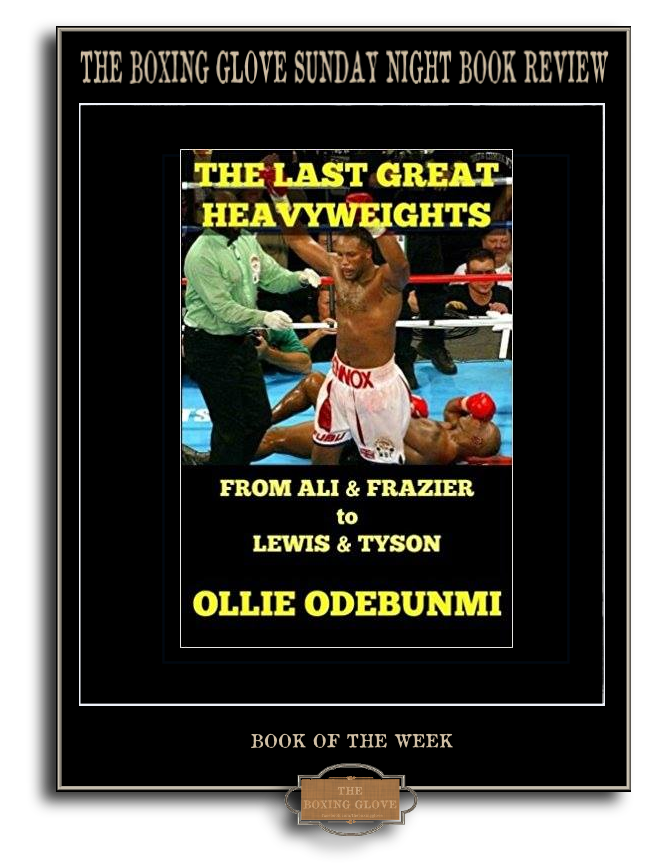
The Boxing Glove Sunday Night Book Review
By Peter Silkov
By Peter Silkov
"The Last Great Heavyweights: From Ali & Frazier to Lewis & Tyson
Written By Ollie Odebunmi
It’s fair to say that no
other weight division in boxing carries such a weight of historical
significance and mythology as does the heavyweight division. From both, the
physical to the spiritual level, the heavyweights have always held the greatest
allure for the sporting public. In years gone by, the heavyweight champion of
the world was an instantly recognizable figure, even amongst those who did not
follow the sport of boxing. While it might be true that the fighters of the
lighter weights are the better boxers, pound-for-pound, compared their larger
counterparts, and often provide the better action between the ropes, it is the
heavyweights who have always held the highest profile within the sport. In it’s
greatest moments, the heavyweight division’s champion has held the highest
profile of all sportsmen, and the world heavyweight championship was recognized
as one of the most prestigious titles throughout all sport.
Sadly, though, things aren’t
what they used to be. Over the past two decades’ multiple world titles,
combined with a drought of talent, and a lack of competitive big fights, have
seen the heavyweight division’s aura as the most important division in boxing
slowly fade. The champions who were once so visible have become more and more
obscure and unknown. In America, formerly the home of the division throughout
most of the 20th century, the heavyweight boxer has been on the
verge of extinction. Part of this is due to the division being steadily taken
over by Europeans and Eastern Europeans since the mid-90s. Since the retirement
of England’s Lennox Lewis in 2004, the division has largely been ruled by
Vitali and Wladimir Klitschko, both of whom, despite their undoubted athletic
and technical gifts, largely failed to capture the imagination of the boxing
public, outside of their adopted country of Germany.
The result is that the
heavyweight division, once the most magnetic in boxing, has become a hollow
entity, operating to a growing indifference of the public, and even the die-hards
of the boxing establishment.
 |
| Photo: Skysports |
However, there was a glimpse
of hope in the past couple of years with the retirement of Vitali Klitschko,
and the rise of a new generation. In America, Deontay Wilder has sparked a new
flicker of interest in what was formerly the countries favourite division. In
England, Tyson Fury and Anthony Joshua, two very different men, and very
different fighters, have led what might still be the beginnings of a new and brighter
era for the division. When Fury defeated Wladimir Klitschko in November 2015,
it seemed as if the division had found a new champion whose quirky, and
sometimes controversial charisma, could bring more attention and excitement to
the moribund division. Unfortunately, Tyson’s subsequent out-of-the-ring issues
have seen him give up his world titles, as his career has gone off the rails. The
result of Fury’s problems has been that the World heavyweight title has once
again become a fragmented and devalued article, with several fighters claiming
a ‘world’ title at the weight. While the upcoming match between Anthony Joshua
and Wladimir Klitschko is undoubtedly a move in the right direction, the fact
remains that the heavyweights of today have a long way to go before they can
restore the division to anything like it was in the glory years.
 |
| Photo: Ali instagram |
In “The Last Great
Heavyweights: From Ali & Frazier to Lewis & Tyson," Ollie Odebunmi takes us back to when the heavyweight division
still carried its weight in excitement and talent, and produced epic world
class encounters on a regular basis. Fights that have become part of boxing
history. Perhaps the measure of how hypnotic the sport’s heaviest division has
been, at its best, can be seen in how the history so easily intertwines with the
lives of those following it. Ollie takes us on a journey from the heavyweight
division’s greatest era of the 1970s, down to the close of Lennox Lewis‘ career.
Ollie’s own fascination with boxing, and primarily the heavyweights, began in
1971, when he watched Joe Frazier defeat Muhammad Ali, in their never to be
forgotten first encounter. This fight sparked a fascination with both the sport
of boxing, and especially the heavyweight division, which has stayed with Ollie
Odebunmi to this day.
The 70s have often been
called the division’s golden era, and Odebunmi illustrates why with a deft
recollection of the rivalries between Muhammad Ali, Joe Frazier, George Foreman,
and Ken Norton; as well as a host of other names from that time. This is a very personal book, with Odebunmi
placing the classic encounters of these great fighters into the context of his
own life at that time. We experience, through Ollie’s eyes, as these great
fighters defend, lose, or regain the richest prize in the sport.

As well as reliving his own
personal circumstances when witnessing these often-epic encounters, Odebunmi
gives some great insights into the inner world of these various fighters,
including his views on what is happening beneath the surface in these
fights. We are reminded that boxing is
as much a mental endeavor as it is physical. Ollie is a man who understands
fighters and has a good feel for both, the athletic and psychological aspects,
of the sport.
As the era of Ali and Frazier
fades, we meet Larry Holmes, and then, Mike Tyson. ’Iron Mikes’ rise and fall is expertly
recollected by Odebunmi. As is the rise of Evander Holyfield, Riddick Bowe, and
Lennox Lewis. As we enter the late 80s, and then the 90s, we can see the
gradual tarnishing of the sport’s most valuable prize. The world title begins
to regularly splinter into multiple champions and top level showdowns become an
increasing rare event.
 |
| Photo:Newsday |
Odebunmi does a good job of
intertwining the stories of Tyson, Holyfield, Bowe, and Lewis. We have Tyson’s
almost Shakespearian story of triumph and defeat, his rise and fall in the 80s
and early 90s, followed by his return and then yet another, even more devastating,
fall from the top. Then there is the indomitable Evander Holyfield, defying
expectations again and again, and the brief brilliance, and wasted promise of
Riddick Bowe. Lennox Lewis’s determined rise to the top is told with some good
insight from Odebunmi, as we see Lewis develop from a seemingly unremarkable
young professional, into the undisputed world champion.
 |
| Photo: Boxrec |
The climatic fight of “The
Last Great Heavyweights: From Ali & Frazier to Lewis & Tyson" is Lewis’s demolition of a faded Mike Tyson, in what
was to be the pinnacle of his career. Lewis would have one more fight, his
brutal and bloody victory over Vitali Klitschko, before he chose to walk away
from the sport while still undisputed champion. What has followed in the
division since has, unfortunately, been largely forgettable. This is
illustrated by Odebunmi’s brief sketch of the decade following the retirement of
Lewis.
Odebunmi does mention Anthony
Joshua briefly in the closing pages of this book. At this point, Joshua had only just turned
professional. Armed with an Olympic gold medal, and had fought only once, but
already had shown the kind of raw promise, which followers of boxing’s one time
greatest division are always searching to find.
Weighing in with 302 pages, “The
Last Great Heavyweights: is a fast-moving and entertaining read by someone who
has a great ability to transfer his insight and enthusiasm for the subject into
his writing. While some photos would have been nice, their absence should not
be a deal breaker. This is an excellent book for anyone who has any interest in
the golden days of the heavyweight division, whether you want to read about
Ali, Frazier, Foreman, Tyson, and Holyfield for the first time, or else relive
the past through Odebunmi’s own personal experiences. Don’t be surprised if you
find yourself digging out your old copies (or going to You Tube) to re-watch
some of the great encounters that occurred between these fighters. Odebunmi has
recalled an era that is unlikely ever to be matched, let alone surpassed. It
was a time when the heavyweight division genuinely was the ’heaviest’ division
in boxing. Alas today, it is the heaviest only in physical weight, rather than
world class substance.
Yet, we can always hope for a
better future.
Ollie Odebunmi has his own
website: www.ollieodebunmi.com
and can also be reached on two face book pages.
www.facebook.com/ollieodebunmiauthor
and www.facebook.com/fightgamelegends
Follow us on Twitter: @TheBoxiongGlove and
Facebook: www.facebook.com/theboxingglove
If you are an author and you would like your book reviewed, contact Peter Silkov at petersilkov@yahoo.com or theboxingglove@yahoo.com
Copyright © 2017 The Boxing Glove, Inc. Peter Silkov Art. All Rights Reserved.


