Showing posts with label book review.. Show all posts

Sunday, March 12, 2017

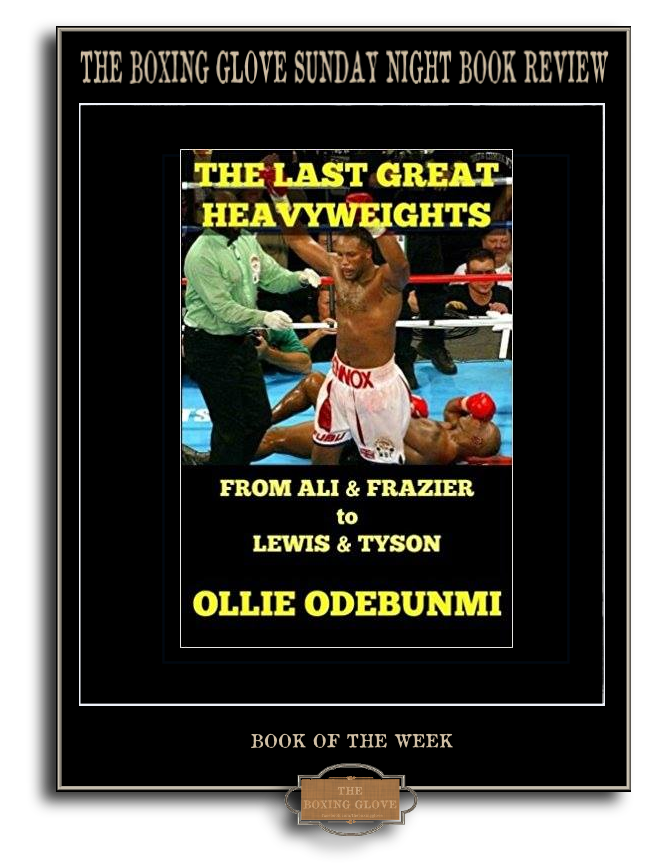
TBG Book Review: The Last Great Heavyweights

The Boxing Glove Sunday Night Book Review

By Peter Silkov

"The Last Great Heavyweights: From Ali & Frazier to Lewis & Tyson 

Written By Ollie Odebunmi 


It’s fair to say that no other weight division in boxing carries such a weight of historical significance and mythology as does the heavyweight division. From both, the physical to the spiritual level, the heavyweights have always held the greatest allure for the sporting public. In years gone by, the heavyweight champion of the world was an instantly recognizable figure, even amongst those who did not follow the sport of boxing. While it might be true that the fighters of the lighter weights are the better boxers, pound-for-pound, compared their larger counterparts, and often provide the better action between the ropes, it is the heavyweights who have always held the highest profile within the sport. In it’s greatest moments, the heavyweight division’s champion has held the highest profile of all sportsmen, and the world heavyweight championship was recognized as one of the most prestigious titles throughout all sport.

Sadly, though, things aren’t what they used to be. Over the past two decades’ multiple world titles, combined with a drought of talent, and a lack of competitive big fights, have seen the heavyweight division’s aura as the most important division in boxing slowly fade. The champions who were once so visible have become more and more obscure and unknown. In America, formerly the home of the division throughout most of the 20th century, the heavyweight boxer has been on the verge of extinction. Part of this is due to the division being steadily taken over by Europeans and Eastern Europeans since the mid-90s. Since the retirement of England’s Lennox Lewis in 2004, the division has largely been ruled by Vitali and Wladimir Klitschko, both of whom, despite their undoubted athletic and technical gifts, largely failed to capture the imagination of the boxing public, outside of their adopted country of Germany. 

The result is that the heavyweight division, once the most magnetic in boxing, has become a hollow entity, operating to a growing indifference of the public, and even the die-hards of the boxing establishment.

Photo: Skysports
However, there was a glimpse of hope in the past couple of years with the retirement of Vitali Klitschko, and the rise of a new generation. In America, Deontay Wilder has sparked a new flicker of interest in what was formerly the countries favourite division. In England, Tyson Fury and Anthony Joshua, two very different men, and very different fighters, have led what might still be the beginnings of a new and brighter era for the division. When Fury defeated Wladimir Klitschko in November 2015, it seemed as if the division had found a new champion whose quirky, and sometimes controversial charisma, could bring more attention and excitement to the moribund division. Unfortunately, Tyson’s subsequent out-of-the-ring issues have seen him give up his world titles, as his career has gone off the rails. The result of Fury’s problems has been that the World heavyweight title has once again become a fragmented and devalued article, with several fighters claiming a ‘world’ title at the weight. While the upcoming match between Anthony Joshua and Wladimir Klitschko is undoubtedly a move in the right direction, the fact remains that the heavyweights of today have a long way to go before they can restore the division to anything like it was in the glory years.


Photo: Ali instagram
In “The Last Great Heavyweights: From Ali & Frazier to Lewis & Tyson," Ollie Odebunmi takes us back to when the heavyweight division still carried its weight in excitement and talent, and produced epic world class encounters on a regular basis. Fights that have become part of boxing history. Perhaps the measure of how hypnotic the sport’s heaviest division has been, at its best, can be seen in how the history so easily intertwines with the lives of those following it. Ollie takes us on a journey from the heavyweight division’s greatest era of the 1970s, down to the close of Lennox Lewis‘ career. Ollie’s own fascination with boxing, and primarily the heavyweights, began in 1971, when he watched Joe Frazier defeat Muhammad Ali, in their never to be forgotten first encounter. This fight sparked a fascination with both the sport of boxing, and especially the heavyweight division, which has stayed with Ollie Odebunmi to this day.

The 70s have often been called the division’s golden era, and Odebunmi illustrates why with a deft recollection of the rivalries between Muhammad Ali, Joe Frazier, George Foreman, and Ken Norton; as well as a host of other names from that time.  This is a very personal book, with Odebunmi placing the classic encounters of these great fighters into the context of his own life at that time. We experience, through Ollie’s eyes, as these great fighters defend, lose, or regain the richest prize in the sport. 

As well as reliving his own personal circumstances when witnessing these often-epic encounters, Odebunmi gives some great insights into the inner world of these various fighters, including his views on what is happening beneath the surface in these fights.  We are reminded that boxing is as much a mental endeavor as it is physical. Ollie is a man who understands fighters and has a good feel for both, the athletic and psychological aspects, of the sport.


As the era of Ali and Frazier fades, we meet Larry Holmes, and then, Mike Tyson.  ’Iron Mikes’ rise and fall is expertly recollected by Odebunmi. As is the rise of Evander Holyfield, Riddick Bowe, and Lennox Lewis. As we enter the late 80s, and then the 90s, we can see the gradual tarnishing of the sport’s most valuable prize. The world title begins to regularly splinter into multiple champions and top level showdowns become an increasing rare event.

Photo:Newsday
Odebunmi does a good job of intertwining the stories of Tyson, Holyfield, Bowe, and Lewis. We have Tyson’s almost Shakespearian story of triumph and defeat, his rise and fall in the 80s and early 90s, followed by his return and then yet another, even more devastating, fall from the top. Then there is the indomitable Evander Holyfield, defying expectations again and again, and the brief brilliance, and wasted promise of Riddick Bowe. Lennox Lewis’s determined rise to the top is told with some good insight from Odebunmi, as we see Lewis develop from a seemingly unremarkable young professional, into the undisputed world champion. 

Photo: Boxrec
The climatic fight of “The Last Great Heavyweights: From Ali & Frazier to Lewis & Tyson"  is Lewis’s demolition of a faded Mike Tyson, in what was to be the pinnacle of his career. Lewis would have one more fight, his brutal and bloody victory over Vitali Klitschko, before he chose to walk away from the sport while still undisputed champion. What has followed in the division since has, unfortunately, been largely forgettable. This is illustrated by Odebunmi’s brief sketch of the decade following the retirement of Lewis.

Odebunmi does mention Anthony Joshua briefly in the closing pages of this book.  At this point, Joshua had only just turned professional. Armed with an Olympic gold medal, and had fought only once, but already had shown the kind of raw promise, which followers of boxing’s one time greatest division are always searching to find.

Weighing in with 302 pages, “The Last Great Heavyweights: is a fast-moving and entertaining read by someone who has a great ability to transfer his insight and enthusiasm for the subject into his writing. While some photos would have been nice, their absence should not be a deal breaker. This is an excellent book for anyone who has any interest in the golden days of the heavyweight division, whether you want to read about Ali, Frazier, Foreman, Tyson, and Holyfield for the first time, or else relive the past through Odebunmi’s own personal experiences. Don’t be surprised if you find yourself digging out your old copies (or going to You Tube) to re-watch some of the great encounters that occurred between these fighters. Odebunmi has recalled an era that is unlikely ever to be matched, let alone surpassed. It was a time when the heavyweight division genuinely was the ’heaviest’ division in boxing. Alas today, it is the heaviest only in physical weight, rather than world class substance. 

Yet, we can always hope for a better future.


Ollie Odebunmi has his own website:  www.ollieodebunmi.com and can also be reached on two face book pages.  www.facebook.com/ollieodebunmiauthor and www.facebook.com/fightgamelegends  


Follow us on Twitter: @TheBoxiongGlove and 


If you are an author and you would like your book reviewed, contact Peter Silkov at petersilkov@yahoo.com or theboxingglove@yahoo.com


Copyright © 2017 The Boxing Glove, Inc. Peter Silkov Art. All Rights Reserved.


Sunday, July 26, 2015

TBG Book Review:The Terror of Terre Haute:Bud Taylor

The Boxing Glove Sunday Night Book Review by Peter Silkov

“The Terror Of Terre Haute”
Written by John D. Wright.


“The Terror of Terre Haute” written by John D. Wright is an engaging and vivid account of  the life and times of Bud Taylor, whose big-punching, all-action fighting style made him one of boxing’s most popular fighters during the golden 1920s. 

Bud Taylor was born in Terre Haute, Indiana, on July 22, 1903, into a close-knit, but relatively poor family. Bud found early on that he was gifted with his fists, taking part in many street fights, before he started to box seriously with gloves on.

After beginning his professional boxing career in 1920, at the age of 17-years-old,  Taylor would go on to fight the best bantamweights and featherweights of the 1920s.  In a career, which spanned 11 years from 1920, until he hung his gloves up in 1931, Taylor had around 166 officially recorded contests, which works out to an astonishing rate of one fight every three weeks. 

At a time when boxing’s popularity in America was second only to baseball, Bud Taylor was one of the top fighters during what is now viewed as a ‘golden era’ in boxing. Jack Dempsey was the World heavyweight champion for much of the 1920s, and boxing was big business during a decade where Americans dedicated much of their time to enjoying themselves, with sports being one of the main vehicles used in the nation’s pursuit of recreation.

In an era where the talent was plentiful, and a fighter had to be both tough and talented just to make it into the ranks of contenders, Taylor’s fighting career culminated with him winning the World bantamweight championship in 1927. He would hold onto the title for over a year, until difficulty in making the 118 weight limit resulted in his decision to vacate his championship, and move up to the featherweight class.

“The Terror of Terre Haute” includes some fascinating descriptions of Bud’ s fights with some of the greats of his day, such as Tony Canzoneri, Jimmy McLarnin, and Bushy Graham, to name just three. Author John D. Wright has obviously done a great deal of research on the life and fighting career of Bud Taylor, and the end result is an entertaining portrait of Taylor both as a boxer, and as a man.

Taylor’s career in the ring is meticulously reviewed; the triumphs and the tragedies.  Taylor had the misfortune to see two of his opponents die after they had been defeated by him, and although he was a tiger of a fighter inside the ring, outside he was a thoughtful and sensitive person who absorbed the weight of these tragedies, and never quite came to terms with them. Although he continued to box following these two deaths, they undoubtedly left their mark on him psychologically, both in and out of the ring.

John D. Wright follows Taylor into his post-boxing life, and we see how the man who had been teetotal and terrifically disciplined for most of his fighting career, embraced the high life with an almost self-destructive zeal once his career was over. In just a few years Taylor would see most of his hard won fortune drain away through a mixture of bad investments, fast living, failed marriages and fast friends, along with the ravages of the 1930s depression.

“The Terror of Terre Haute” is a poignant portrait of a man who, while being a ferocious fighter in the ring, was a gentlemanly and sensitive person outside of the ring. It is also a fascinating portrait of the world of boxing generally in the 1920s and the 1920s themselves. 

In addition to a number of rare photos throughout its pages, this book also has Bud Taylor’s full professional boxing record in the back pages.

Terre Haute welcomes Bud Taylor home.
This book is a must for those who are interested in fighters of the past. Bud Taylor is revealed as a truly great fighter who fought in an era where a fighter really had to be something very special to win a title of any type, but especially a world title. It underlines, more than anything else, how boxing has changed since those days. “The Terror of Terre Haute”  looks back at a time when boxing was one of the most powerful and popular sports in the world, and its champions were household names, and admired wherever they went.

“The Terror of Terre Haute” was first printed in 2008  and published by Dog Ear Publishing.

Copyright © 2015 The Boxing Glove, Inc. Peter Silkov Art. All Rights Reserved. Peter Silkov contributes to www.theboxingglove.com and www.theboxingtribune.com

 
twitterfacebookgoogle pluslinkedinrss feedemail

Sunday, June 14, 2015

The Boxing Glove Book Review: Raging Bull by Jake Lamotta

The Boxing Glove Book Review By Peter Silkov
"Raging Bull: My Story Jake La Motta"  Written by  By Jake Lamotta, with Joseph Carter and Peter Savage


Former World middleweight champion, Jake "The Bronx Bull" Lamotta, is one of boxing’s most enduring legends, whose life outside of the ring has been as stormy and controversial, as his life inside of it. Lamotta was world champion from June 16, 1949, until February 14, 1951, and is famed as having fought the great Sugar Ray Robinson six times, as well as being the man to hand Robinson his first professional defeat.  Ironically, it would be Robinson who would relieve Lamotta of his World Middleweight title.  As he approaches his 94th birthday this year and as far as I am aware, he is boxing’s oldest surviving ex-world champion. However, there is a lot more to Lamotta than just a straightforward story of a boxer fighting his way to the world championship. 

Lamotta is far from a straightforward person, just as he was far from being simply a take three punches to land one punch type of slugger that many today believe.  Jake’s life story was portrayed in the 1980 Martin Scorsese film “Raging Bull” with Robert Deniro giving one of the most powerful performances of his career. Raging Bull was hailed as one of the greatest boxing movies ever, and laid bare the rage and paranoia that both drove and tortured Jake Lamotta.

The film was based on Lamotta’s biography “Raging Bull” of the same name, which was first published in 1970. If “Raging Bull” the film is often operatic in its portrayal of Jake’s rages and struggles with his inner demons, then the book is altogether more darker and detailed. This is an autobiography of a man at war with himself, as well as the world around him. 

Jake Lamotta grew up in the Bronx New York, in a run down tenement, with an abusive father who beat him and his siblings, and his mother. By the age of 16 years old, Jake was in his own words a ’hardcore’ juvenile delinquent.  “I was a bum, and lived like a bum, in a bum neighbourhood.’ At about this age, Lamotta mugged a local bookie, and was left believing he had killed him. This early savage act is one of the main incidences that formed Jake’s outlook on the world and himself, he is a man riven with guilt, anxieties, and suspicion. Boxing eventually offered Jake a way out from the criminal life that he had become entangled. Yet, he could not get away from the insecurities that his upbringing and early experiences have sowed within him.  Lamotta has been married 7 times during his life, and it’s not hard to see why.  Within this book, he is very open about the paranoia and jealousy that eventually brought an end his marriage to Vicky Lamotta, his wife during his boxing days.

Lamotta seemed to trust no one and had few friends, save for his life long buddy, Pete.  He often had reason to be suspicious of people, but at other times, it was revealed that his own worst enemy was, too often, himself.   

Always a loner, Lamotta’s aloofness from the mob elements, who ran boxing at this time, meant that he was kept waiting for years for his chance at the world’s championship. In the end, Jake was forced to pay a tremendous price in order to receive his chance at the title; he was forced to take a dive against Billy Fox in 1947. Even after taking the dive, Lamotta was kept waiting almost another two years before he finally received his world title shot.

When he beat Marcel Cerdan for the World middleweight title on June 16, 1949, despite it being the greatest day of his life, it would also ironically prove to be the beginning of his downfall both as a boxer and a person.  Lamotta soon realized, through a number of incidences, that being world champion would not take away the turmoil that ate away inside of him. In many ways, it is as if he did not feel that he deserved to be world champion.

“Raging Bull” follows Lamotta through his bittersweet title reign and then looks at how his world quickly starts to fall apart after he loses the championship to Sugar Ray Robinson. As his boxing career fell apart, so did his private life. After his boxing career is over, Jake is bereft at having lost the one thing that held him together, and made him able to function in a world in which he felt so alienated.

There was a culmination of events that happen which eventually throw Lamotta’s life into a spiral of decline. Firstly, he was incarcerated for abetting prostitution, and then, later, testified at the 1960 Senate investigations into corruption in boxing, admitting he threw the ’47 fight against Billy Fox. With this admission, Lamotta is publicly humiliated and banished from the boxing establishment. While Lamotta’s confession is seen as brave in some quarters, it makes him a leper in most boxing circles, and has reverberations that continue until this day. Lamotta had confessed to doing the unthinkable, but perhaps more than the dive itself,  it was the confession itself that so enraged some elements within the boxing establishment.

Eventually, Lamotta was to enjoy at least a partial return to public favour. It was a process that began with this book being published in 1970, and eventually reached its full fruitation with the release of Scorsese’s film of the book in 1980.

Lamotta remains a controversial character, but in “Raging Bull”, he certainly doesn’t pull any punches regarding himself. This is a warts-and-all autobiography. There are strong parallels between Lamotta’s story and that of Rocky Graziano, who grew up in the Bronx at the same time as Lamotta, and won the World middleweight title, during a time when Lamotta was waiting his chance, and being called by many the ‘uncrowned’ champion. Graziano would also write a book about his life, and rise from juvenile delinquent to middleweight world champion, in “Somebody Up There Likes Me” (a great book in its own right.)  Graziano’s autobiography was also later made into a film, by the same name, starring Paul Newman.

However, despite the similarities between the two men and their life stories, “Raging Bull” is an altogether darker more complex book. 

Over 40 years since it was originally published, “Raging Bull” still packs a powerful punch. It is a brilliant study of Jake Lamotta’s rise to the top of the boxing world, despite many obstacles being thrown in his way by various elements other than his opponents in the ring. We also see how the very character traits, which make Lamotta so fearless and formidable in the ring, eventually prove to be his downfall in his private life, and come very close to totally destroying him.

Anyone who has ever watched the film “Raging Bull” can find where all of the inspiration and drama came from in this autobiography. The term ‘living legend’ is almost embarrassingly overused today, but it is a term that Jake Lamotta deserves.  “Raging Bull” tells us what a complex man he is, and also gives us a glimpse into the complex and often-nefarious world of boxing.


*Not all photos on this page are published in "Raging Bull."

Copyright © 2015 The Boxing Glove, Inc. Peter Silkov Art. All Rights Reserved. Peter Silkov contributes to www.theboxingglove.com and www.theboxingtribune.com

 
twitterfacebookgoogle pluslinkedinrss feedemail

Saturday, May 30, 2015

Book Review: In This Corner: Forty World Champions Tell Their Stories

The Boxing Glove Sunday Night Book Review by Peter Silkov

In This Corner: Forty World Champions Tell Their Stories.
Written by Peter Heller


This week at The Boxing Glove, we are reviewing a book, which originally came out in 1973, but is still available either new or second hand.

Pete Herman
From early 1970 to late 1972, Peter Heller traveled up and down America with a tape recorder, interviewing over forty former world boxing champions, going back to the 1910s. The result is a fascinating insight into the lives of these fighters, who at one point were the best in the world at their weight, back in the days when a world champion really was a world champion.

The book is sectioned off by decades, with varying amount of fighters representing each decade.  From 1910 to 1920, then the 20s, 30s, 40s, 50s, and 60s. 

Part of the charm of this book is that most of the fighters interviewed for it have since passed on, so this is in many ways a rare and precious recording of these men in conversation, talking about not just their boxing careers, but their lives, and experiences outside of the ring. There are many social insights within these pages, though so much has changed in many ways, interestingly much has remained the same.  For instance, the question of racism and prejudice comes up numerous times in this book, and we need only to look around us today and see that many of these problems are still with us today.

Jack Dempsey
The fighters interviewed in this book rage from legendary figures such as Jack Dempsey, Joe Louis, Henry Armstrong, Willie Pep, and Sugar Ray Robinson, to those not so widely known, especially today, men like Gunboat Smith, Charley Phil Rosenberg, and Pete Herman.

Even though many of the fighters who appear in this book have been written about many times and even published their own autobiographies, many of them were never interviewed in a one-on-one situation before this book. The result is that the ex-fighters often seem to come out with memories and feelings, which they had never expressed publicly before.  In his interview, for instance, Jack Dempsey says about the great Sam Langford “even at my best I don’t know whether I could lick him or not."

Lou Ambers
Some of the other fighters contained in this book are Willie Richie, Jack Sharkey, Lou Ambers, Jim Braddock, Battling Battalino, Lew Jenkins, Don Jordan, Willie Pep, Sandy Saddler, Billy Conn, Archie Moore, Bobo Olsen, Jake Lamotta, Rocky Graziano, Floyd Patterson, and Emile Griffith, just to name just a few.

This book is really a time capsule of the experiences and feelings of many of the great fighters who fought in the ring when boxing was one of the hardest and most poplar sports in the world. There are many insights into their lives and boxing careers that you cannot find elsewhere.  Peter Heller’s gift in putting this book together is that he had the ability to make each of these men relaxed enough with him so that they could confide in him things, which they often had never revealed before in public.  Many were also able to look at their careers in a more objective and philosophical light, now that they were years removed away from fighting.

Sugar Ray Robinson
I have had a copy of this book for over 30 years now and still dip into it regularly for quotes or information about some of the fighters that were interviewed. It is that good.

In all, no serious boxing follower can ignore this exceptional book. For those who are interested already in the fighters of the past, this book is invaluable, and for those who may think that the fighters of the past are irrelevant or over hyped, this is the book that will change your mind. 


Copyright © 2015 The Boxing Glove, Inc. Peter Silkov Art. All Rights Reserved. Peter Silkov contributes to www.theboxingglove.com and www.theboxingtribune.com

 
twitterfacebookgoogle pluslinkedinrss feedemail

Sunday, May 24, 2015

Book Review: The Real Rockys-A History of the Golden Age of Italian Americans In Boxing 1900-1955


The Boxing Glove Sunday Night Book Review by Peter Silkov

The Real Rocky’s: A History of the Golden Age of Italian Americans In Boxing 1900-1955      
Written by Rolando Vitale


Rocky Graziano
The name “Rocky” has become almost inextricably linked with boxing. Sylvester Stallone’s “Rocky” films brought home the relevance of the name to the wider public, but the name, and Rocky’s Italian heritage goes back much further into boxing’s golden history. It is this subject, which Rolando Vitale tackles with such depth in “The Real Rockys: A History of the Golden Age of Italian Americans in Boxing 1900 - 1955.”  The author looks at the role of the Italian-American in boxing during a time when boxing was booming with a multitude of clubs and daily shows, the like’s of which today’s boxing fans can only sit and think about with wonder.

Casper Leon
The book is an eye opener into how many excellent Italian-American boxers there were during this period of time.  The fact that the Italian-American fighter prospered during boxing’s boom time, when the amount of active fighters was at its highest, and the depth of talent at its deepest, serves to illustrate just how prevalent the Italian-American became in boxing.

Set out in these pages is a veritable encyclopaedia of information about the greatest exploits of the Italian American in boxing. Every thing that a boxing historian would want to find, from fascinating statistics to individual biographies upon the most outstanding of the Italian-American boxers, is in this book.

One of the welcomed aspects of this book is that the huge amount of information which is contains is set out in a reader friendly way. The book is divided into two sections; the first part consists of a straightforward narrative by Rolando Vitale, in which he analyzes the place of the Italian-American, not only in boxing, but also within American society itself.  Vitale delves into how the Italian immigrants had to fight for their survival in America and the roots of boxing in Italy. It is very interesting to read about the social upheaval of the late 1890s and early 1900s, and how the Italian vied for survival with immigrants of different nationalities, with this bitter competition eventually going from the streets into the boxing rings.

Young Zulu Kid
Vitale takes us all the way from the earliest Italian immigrants who were beginning to ply their trade in the American boxing rings, right up to the mid 1950s and beyond, where increased social mobility and education eventually see’s the numbers of Italian-American boxers dwindle to a trickle. Today, the Italian-American is more likely to be found in the business side of boxing, either in promoting, management or broadcasting.

The second part of this book is a collection of appendices, which contains a wealth of fascinating statistical information, broken up into twenty-one different chapters.  Included in this section is a chapter devoted to short, but informative biographies of 100 outstanding Italian-American boxers of 1900 to 1955.  The scope and variety of the other chapters in this section is impressive, including subjects such as; Italian Americans and prize money in professional boxing 1900-to-1955 (chapter 2), Italian American prize-fighters using Irish and anglicized names, 1900-to-1955 (chapter 4), Italian American world boxing title claimants 1900-to-1955 (chapter 8), Italian Americans in world title bouts 1900-to-1955 (chapter 10), Italian Americans in world top 20 rankings 1924-to-1955, (chapter 12), and, inter-ethnic rivalry in world title fights 1900-to-1955 (chapter14).

While the first section of this book is an engrossing study of the history of Italian Americans, not just in boxing, but also in American society itself, it is the second section of the book, which will draw in the boxing fanatic again and again, in order to study the multitude of historical facts and figures that it holds. This is a book that is likely to interest both the boxing historian and the more relaxed boxing fan, who is interested in discovering a wealth of information about a part of boxing history that has been so far surprisingly neglected.  “The Real Rockys” reveals just how prominent the Italian American once was inside the boxing ring, and how these fighters played an integral role at a time when boxing was at its most popular and powerful. This is certainly a welcome addition for any serious boxing collector, entertaining, informative, and at times surprisingly enlightening.  


Copyright © 2015 The Boxing Glove, Inc. Peter Silkov Art. All Rights Reserved. Peter Silkov contributes to www.theboxingglove.com and www.theboxingtribune.com

 
twitterfacebookgoogle pluslinkedinrss feedemail