Showing posts with label middleweight champion. Show all posts

Sunday, November 4, 2018

The Mystery of Tony Zale and Carmen Basilio's Stolen Championship Belts


By Peter Silkov
The Boxing Glove


IBHOF in Canastota, NY.
I recently had the pleasure of going to the International Boxing Hall Of Fame, in Canastota, New York.  Though it was a little bit of a fleeting visit, I certainly had enough time to appreciate the wonders of Canastota's legendary boxing museum.  It is quite simply a boxing time capsule, laden with treasures from the sport's rich history, from Gumshields, Robes, Trunks, Gloves to championship belts.  The hall rolls back the years, to when greats of the ring such as Battling Battalino, Jack Dempsey, Joe Louis, Willie Pep, Henry Armstrong, Sugar Ray Robinson, Carmen Basilio, Tony Zale, Rocky Marciano, Kid Gavilan, Muhammad Ali, Joe Frazier and Sugar Ray Leonard, to name just a few, were creating their legends inside the ring, before thousands of screaming fans.  Although physically, the museum is compact, verging on small, it packs a lot of fascinating boxing history into its limited frame. 

IBHOF in Canastota, NY.
Canastota's Boxing Hall of Fame has long been viewed upon as a haven for ex-champions of the ring, a place where they are still remembered and admired, often decades after their ring careers have come to an end.  There are a number of boxing halls of fame paying homage to boxing stars of the past, but the IBHOF in Canastota, set up in 1989, was the original trailblazer for all the halls that have followed in recent years, and is still viewed by the majority of the boxing world as the most prestigious of all the halls of fame.  Fighters often find being elected to the hall of fame to be the greatest achievement of their lives and the pinnacle of their boxing careers.  It is proof to that person, that through boxing they have achieved a form of immortality.

However, for the past three years, a cloud has hung over Canastota's hall of fame.  It is evident when you enter through the museum's entrance and are confronted by the large cabinets, which once held six priceless championship belts belonging to boxing legends Tony Zale and Carmen Basilio. Unfortunately, the belts no longer there.

IBHOF Entrance with Tony Zale and Carmen Basilio's Belts Before Theft

IBHOF Entrance with Tony Zale and Carmen Basilio's Belts After Theft
Three years ago on November 5th, 2015, a person or persons unknown, broke into Canastota's hall of fame, through an unbarred window at 2.45am, then broke into the cases containing the precious belts, four belonging to Carmen Basilio, and two belonging to Tony Zale.  Despite the vast amount of unique memorabilia in the museum, the thief (or thieves) seemed intent solely on Zale's and Basilio's belts.  This is no surprise since the stolen belts were the most valuable artifacts in the museum, whoever stole them knew exactly what they were taking.  Zale's Boxing Hall of Fame ring, which sat next to his belts was left untouched by the thief.  The ring, despite its attractive appearance, was a duplicate of the original ring, with plastic diamonds that was provided by the IBHOF. 

The three cases that held Zale and Basilio's belts stand at the center of the Canastota museum, but the prized exhibits, which once laid so proudly inside them are gone. Understandably, both the Zale and the Basilio families have been left distraught and angry at the thefts of their precious family heirlooms.

Tony Zale's Stolen World Middleweight Belts
It is sadly ironic that it was Zale and Basilio's treasured mementos that were targeted by thieves.  It is hard to imagine two champions who fought harder for what they achieved in their boxing careers.  Tony Zale 'The Man Of Steel' fought his way out of the steel town of Gary, Indiana, to reign as World Middleweight Champion from July 19th 1940 to September 21st 1948, with just an eleven month break between July 16th 1947 and June 10th 1948, when he lost and then regained the World Middleweight title with Rocky Graziano, in the second and third fights of their legendary trilogy.  Zale received a world championship belt after he beat Georgie Abrams on November 28th, 1941, to become the undisputed World Middleweight Champion, (Zale had gone into the match with the NBA title, while Abrams had been defending the New York State version of the crown.) Zale was awarded another world championship belt by The Ring Magazine after he had regained the world title from Rocky Graziano.  These are the belts that were stolen from the Zale case.
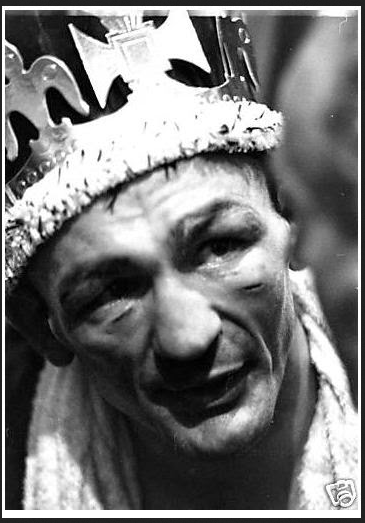
Carmen Basilio After His Win After Robinson
The four belts that were stolen from Carmen Basilio's case comprised of Basilio's New York State welterweight title belt, (which he won on June 6th, 1953, by beating Billy Graham for the New York State Welterweight title,) and his three world championship belts, all awarded to him by The Ring Magazine. Carmen won the first of these three belts on June 10th, 1955, when he beat Tony Demarco for the World Welterweight title in the first of their two savage classics.  The second belt was awarded to Basilio after he stopped Johnny Saxton in 9 rounds, on September 12th, 1956, (having controversially lost the title to Saxton six months earlier.) 

Basilio gained his third world championship belt after scoring the most memorable victory of his career, by outpointing Sugar Ray Robinson September 23rd, 1957, to win Robinson's World middleweight crown. 

It's perhaps an understatement that Zale and Basilio won their titles the hard way.  Zale was involved in The Ring Magazine's 'Fight of the year' three times running, from 1946 to 1948. While, Basilio was involved in battles, which won The Ring's 'Fight of the Year' vote a record five times in a row between 1955 and 1959.

Both fighters and their families loaned their championship belts to the IBHOF out of a sense of pride for their ring achievements, and a desire to share their accomplishments with their fans, both young and old.  Each man felt very strongly about inspiring the younger generation to achieve their full potential in life, whether it be through boxing or other endeavors.

Awarded Ring Magazine Belt by Nat Fletcher
Ironically the IBHOF was built around Carmen Basilio, who was and still is, the most famous and successful fighter to come out of the small town of Canastota. The town's only other world champion is Carmen's nephew, Billy Backus, who won the welterweight title in the early 70s.  The museum is adorned by life-size statues of both Carmen and Billy.  

Tony and Carmen's belts were won in an era where it was so much tougher for a fighter to reach world championship status than it is today, and the chances of a world title chance, even if you managed to get rated in the world top ten, were few and far between.  The belts themselves are a long way from the mass produced belts handed out to fighters today.  They were hand-crafted and each one was unique and one of a kind.  Aside from their physical uniqueness, the value of the belts to each fighters families cannot be overemphasized.  These are precious, irreplaceable heirlooms, which carry so many memories for each family, especially now that both Tony and Carmen have sadly passed away.

Although three years have passed since the theft, there have been few leads in the chase for answers to their whereabouts.  The Zale family have been very proactive in their attempts to find answers, and ultimately find all six stolen belts, and yet have found much of their efforts frustrated by a lack of communication with the Canastota Museum, and its director Ed Brophy.

Tony and Ted Zale
The Zale's frustrations at the Museum's lack of adequate security at the time of the thefts, (no on-site security guard and no CCTV) have been compounded over the past three years by Mr. Brophy's apparent unwillingness to take a proactive approach in trying to find the stolen belts, plus a complicated relationship with the local Canastota Police department that has often seemed unwilling to share any new information with the Zales.  At times it has looked as if the IBHOF has been attempting to downplay the thefts so as not to attract adverse publicity.  This could be seen from the beginning, when the museum delayed making the thefts public knowledge for five days, for reasons that are still unclear. 

Despite a mention of the thefts on their website, the overall response of the IBHOF can be said at best, to be rather muted.  Most of the publicity created about the loss of Tony and Carmen's belts has been generated by the Zales themselves, as they seek to keep the crime in the public eye in the hope that someone, somewhere will one day come forward with some crucial information.

The Zales were also hurt and frustrated by the IBHOF’s failure to offer a reward for the return of the belts for over three months after the theft.  The IBHOF were finally persuaded to put up a reward after ex-world heavyweight champion, Mike Tyson, (who has taken a great interest in the theft of the belts) put up a reward of his own for the belts return.

Since the belts were stolen, the Zale family has also removed the remaining articles that had been loaned on Tony's behalf, including his Presidential Citizens Medal, which was awarded to Tony in 1990 by President Bush.  While Tony was immensely proud of his Polish heritage he was equally proud of being an American citizen, and this award was important to him as he felt that it signified how he had been an inspiration to others through his achievements in boxing, both during and after his career.

Zale Presidential Citizens Medal Removed from the IBHOF by Zale Family
“Receiving this medal was a confirmation that his life's effort and dedication to helping others was worthwhile,” remembers Tony's nephew, Ted Zale.

One of the saddest repercussions of the theft of the belts is that the Zale family felt it necessary to withdraw this medal from the museum, due to continuing concerns over its security.  This is painful for the family, as they regret that visitors to the IBHOF can no longer share in Tony's accomplishments as he would have wished.

Yet there has seemingly been little to go on in the three years since the thefts, despite the involvement of the FBI and the fact that blood was found on the scene (thought to be of the perpetrator cutting themselves on a shard of glass during the theft.)  

Zale's  World Middleweight Belt Awarded  After Beating Abrams
Various rumours have grown in the last three years, ranging from money being collected on an insurance policy covering the belts, to the thefts themselves being an inside job.

Regarding the rumours that the IBHOF collected insurance money for the theft of the belts, Ted Zale had this to say:

“If this is true, what does that say to our family?”

The Zale family has also heard rumours recently that the belts have been located.  But, these rumours have yet to be proved ultimately true or false.  For the moment at least, all six championship belts remain missing. 

There is little chance of the belts ever being sold on the open market, and as they were not made of gold they would be worthless melted down.  The only remaining way that the thieves could profit from their theft is by selling the belts on the black market.  There also remains the possibility that the theft was made-to-order.

What remains clear, is the distress and anger that this theft still provokes within the Zale and Basilio families. Both fighters have passed on and didn't suffer the trauma of seeing their beloved belts stolen.  Yet both fighters families have had to bear the loss of irreplaceable family heirlooms, that were won literally with the sweat and blood of Tony Zale and Carmen Basilio.

Tony Zale Wearing His Belts
From the Zale's point of view, the theft of Tony's belts is made all the more poignant by the fact that Tony suffered some severe hard times after he retired from the ring, and even found himself homeless at one point.  Yet, this proud man kept his struggles to himself as much as he could and no matter how bad his economic hardships became, he always refused to sell his hard-won championship belts.

How unfortunate then, that these belts which meant so much to Tony, are now in the hands of someone who has no right to hold them. 

The mission statement of the IBHOF is to ‘Honor and preserve boxing's rich heritage, chronicle the achievements of those who excelled, and provide an educational experience for our many visitors.’

The Zales feel that the stolen championship belts have fallen victim to the IBHOF failure to live up to its mission to ‘preserve and protect’.

There remains a reward of 15,000 dollars for any information leading to the recovery of the six missing belts.  As of yet, there have been no takers.

$15, 000 Award for the Return of the Belts

Hopefully, this is a mystery which one day will be resolved.

If you would like to find out more about the stolen belts, or perhaps have any information that could be helpful in their return, please look up #bringbackthebelts @bringbackthebelts on social media.

Facebook:


or the Zale's own website www.tonyzale.org   


Family of Tony Zale on theft of boxing belts: 'They stole our heritage'


Follow us on Twitter: @TheBoxingGlove and  
Facebook: www.facebook.com/theboxingglove

If you are an boxer, amateur or professional, and want us to follow you or tell your story, contact petersilkov@yahoo.com   or theboxingglove@yahoo.com

If you are an author and you would like your book reviewed, contact Peter Silkov at petersilkov@yahoo.com or theboxingglove@yahoo.com

Thursday, October 5, 2017

On This Day: Kid Tunero Remembered


By Peter Silkov

Kid Tunero was a brilliant boxer-puncher, in the true Cuban mould. Born, Evelio Celestino Mustelier, on May 19, 1910, in Victoria de las Tunas, Cuba, Tunero turned professional in 1929, aged 19 years of age. Tunero would be one of the outstanding middleweights of the 30s and 40s, but found himself avoided by many of the top white contenders, with his colour often being used as an excuse, but quite often it was really his ability that frightened away a lot of possible opponents.


Although he had this obstacle throughout his career, Kid Tunero would still manage to fight an impressive array of fighters during his career, many of them were suffering from the same prejudices and political intrigues as Tunero himself. Some of the top fighters whom he met during his career include Marcel Thil, Gustave Roth, Erich Seelig, Jock McAvoy, Anton Christoforidis, Ken Overlin, Holman Williams, Ezzard Charles, and Jean Stock. For much of his career Tunero fought in Europe, where he was extremely popular with the European boxing fans.


Despite the politics of the times, Tunero did manage to receive two shots at the World middleweight title. This happened at least partly due to Tunero’s popularity with the fans, and partly due to the fact that the champion who Tunero met on both occasions, Marcel Thil, was the kind of fighter who didn’t duck anybody.

Tunero actually fought Thil three times. In their first meeting on January 16, 1933, Thil’s NBA and IBU world middleweight title was not on the line, as both men weighed over the middleweight limit. This was just as well for Thil, as Tunero beat him on points, over 12 rounds. Nine months later the two met again, and this time with the world title at stake, and Thil won on points, after 15 rounds.

Tunero gained his second and final shot at the world title on July 13, 1935, with Thil once more out-pointing him over 15 rugged rounds. Tunero would continue to fight at the top level for the remainder of his career, always winning more than he lost, until the last few years of his fighting career. In his last official contest, on August 14, 1948, Hankin Barrows held Tunero to a draw over 10 rounds. H e retired with a final official record of 96(34koes)-32-16.

After his fighting career ended, Tunero became a boxing trainer, and amongst the fighters he trianed were Jose Legra and Angel ’Robinson’ Garcia. Tunero died on October 6. 1992, aged 82.


If you are an boxer, amateur or professional, and want us to follow you or tell your story, contact petersilkov@yahoo.com   or theboxingglove@yahoo.com

If you are an author and you would like your book reviewed, contact Peter Silkov at petersilkov@yahoo.com or theboxingglove@yahoo.com
, contact Peter Silkov at petersilkov@yahoo.com or theboxingglove@yahoo.com

Sunday, May 15, 2016

De La Hoya's 10 Year Plan for Alvarez Revealed

Click to see larger version of blueprint


By Peter Silkov

Supposedly, negotiations are in the works for an Alvarez Vs. Golovkin fight for the fall of 2016, but a secret 10-year plan by De La Hoya has been discovered that reveals the future of WBC middleweight champion Saul “Canelo” Alvarez, and the direction Goldenboy wants to lead his career. Earlier in the year, Oscar laid out a plan in which he wanted to make it clear that, for the next 10 years, Cinco de Mayo belonged to the talented Mexican boxer. Now that the WBC has ordered the fight to happen and the Alvarez camp has 2 weeks to cut a deal or vacate, these plans might not come to light as De La Hoya had planned!

According to the blueprints, which are very detailed, the Cinco de Mayo's, from 2017-2026, give prospective opponents that Oscar would like to see his 'goldenboy' fight. 

The list, which consists of flyweights, up to welterweights, to finally, GGG, who is a middleweight is a chance for Canelo to develop into a true  middleweight:

  • 2017: Donnie Nietes
  • 2018: Roman Gonzalez
  • 2019: Diego De La Hoya
  • 2020: Juan Francisco Estrada
  • 2021: Leo Santa Cruz
  • 2022: Nonito Donaire
  • 2023: Lucas Martin Matthysse
  • 2024: Terence Crawford
  • 2025: Keith Thurman
  • 2026: Gennady Golovkin
  •  There might be a possibility of Rigondeaux replacing Matthysse if he is unable to fight. 

Whether the blueprints will be of any use all depends upon the on-going negotiations between the Alvarez and Golovkin camps, but judging from the tension and fear in De La Hoya's face when asked about the imminent fight, his future plans for Canelo might go up in smoke. If GGG refuses to accept a catch-weight of 155lb or a low-ball purse, then Oscar will be sure to celebrate, and his fighter will remain protected.


Copyright © 2016 The Boxing Glove, Inc. Peter Silkov Art. All Rights Reserved. Peter Silkov contributes to www.theboxingglove.com

Saturday, May 7, 2016

Frank "The Animal" Fletcher: A Breathless, Blood-Splattered, Pugilistic Rollercoaster Ride


Frank ’The Animal’ Fletcher was one of the most exciting fighters of the 1980s, a sawn-off southpaw middleweight with an all-action do-or-die style. He epitomized the Philadelphia fighter’s reputation for being the bravest and most enthralling of fighters, and he fought at a time when the city of brotherly love had a fearsome reputation for churning out outstanding, gun-ho middleweights.

‘The Animal’ came from a fighting family, his uncle Dick Turner was an outstanding welterweight, and his younger brother, Anthony, was also a talented boxer in the lightweight division.

Fletcher was born on May 7, 1954, in Philadelphia, Pennsylvania.  He grew up in a tough neighbourhood, and soon showed that he had a penchant for finding himself in trouble, one way or another.  However, boxing offered him a way out from street fights and the petty crime, which was already consuming his life by the time he had reached his teenage years.  Fletcher began his professional career in 1976, and was pushed in deep from the beginning, being matched with rising prospects Art McCloud, Tony Braxton (twice), Jerome Jackson, and Caveman Lee, in his first 10 contests.  Yet,only McCloud and Braxton beat Fletcher, who was building up a following due to his exciting kamikaze style, which perfectly fit his ring nickname of ‘Animal.’

Fletcher’s Mother also became something of a minor celebrity, due to her vociferous ringside support of her son.  Watch any ‘Animal’ Fletcher fight on video from around this time and you will surely hear his Mother’s raucous shouts of support, rising about the voices of the rest of the crowd, and on occasion, the TV commentators themselves.

‘The Animal’ burst onto the big time on June 14, 1981, when he out-pointed Norberto Sabater over 10 brutal rounds, to win the vacant USBA Middleweight title.  


Over the next 20 months, Fletcher took American boxing fans on a breathless, blood splattered, pugilistic rollercoaster ride, as he defended his USBA title five times, all against world-class middleweights. He faced fighters such as Ernie Singletary, Tony Braxton, Clint Jackson, James ’Hard Rock’ Green, and Wilford Scypion, in a series of fights that contained the kind of fistic violence seldom seen outside of a ’Rocky’ movie.  For a while ’The Animal’ was riding high.  He overcame copious amounts of blood, swollen flesh, and more punches, which at times seemed impossible for a fighter to take and still win, and keep winning.  He successfully defended his USBA title 4 times, with displays of heart, durability, and a will to win that were astonishing.  Fletcher was often out-boxed, out-speeded, and outgunned, but he simply wanted it more.  He would wear his opponents down with his non-stop attacks and his gleeful love of going to fistic war.

However the ride couldn’t last, and when it came to an end, the road downhill was sudden and steep.  It was 5th defence unlucky for ’The Animal’ when he faced challenger Wilford Scypion, on February 13, 1983, and found himself out-pointed over 12 torrid rounds.  For the first time, Fletcher lacked that extra spark that had taken him to his improbable victories.  Defeat cost him both his USBA title and a guaranteed shot at Marvin Hagler’s World middleweight title. 

There was a comeback victory over Curtis Ramsey five months later, but then in November 10, 1983, Fletcher was steamrolled by the ultra-tough Argentine, Juan Domingo Roldan, being knocked out in the 6th round. The almost superhuman resistance that had taken ’The Animal’ so close to the very top had waned considerably. There are only so many wars that a human body can take, and it is no coincidence that the vast majority of Philadelphia’s war hungry contenders of the 70s and 80s, often ended their careers prematurely burnt out.

If there was any doubt about ‘the Animal’s’ flame being all, but completely extinguished, the answer came on August 5, 1984, when Fletcher was brutally beaten by an undefeated and rampaging John ‘The Beast’ Mugubi.  ‘The Animal’ was pounded and stopped in 4 rounds.  There would be one more fight on February 4, 1985, ironically at the hands of another Philadelphia warmonger, Curtis Parker, who stopped Fletcher after 2 one-sided rounds.


Unfortunately with his boxing career over, and without the safety net of boxing to keep him on the straight and narrow, Fletcher soon fell back into the grip of the streets.  After a series of brushes with the Philadelphia Police, Frank Fletcher is sitting in a Pennsylvania jail, the Graterford Correctional Institute, after falling foul of the ‘three strikes and you are out’ policy.

Frank Fletcher’s final record is 18(12koes)-6-1, which are surprisingly short and unimpressive statistics that do not begin to show the drama and violence that the ‘Animal’ brought to the ring during the late 70s and early 80s. For a short time, Fletcher was one of the most exciting fighters in boxing, during an era where excitement was not hard to find.  That fact alone should mean that Frank ‘The Animal’ Fletcher will always be remembered by boxing fans who enjoy a classic fight.

In a sad irony, Frank’s younger brother, Anthony, a talented fighter, who saw his own career crumble due to bad management, injuries, and bad luck, has now spent over 20 years incarcerated for shooting a man to death, despite overwhelming evidence that proves that he was acting in self-defence. 

What they share in their pugilistic talents and careers, the Fletcher brothers also share in an abundance of bad luck.  


Copyright © 2016 The Boxing Glove, Inc. Peter Silkov Art. All Rights Reserved. Peter Silkov contributes to www.theboxingglove.com

Tuesday, April 26, 2016

On This Day: Gene Fullmer: The Cyclone From West Jordan Remembered


By Peter Silkov

Gene Fuller was one of the roughest and toughest fighters to ever hold the World middleweight title, he was a throwback to the fighters of the turn of century, who stood toe-to-toe with every opponent they met.

Fullmer was born on July 21, 1931, in West Jordan, Utah, and turned professional in 1951.  Fullmer made up for in strength and endurance, what he lacked in science, and finesse.  On January 2, 1957, Fuller caused a huge upset when he won the World middleweight title by out-pointing the already legendary Sugar Ray Robinson.   However in a rematch 3 months later, Robinson regained his World middleweight title by knocking out Fullmer with a perfect left hook in the 5th round.

After losing the title back to Robinson, Fullmer put together a run of 9 victories, and then on August 28 he fought Carmen Basilo for the vacant NBA version of the World middleweight title (Robinson  having been stripped of recognition by the NBA due to his inactivity.) Fullmer won the NBA title by stopping Basilo in the 14th round after a brutal contest.

Fullmer made 8 defences of his NBA World middleweight title, successfully defending it against Spider Webb, Joey Giardello, Carmen Basilo, Sugar Ray Robinson (twice) Florentino Fernandez and Benny Paret, before losing his championship on October 23, 1962, when he was out-pointed by Dick Tiger.

Fullmer would try to regain his title twice from Tiger. On February 23, 1963, he and Tiger fought to a draw after 15 rounds and then six months later, Tiger stopped Fullmer in the 7th round. That was the end of the road for Gene, and on July 23, 1964, he announced his retirement, with a final record of 55(24koes)-6-3.

Fullmer would go on to be part owner of the Rocky Mountain Region Golden Gloves Boxing franchise in 1964. In 1978, he would open the Fullmer Brothers Gym with his brothers Jay and Don in Utah, where he would train boxers, along with his brothers. He lived a provincial life in Utah, raising quarter horses, minks, and farming while participating on the fair board with his second wife, Karen. He also taught Sunday school and headed priesthood classes at his Mormon Church.

The International Boxing Hall of Fame inducted Fullmer in 1991. Unfortunately, on April 27, 2015, Gene Fullmer, who had Alzheimer's, dementia, and was battling a bacterial infection, died in Taylorsville, Utah. Ironically, he would die hours after his brother Jay’s funeral, who had been suffering from chronic lymphocytic leukemia (CLL.) His brother, Don, also died from chronic lymphocytic leukemia (CLL) in 2013.


Watch the documentary "The Fullmer Brothers":


Copyright © 2016 The Boxing Glove, Inc. Peter Silkov Art. All Rights Reserved. Peter Silkov contributes to www.theboxingglove.com

Sunday, December 6, 2015

Daniel Jacobs vs. Peter Quillin: The Miracle Man Breaks Kid Chocolate in One Round

Photo credit: Esther Lin/SHOWTIME


By Peter Silkov


Daniel Jacobs arrived last night as a serious force in the middleweight division.  Although he has held the ‘regular’ version of the WBA world middleweight title for over a year, there was always a question whether Jacobs had real merit as a world class fighter.  Quite simply, he had not fought anyone of note at world class level, until last night, when he faced Peter ’Kid Chocolate’ Quillin.

The fight turned out to be short and explosive. Both men started off cautiously, probing with jabs as they each looked for an opening. It wouldn’t be a long wait. A sudden over-hand right rocked Quillin, and Jacobs wasted no time jumping upon his fellow Brooklynite.  Jacobs unleashed a vicious two-fisted barrage, which drove Quillin across the ring, and into the ropes. The best Quillin could do is cover up and vainly try and ride out the storm. Those hopes crashed down when Jacobs landed a right hand flush upon Quillin’s temple. Kid Chocolate reacted to the punch as if he had been given an electric shock, jumping up in the air, before staggering across to the other side of the ring with his hands down at his sides. It looked as if he was going to fall, but somehow he didn’t. Instead, Quillin came to rest against the ropes, with his legs still giving a weird hop-like stagger, as referee Harvey Dock looked at him for a tense moment or two, before decisively stepping forward and calling a halt to the fight.

Photo: Rich Schultz/Associated Press
It was all over in less than 90 seconds. The stoppage was controversial for many in the immediate aftermath of the fight, but when looked at for a second or third time, it seems clear that Quillin was in no condition to defend himself, and referee Dock stopped the fight at just the right time. 

After a fight with such sudden, yet brief brutality, the post-fight interviews were almost as shocking for the friendship, and sportsmanship of both men.

“I told him I love him. Me and Peter go back to the Golden Glove days. I respect him to death, but I knew this fight would be my night. There are no lucky shots in boxing.  Obviously, I caught him with a shot. Once I knew I had him hurt I kept going,” Jacobs said at ringside after the fight.

Quillin was equally magnanimous in defeat, as Jacobs was in victory.
“This is a time you sit with your family and figure out what you have to do. I have a lot of options, maybe a rematch is the best option. I can’t think of a better person to lose to than Danny Jacobs.”

Both fighters have a lot of options now, especially Jacobs, who as a genuinely proven world class fighter, has finally arrived. His next fight looks set to be against the winner of the December 12 showdown between Chris Eubank Jr. and Spike O’Sullivan. Jacobs is also looking at attractive future matches against the likes of Andy Lee, Billy Joe Saunders, and of course, Gennady Golovkin, and not forgetting, Saul Alvarez, unless he decides to restrict himself to fighting ex-light-middleweights at 155-pounds.

Photo: Esther Lin/Showtime
For Quillin, his first career defeat will be a huge blow, but if ever a fighter has emerged from defeat with a huge increase of respect, then that man is Peter Quillin. 

There are many ways to prove you are a champion, sometimes even in defeat, but Saturday was Daniel Jacobs’s night, and the middleweight division suddenly exploded. 


Watch the post-fight conference here:


Copyright © 2015 The Boxing Glove, Inc. Peter Silkov Art. All Rights Reserved. Peter Silkov contributes towww.theboxingglove.com

Saturday, December 5, 2015

Daniel Jacobs Vs. Peter Quillin: The Miracle Man Takes On Kid Chocolate at Barclays Center


 By Peter Silkov

Daniel Jacobs (30-1, 27koes) defends his WBA world middleweight title against Peter Quillin (32-0-1, 23koes) on Saturday night, in a fight that fans are hoping is a early step towards the middleweight division gaining a unified world champion.  The situation with the world middleweight titles is confusing to say the least.  Jacobs is the ‘Regular’ WBA world middleweight champion, while Gennady Golovkin is the ‘Super’ WBA world middleweight champion (in addition to being the IBF title holder.)  Then you have Saul Alvarez who holds the WBC middleweight title. His future opponents have not been addressed, whether he will face Golovkin, or what weight he will be allowed to fight, is still a mystery. Most people view Golovkin as the world number 1 at middleweight already, but an official unified title with all the belts remains Golovkin’s goal.  

Both Jacobs and Quillin have so far kept away from any path that would lead them to a fight with the GGG man. The winner on Saturday night will have the option of finally going ahead and taking part in a series of fights, which will conclude with an undisputed World middleweight champion. There are already plans for whoever wins Saturday’s fight to take on the winner of the upcoming clash between Andy Lee and Billy Joe Saunders, on December 12, for Lee’s WBO world title. Before that will happen, Jacobs and Quillin have to sort out their differences on Saturday night, December 5, at the Barclays Center in Brooklyn, New York.

Aside from the question of the world ‘title,’ which Jacobs is defending, this is a genuinely even contest between two well-matched middleweights, who may well deliver one of 2015’s better fights.  Quillin and Jacobs are evenly matched in height and age, and have similar boxer-puncher styles. They also both reside in Brooklyn, New York, although Quillin originally hails from Chicago.  One of the biggest differences between the two boxers is experience, while it is Jacobs who is the defending title holder, Quillin, who formerly held the WBO title before vacating it, has fought at the higher level.  Having already faced fighters such as Antwun Echols, Roland Wright, Hassan N’Dam N’Jikam, Gabriel Rosado, and Andy Lee, with his only career blemish coming with a draw against Lee in April this year.

Jacobs’s biggest test so far has come against Sergio Mora in his most recent contest.  Unfortunately that fight was cut short in the 2nd round, when Mora was unable to continue due to an injured ankle, but not before both men had hit the deck in the 1st round.


This is one of the reasons why this fight has the makings of a good scrap, both Jacobs and Quillin have been floored in previous fights.  Quillin, most recently in his fight against Lee.  With each man possessing a dangerous punch, this is a fight that could break out into a slugfest. With the recent big middleweight match-ups of Gennady Golovkin vs David Lemieux and Miguel Cotto vs Saul Alvarez falling short as competitive attractions, fans will be hoping that in the case of Jacobs vs Quillin, the fight will surpass its rather muted build up.  This is one of those fights which could end early or go into the later rounds. Both fighters are likely to start off using their boxing skills, before going for the power punches. We may see a chess match for a couple of rounds before things get really interesting.

Daniel Jacobs has a compelling life story after recovering from cancer and winning his WBA middleweight title, but the odds seem to be against him this Saturday.  This is certainly a fight that either man can win, but with both men so well matched, Quillin’s extra experience against higher quality opposition is likely to be a crucial advantage.

The Boxing Glove’s pick for this fight is a Quillin win either by points, or a late KO.


Also sharing the bill with Jacobs and Quillin are featherweights Jesus Cuellar (27-1) and Jonathan Oquendo (26-4) who will be fighting for Cuellar’s WBA World Featherweight title.  This is another evenly matched fight, which might steal the show.

The under card to Jacobs vs Quillin, has some interesting fights, including the returns to the ring of former world champions, Chris Algieri (20-2) and Yuri Foreman (32-2.) Algieri, having his first contest since his competitive defeat at the hands of Amir Khan, takes on Eric Bone (16-2) at welterweight, while Yuri Foreman returns to the ring after a two year absence, against Lenwood Dozier (9-9-1.) 

Watch the weigh-ins and face-offs here:


 Copyright © 2015 The Boxing Glove, Inc. Peter Silkov Art. All Rights Reserved. Peter Silkov contributes to www.theboxingglove.com

Tuesday, November 3, 2015

The Nonpareil: The Original Jack Dempsey


Remembering…Nonpareil Jack Dempsey
December 15, 1862 - November 2, 1895

By Peter Silkov


Long Before the ‘Manassa Mauler’ Jack Dempsey reigned as World heavyweight champion in the 1920s, there was ‘Nonpareil’ Jack Dempsey. This Dempsey was considered one of the greatest boxers ever seen, pound-for-pound. Fast and clever, with a good punch, Dempsey was a boxer-puncher who was decades ahead of his time in his ring generalship. Dempsey could adapt to any style of opponent, and in his prime, he ranked only below heavyweight champion John L Sullivan in fame and popularity. Technically, he was a far greater fighter than Sullivan, and many boxing followers at that time believed that he would be able to beat Sullivan if he was just a stone or so heavier than the 152 pounds, which he weighed at his prime. Fans gave him the name "Nonpareil" because he was considered unrivaled in his fistic prowess.

Nonpareil was the first internationally recognized World Middleweight champion, and helped bring acceptance and recognition to the middleweight division at a time when the heavyweights dominated boxing.

Dempsey was born in Curran, County Kildare, Ireland, on December 15, 1862, but grew up in Brooklyn, New York, after his family moved to America while he was still very young. Dempsey’s real name was John Edward Kelly, and it is not clear why he changed his name to Jack Dempsey, but it is likely to be because he did not want his family to know that he was boxing. After training to be an apprentice Cooper, Dempsey began to box for pay in 1883. 

In just over a year, Dempsey had picked up the Lightweight championship of New York and then the Lightweight Championship of America. On February 3, 1886, Dempsey knocked out John Forgarty out in the 27th round to win the Middleweight Championship of America. One month later, The Nonpareil knocked out George Lablanche in the 13th round, and gained recognition as the World middleweight champion. Dempsey was to hold this title until 1891. In August 1899, Dempsey was knocked out in the 32nd round by George Lablanche, but retained his status as the World middleweight champion as Lablanche had weighed in for the fights at 161 pounds, over the middleweight limit. Lablanche had also knocked Dempsey out with the illegal ‘pivot’ punch. Other than this dubious setback, Dempsey reigned supreme at middleweight until January 14th, 1891, when Bob Fitzsimmons shockingly beat him in 13 rounds. In what was a sensational result at the time, the gangling and freckled Fitzsimmons handed Dempsey a terrible beating, and the Nonpareil gave a great exhibition of courage to last as long as he did, before he was finally pulled out by his corner-men in the 13th round.

Fitzsimmons would go on to become one of the greatest fighters in the ring, and the first man to win world titles at 3 weights, however for Dempsey, it was all tragically downhill after his defeat by Fitzsimmons. After he lost his world championship, Dempsey’s life went into a downward spiral, he started to drink heavily, and then contracted Tuberculosis. He would fight just 3 more times, winning once. His last fight was on January 18 1895, against the Welterweight world champion, Tommy Ryan. Dempsey’s condition and display in the ring was so poor that he was unmercifully jeered and booed from the ring after the fight had been mercifully stopped in the 3rd round. Nine months later, on November 2 (some sources say Nov 1st) 1895, the Nonpareil died of tuberculosis, at just 32.

Nonpareil Jack Dempsey’s final record was 54(23koes)-4-11.


Copyright © 2015 The Boxing Glove, Inc. Peter Silkov Art. All Rights Reserved. Peter Silkov contributes to www.theboxingglove.com
twitterfacebookgoogle pluslinkedinrss feedemail