
By Peter Silkov
The Boxing Glove
The Boxing Glove
 |
| IBHOF in Canastota, NY. |
I recently had the pleasure of going to the International Boxing Hall Of Fame, in Canastota, New York. Though it was a little bit of a fleeting visit, I certainly had enough time to appreciate the wonders of Canastota's legendary boxing museum. It is quite simply a boxing time capsule, laden with treasures from the sport's rich history, from Gumshields, Robes, Trunks, Gloves to championship belts. The hall rolls back the years, to when greats of the ring such as Battling Battalino, Jack Dempsey, Joe Louis, Willie Pep, Henry Armstrong, Sugar Ray Robinson, Carmen Basilio, Tony Zale, Rocky Marciano, Kid Gavilan, Muhammad Ali, Joe Frazier and Sugar Ray Leonard, to name just a few, were creating their legends inside the ring, before thousands of screaming fans. Although physically, the museum is compact, verging on small, it packs a lot of fascinating boxing history into its limited frame.
 |
| IBHOF in Canastota, NY. |
Canastota's Boxing Hall of Fame has long been viewed upon as a haven for ex-champions of the ring, a place where they are still remembered and admired, often decades after their ring careers have come to an end. There are a number of boxing halls of fame paying homage to boxing stars of the past, but the IBHOF in Canastota, set up in 1989, was the original trailblazer for all the halls that have followed in recent years, and is still viewed by the majority of the boxing world as the most prestigious of all the halls of fame. Fighters often find being elected to the hall of fame to be the greatest achievement of their lives and the pinnacle of their boxing careers. It is proof to that person, that through boxing they have achieved a form of immortality.
However, for the past three years, a cloud has hung over Canastota's hall of fame. It is evident when you enter through the museum's entrance and are confronted by the large cabinets, which once held six priceless championship belts belonging to boxing legends Tony Zale and Carmen Basilio. Unfortunately, the belts no longer there.
 |
| IBHOF Entrance with Tony Zale and Carmen Basilio's Belts Before Theft |
 |
| IBHOF Entrance with Tony Zale and Carmen Basilio's Belts After Theft |
Three years ago on November 5th, 2015, a person or persons unknown, broke into Canastota's hall of fame, through an unbarred window at 2.45am, then broke into the cases containing the precious belts, four belonging to Carmen Basilio, and two belonging to Tony Zale. Despite the vast amount of unique memorabilia in the museum, the thief (or thieves) seemed intent solely on Zale's and Basilio's belts. This is no surprise since the stolen belts were the most valuable artifacts in the museum, whoever stole them knew exactly what they were taking. Zale's Boxing Hall of Fame ring, which sat next to his belts was left untouched by the thief. The ring, despite its attractive appearance, was a duplicate of the original ring, with plastic diamonds that was provided by the IBHOF.
The three cases that held Zale and Basilio's belts stand at the center of the Canastota museum, but the prized exhibits, which once laid so proudly inside them are gone. Understandably, both the Zale and the Basilio families have been left distraught and angry at the thefts of their precious family heirlooms.
The three cases that held Zale and Basilio's belts stand at the center of the Canastota museum, but the prized exhibits, which once laid so proudly inside them are gone. Understandably, both the Zale and the Basilio families have been left distraught and angry at the thefts of their precious family heirlooms.
 |
| Tony Zale's Stolen World Middleweight Belts |
It is sadly ironic that it was Zale and Basilio's treasured mementos that were targeted by thieves. It is hard to imagine two champions who fought harder for what they achieved in their boxing careers. Tony Zale 'The Man Of Steel' fought his way out of the steel town of Gary, Indiana, to reign as World Middleweight Champion from July 19th 1940 to September 21st 1948, with just an eleven month break between July 16th 1947 and June 10th 1948, when he lost and then regained the World Middleweight title with Rocky Graziano, in the second and third fights of their legendary trilogy. Zale received a world championship belt after he beat Georgie Abrams on November 28th, 1941, to become the undisputed World Middleweight Champion, (Zale had gone into the match with the NBA title, while Abrams had been defending the New York State version of the crown.) Zale was awarded another world championship belt by The Ring Magazine after he had regained the world title from Rocky Graziano. These are the belts that were stolen from the Zale case.
 |
| Carmen Basilio After His Win After Robinson |
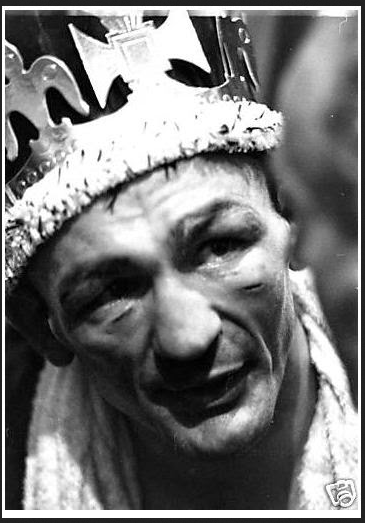
The four belts that were stolen from Carmen Basilio's case comprised of Basilio's New York State welterweight title belt, (which he won on June 6th, 1953, by beating Billy Graham for the New York State Welterweight title,) and his three world championship belts, all awarded to him by The Ring Magazine. Carmen won the first of these three belts on June 10th, 1955, when he beat Tony Demarco for the World Welterweight title in the first of their two savage classics. The second belt was awarded to Basilio after he stopped Johnny Saxton in 9 rounds, on September 12th, 1956, (having controversially lost the title to Saxton six months earlier.)
Basilio gained his third world championship belt after scoring the most memorable victory of his career, by outpointing Sugar Ray Robinson September 23rd, 1957, to win Robinson's World middleweight crown.
It's perhaps an understatement that Zale and Basilio won their titles the hard way. Zale was involved in The Ring Magazine's 'Fight of the year' three times running, from 1946 to 1948. While, Basilio was involved in battles, which won The Ring's 'Fight of the Year' vote a record five times in a row between 1955 and 1959.
Both fighters and their families loaned their championship belts to the IBHOF out of a sense of pride for their ring achievements, and a desire to share their accomplishments with their fans, both young and old. Each man felt very strongly about inspiring the younger generation to achieve their full potential in life, whether it be through boxing or other endeavors.
Basilio gained his third world championship belt after scoring the most memorable victory of his career, by outpointing Sugar Ray Robinson September 23rd, 1957, to win Robinson's World middleweight crown.
It's perhaps an understatement that Zale and Basilio won their titles the hard way. Zale was involved in The Ring Magazine's 'Fight of the year' three times running, from 1946 to 1948. While, Basilio was involved in battles, which won The Ring's 'Fight of the Year' vote a record five times in a row between 1955 and 1959.
Both fighters and their families loaned their championship belts to the IBHOF out of a sense of pride for their ring achievements, and a desire to share their accomplishments with their fans, both young and old. Each man felt very strongly about inspiring the younger generation to achieve their full potential in life, whether it be through boxing or other endeavors.
 |
| Awarded Ring Magazine Belt by Nat Fletcher |
Ironically the IBHOF was built around Carmen Basilio, who was and still is, the most famous and successful fighter to come out of the small town of Canastota. The town's only other world champion is Carmen's nephew, Billy Backus, who won the welterweight title in the early 70s. The museum is adorned by life-size statues of both Carmen and Billy.
Tony and Carmen's belts were won in an era where it was so much tougher for a fighter to reach world championship status than it is today, and the chances of a world title chance, even if you managed to get rated in the world top ten, were few and far between. The belts themselves are a long way from the mass produced belts handed out to fighters today. They were hand-crafted and each one was unique and one of a kind. Aside from their physical uniqueness, the value of the belts to each fighters families cannot be overemphasized. These are precious, irreplaceable heirlooms, which carry so many memories for each family, especially now that both Tony and Carmen have sadly passed away.
Although three years have passed since the theft, there have been few leads in the chase for answers to their whereabouts. The Zale family have been very proactive in their attempts to find answers, and ultimately find all six stolen belts, and yet have found much of their efforts frustrated by a lack of communication with the Canastota Museum, and its director Ed Brophy.
Tony and Carmen's belts were won in an era where it was so much tougher for a fighter to reach world championship status than it is today, and the chances of a world title chance, even if you managed to get rated in the world top ten, were few and far between. The belts themselves are a long way from the mass produced belts handed out to fighters today. They were hand-crafted and each one was unique and one of a kind. Aside from their physical uniqueness, the value of the belts to each fighters families cannot be overemphasized. These are precious, irreplaceable heirlooms, which carry so many memories for each family, especially now that both Tony and Carmen have sadly passed away.
Although three years have passed since the theft, there have been few leads in the chase for answers to their whereabouts. The Zale family have been very proactive in their attempts to find answers, and ultimately find all six stolen belts, and yet have found much of their efforts frustrated by a lack of communication with the Canastota Museum, and its director Ed Brophy.
 |
| Tony and Ted Zale |
The Zale's frustrations at the Museum's lack of adequate security at the time of the thefts, (no on-site security guard and no CCTV) have been compounded over the past three years by Mr. Brophy's apparent unwillingness to take a proactive approach in trying to find the stolen belts, plus a complicated relationship with the local Canastota Police department that has often seemed unwilling to share any new information with the Zales. At times it has looked as if the IBHOF has been attempting to downplay the thefts so as not to attract adverse publicity. This could be seen from the beginning, when the museum delayed making the thefts public knowledge for five days, for reasons that are still unclear.
Despite a mention of the thefts on their website, the overall response of the IBHOF can be said at best, to be rather muted. Most of the publicity created about the loss of Tony and Carmen's belts has been generated by the Zales themselves, as they seek to keep the crime in the public eye in the hope that someone, somewhere will one day come forward with some crucial information.

The Zales were also hurt and frustrated by the IBHOF’s failure to offer a reward for the return of the belts for over three months after the theft. The IBHOF were finally persuaded to put up a reward after ex-world heavyweight champion, Mike Tyson, (who has taken a great interest in the theft of the belts) put up a reward of his own for the belts return.
Since the belts were stolen, the Zale family has also removed the remaining articles that had been loaned on Tony's behalf, including his Presidential Citizens Medal, which was awarded to Tony in 1990 by President Bush. While Tony was immensely proud of his Polish heritage he was equally proud of being an American citizen, and this award was important to him as he felt that it signified how he had been an inspiration to others through his achievements in boxing, both during and after his career.
Since the belts were stolen, the Zale family has also removed the remaining articles that had been loaned on Tony's behalf, including his Presidential Citizens Medal, which was awarded to Tony in 1990 by President Bush. While Tony was immensely proud of his Polish heritage he was equally proud of being an American citizen, and this award was important to him as he felt that it signified how he had been an inspiration to others through his achievements in boxing, both during and after his career.
 |
| Zale Presidential Citizens Medal Removed from the IBHOF by Zale Family |
“Receiving this medal was a confirmation that his life's effort and dedication to helping others was worthwhile,” remembers Tony's nephew, Ted Zale.
One of the saddest repercussions of the theft of the belts is that the Zale family felt it necessary to withdraw this medal from the museum, due to continuing concerns over its security. This is painful for the family, as they regret that visitors to the IBHOF can no longer share in Tony's accomplishments as he would have wished.
Yet there has seemingly been little to go on in the three years since the thefts, despite the involvement of the FBI and the fact that blood was found on the scene (thought to be of the perpetrator cutting themselves on a shard of glass during the theft.)
One of the saddest repercussions of the theft of the belts is that the Zale family felt it necessary to withdraw this medal from the museum, due to continuing concerns over its security. This is painful for the family, as they regret that visitors to the IBHOF can no longer share in Tony's accomplishments as he would have wished.
Yet there has seemingly been little to go on in the three years since the thefts, despite the involvement of the FBI and the fact that blood was found on the scene (thought to be of the perpetrator cutting themselves on a shard of glass during the theft.)
 |
| Zale's World Middleweight Belt Awarded After Beating Abrams |
Various rumours have grown in the last three years, ranging from money being collected on an insurance policy covering the belts, to the thefts themselves being an inside job.
Regarding the rumours that the IBHOF collected insurance money for the theft of the belts, Ted Zale had this to say:
“If this is true, what does that say to our family?”
The Zale family has also heard rumours recently that the belts have been located. But, these rumours have yet to be proved ultimately true or false. For the moment at least, all six championship belts remain missing.
There is little chance of the belts ever being sold on the open market, and as they were not made of gold they would be worthless melted down. The only remaining way that the thieves could profit from their theft is by selling the belts on the black market. There also remains the possibility that the theft was made-to-order.
Regarding the rumours that the IBHOF collected insurance money for the theft of the belts, Ted Zale had this to say:
“If this is true, what does that say to our family?”
The Zale family has also heard rumours recently that the belts have been located. But, these rumours have yet to be proved ultimately true or false. For the moment at least, all six championship belts remain missing.
There is little chance of the belts ever being sold on the open market, and as they were not made of gold they would be worthless melted down. The only remaining way that the thieves could profit from their theft is by selling the belts on the black market. There also remains the possibility that the theft was made-to-order.
 |
| Tony Zale Wearing His Belts |
From the Zale's point of view, the theft of Tony's belts is made all the more poignant by the fact that Tony suffered some severe hard times after he retired from the ring, and even found himself homeless at one point. Yet, this proud man kept his struggles to himself as much as he could and no matter how bad his economic hardships became, he always refused to sell his hard-won championship belts.
How unfortunate then, that these belts which meant so much to Tony, are now in the hands of someone who has no right to hold them.
The mission statement of the IBHOF is to ‘Honor and preserve boxing's rich heritage, chronicle the achievements of those who excelled, and provide an educational experience for our many visitors.’
The Zales feel that the stolen championship belts have fallen victim to the IBHOF failure to live up to its mission to ‘preserve and protect’.
There remains a reward of 15,000 dollars for any information leading to the recovery of the six missing belts. As of yet, there have been no takers.
How unfortunate then, that these belts which meant so much to Tony, are now in the hands of someone who has no right to hold them.
The mission statement of the IBHOF is to ‘Honor and preserve boxing's rich heritage, chronicle the achievements of those who excelled, and provide an educational experience for our many visitors.’
The Zales feel that the stolen championship belts have fallen victim to the IBHOF failure to live up to its mission to ‘preserve and protect’.
There remains a reward of 15,000 dollars for any information leading to the recovery of the six missing belts. As of yet, there have been no takers.
 |
| $15, 000 Award for the Return of the Belts |
Hopefully, this is a mystery which one day will be resolved.
If you would like to find out more about the stolen belts, or perhaps have any information that could be helpful in their return, please look up #bringbackthebelts @bringbackthebelts on social media.
Facebook:
or the Zale's own website www.tonyzale.org
Family of Tony Zale on theft of boxing belts: 'They stole our heritage'
Follow us on Twitter: @TheBoxingGlove and
Facebook: www.facebook.com/theboxingglove If you are an boxer, amateur or professional, and want us to follow you or tell your story, contact petersilkov@yahoo.com or theboxingglove@yahoo.com
If you are an author and you would like your book reviewed, contact Peter Silkov at petersilkov@yahoo.com or theboxingglove@yahoo.com


