Showing posts with label peter silkov.. Show all posts

Sunday, May 8, 2016

TBG Book Review: Facing Tyson: 15 Fighters 15 Stories


The Boxing Glove Sunday Night Book Review 

By Peter Silkov 

"Facing Tyson: 15 Fighters 15 Stories" Written by Ted Kluck


Once upon a time, not so long ago, (though it may seem like a lifetime ago for some people), ‘Iron’ Mike Tyson was universally accepted as ‘The Baddest Man’ on the planet.  For a relatively short time in the mid to late 1980s, Mike Tyson was the Heavyweight champion of the world, and seemed to be invincible.  His aura of indestructibility, and destruction instilled a fear into many of his opponents not seen since the days of Foreman, Liston, and Louis.  Many of Tyson’s opponents during his peak years were beaten before they entered the ring. Nothing puts fear into a fighter such as knowing that your opponent can separate you from your senses with one punch.  Even after Tyson was sensationally beaten by Buster Douglas and lost his world title, his aura of violent menace lingered.  Right up to the end of his career, when he was fighting from memory. and going through the motions in an effort to recoup some of his squandered fortune. Tyson’s punching power still demanded some respect from everyone who entered the ring against him.

What must it have been like to enter the ring against Mike Tyson? This is the question that Ted A. Kluck asks in "Facing Tyson."  He has tracked down 15 of Tyson former opponents, from various points of his career, and asked them to tell their stories. The result is a fascinating kaleidoscope of characters, who in some aspects could not be more different from each other, yet in other ways, share some common bonds that go way beyond the fact that they all, at one time, had Mike Tyson facing them in the opposite corner.

The stories we hear are much more than simple recollections of each man’s experience at the fists of the ‘Iron’ one.  We get to look into these men’s psyches and find out what it is that drove many of them into a boxing ring in the first place. In some of their stories, their encounter with Tyson proves to be almost incidental, and the least interesting part of their life story.  For others fighters in this book though, their meeting with Tyson has proved to be not just the pinnacle of their boxing career, but the defining moment of their life.

Quite often we find that the greatest struggles for the boxers interviewed in "Facing Tyson" have come outside of the ring, and many times with themselves and their own demons.  Boxing is shown to be a bittersweet element in many of these fighters’ lives. On one hand, it has saved them from self-destruction on the streets, and a life of drugs and crime,  yet it has often inflicted a price of its own, in damage both physical and psychological.
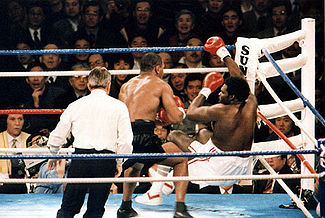
The men included here vary, from the fringe contenders, whom Tyson fought at the beginning of his career, such as, Sam Scaff, Mitch ‘Blood’ Green, Marvis Frazier, and Jose Ribalta, to some of the men he faced during his world title reigns, including, Tyrell Biggs, James ‘Bone Crusher’ Smith, Evander Holyfield, and Pinklon Thomas.  The book ends with the tales of a number of the men who faced Tyson in his declining years, including Lou Savarese, Lennox Lewis, and Kevin McBride.
  
Perhaps the one glaring omission from this book, is the lack of an interview with Buster Douglas, the first man to really burst Mike Tyson’s iron bubble.  Although this admission is apparent, the author has put together a fascinating, and fast-moving glimpse into a part of boxing history.  It is very thought provoking to read about how these very different men dealt with not only their respective fights with Tyson, but their individual boxing careers as a whole, and also their lives after boxing. Perhaps Kluck’s greatest achievement in these pages is his ability to coax so much more out of each fighter, far beyond their facing Mike Tyson.

While Tyson is not interviewed himself in ’Facing Tyson’ he is of course a constant presence within its pages.  He emerges once more as an enigma, not just to those he has fought but perhaps most poignantly, to himself as well. The book was originally published in 2006 and the copy I have, is the 2009 edition. There are no photographs in the book.

*The book does not contain photographs, the photos on this page are not from the book. 

*Book available at Abe Books and Amazon:


Copyright © 2016 The Boxing Glove, Inc. Peter Silkov Art. All Rights Reserved. Peter Silkov contributes to www.theboxingglove.com

Sunday, December 6, 2015

40 Years Ago Today: John H. Stracey Defeats Jose Napoles To Capture the Welterweight World Title


 By Peter Silkov

When Tyson Fury sensationally captured the World heavyweight championship from Wladimir Klitschko last week, with a performance and victory that quite literally shook the boxing world, it was rather apt that he did so almost 40 years to the day that John H Stracey beat Jose Napoles for the Welterweight championship of the world.  It was a victory, which still ranks alongside the greatest performances by a British boxer abroad.

The date was December 6, 1975, when Stracey separated Napoles from his beloved welterweight crown.  Stracey made his challenge in the Monumental Plaza De Toros, in Mexico City, Mexico. The match was in a Mexican bullring that housed 40,000 people, and was so full and fiery, that it looked as if at any moment that the crowd was about to rush forward, and swallow up the ring.

Napoles was already a ring legend, who had dominated the welterweight division for over 6 years, and was considered one of the greatest boxers ever to hold the 147-pound title. He had been a number one contender for many years, at lightweight, and then light welterweight, before finally receiving his title shot at welterweight. Born in Cuba, Napoles had fled to Mexico in the early 60s, when Castro outlawed professional boxing, and was soon gladly adopted by the Mexican boxing fans as one of their own. Napoles’ nickname was ’Mantequilla’, which in Spanish means butter, a description that alluded to Napoles’ smooth effortless boxing style. He was a masterful technician, yet beneath the silky skills, Napoles was also a devastating puncher when he chose to be.  With such ability, it was hardly surprising that it took Napoles so long to secure a world title shot.

By the time he defended his title against England’s Stracey, ’Mantequilla’ was 35 years of age, although some guessed that he might be at least 5 years older. Whatever his age there was no denying that the old maestro was not quite the fighter that he had been when he first won his world crown. The speed and reflexes had become dulled by age, and years of making the 147-pound limit, while the legs were no longer the nimble tools they had once been, and above both eyes there was the scar tissue of almost 20 years of ring warfare. 

When he stepped into the Mexican bulling ring that day, Stracey was a well-respected boxer, the reigning British and European Welterweight champion, but no one expected him to unseat the legendary Napoles.

Despite his age and ring-wear, Napoles had produced an impressive display in his most recent title defence, to outwork, and outbox arch rival Armando Muniz. 

Although his speed and skills may had diminished with age, it was generally agreed in boxing circles that Napoles would have too much for the likeable Stracey, who was a good boxer, with a decent punch, but didn’t seem equipped to beat a legend of Napoles caliber.  After all, Napoles had just beaten his number one challenger Muniz, just five months earlier.

The fight began with both men showing that they meant business. Stracey, known usually as a slow starter, was coming forward, using his solid jabs, seemingly determined to set the kind of fast pace, which the 35 year old Napoles would not enjoy. Meanwhile, the champion was setting a high-pace of his own as he swung away with both hands, looking for an early stoppage victory. Mid way through the 1st round it looked as if an early victory was within the champion’s grasp, as a dynamite combination of punches, which showed just why Napoles was known as ‘Mantequilla’, put Stracey onto the deck. As the crowd howled and cheered with premature jubilation, Stracey beat the count, and weathered the storm of leather that Napoles then through at him in a desperate attempt to land a finishing blow. By the end of the round the challenger was fighting back, and there was already a weariness about Napoles when he returned to his corner at the bell. 

In the 2nd round Stracey continued to put intelligent pressure onto the champion, working mainly behind his excellent jab, while also looking to land his damaging right hand. Napoles was seeking to control matters with his combinations, and jabs of his own, yet there was a glimmer of panic in the champion’s fighting, and a suspicion that he had already shot his bolt in that 1st round.

In the 3rd round, it became clear that the 40,000 plus fans, weighing down the bullring that night, were watching the crumbling of their champion and idol. The fight was still being fought at a frenetic pace, but while Stracey was growing in confidence and strength with every passing minute, Napoles, was beginning to look like a wound up toy that was suddenly slowing down. Although he continued to valiantly fight back, Napoles couldn’t get away from Stracey’s precise punches, especially that pole like left jab. Napoles was already cut over the right eye and his left eye was swelling.

The beginning of the end was signaled near the end of the 3rd round, when Napoles briefly hit the canvas after taking a Stracey left hook. Although he beat the count, amid cushions being thrown into the ring by the suddenly stricken Mexican crowd, Napoles fate had been set. Stracey would not be denied on this night. For the ensuring rounds, Napoles was no longer trying to defend his title, he was simply trying to survive, as Stracey landed upon him at will, only the courage, and guile of a great champion was keeping Napoles standing.

By the 6th round the fight had become a massacre, with Napoles’ face now a mask of swollen flesh and blood. Unable to see the punches coming at him from his inspired challenger, Napoles tried to bob and weave as he had done so often in the past, but instead resembled a drunk staggering down a rain soaked street. As Napoles teetered on unsteady legs, Stracey stepped up his attack, raining blows upon the wilting champion, and driving him about the ring. Finally the referee had seen enough, and stepped between Stracey and Napoles, while signaling the end of the fight. It was a merciful stoppage that saved Napoles the indignity of being beaten into an even more devastating defeat. Napoles went out like the great champion he was, bloodied and battered almost beyond recognition, but still on his feet.

John H. Stracy was the new Welterweight champion of the world. His celebrations with his corner, which included his father, were jubilant, while a wave of sadness and despair swept over the beaten champion and his corner men. The Mexican crowd stood on its feet, not quite sure what to do as they looked on in a mixture of shock and horror at what had happened to their treasured ’Mantequilla.’

Yet, there was respect too for the Englishman who had come over and beaten the champion into defeat. Stracey was Britain’s first World welterweight champion since Ted ‘Kid’ Lewis, and one of the few British fighters to win a world title abroad.

Even today, with a multitude of world titles available for a diluted supply of contenders, very few British fighters win their world titles abroad, let alone somewhere as hostile as a Mexican bullring.

John H. Stracey’s victory over Jose Napoles still stands as one of British boxing’s greatest nights.  The night when a boxer from Bethnal Green beat a Cuban born, Mexican legend.

Copyright © 2015 The Boxing Glove, Inc. Peter Silkov Art. All Rights Reserved. Peter Silkov contributes to www.theboxingglove.com

Watch the fight here:


Friday, November 27, 2015

Wladimir Klitschko vs. Tyson Fury: Weekend Prediction & Preview


By IDran James

Tomorrow night there will be a number of big fights taking place. The biggest of them all will be the World heavyweight title fight between Wladimir Klitschko (64-3, 54 KOs) and Tyson Fury (24-0, 18 KOs) in Germany. At one point it looked as if the match was in jeopardy due to a dispute over gloves, but now everything seems to have been sorted out and agreed, and the fight will finally go ahead. Fury will be watched by a large contingent of British fans that have made their way over to Germany to support him, but has Tyson got a chance of springing an upset?

The champion is hugely experienced (he's had more world title fights than Fury has had fights) and very sound technically and physically. If Wladimir has a weakness, it is his chin, he has been stopped 3 times during his career, but has remained unbeaten in the last 11 years. When compared statistically, the only advantages that Tyson has got is his youth, and size. Yet, these could be two aspects that can give him a crucial edge and a little more of a chance. It is also interesting to note that some years ago Tyson was chosen as the possible successor to the Klitschko brothers by, none other than Emanuel Steward, the trainer who turned Wladimir into a near invincible fighting machine.

Realistically, no fighter is truly invincible, especially when they are on the cusp of 40 years of age. Perhaps Fury's biggest motivator is the fact that most people are giving him little chance of winning, that and Fury's own confidence in himself, which despite the pressure of the big fight, seems to have survived undimmed. If Fury can survive the early rounds when Wladimir looks certain to be looking for a knockout, then there is the interesting possibility that Fury may be able to get his jab going and begin utilizing his height and size advantage, which could make things very interesting. Fury is better than he is often given credit for, and if he can produce the fight of his life tomorrow night, then the world of boxing could be in for a surprise. Logic tells us that Fury will not win, and the champion is too experienced and too good, but boxing is not logical, and sometimes a person who is inspired can overcome all logical bounds. This is the beauty of boxing.

The undercard:

Robert Tlatlik    (17-0 ) vs. Said Rahimi (9-2). Light Welterweight. 10 rounds.
Hugie Fury (17-0) vs. Adnan Radovan (16-1). Heavyweight. 10 rounds.
Jono Carrol (8-0) vs. Miguel Gonzalez (13-0). Junior Lightweight. 8 rounds.
Samy Raid Musa (8-0) vs. Jay Spencer (10-0). Super Middleweight. 6 rounds.
Patrick Korte (2-0) vs. Moises Distino (2-0). Heavyweight. 4 round.


Wladimir Klitschko weighed in at 245.8 and Tyson Fury weighed in at 246.9:


Watch


If you would like a full list of the many fights going on this weekend, visit Boxrec’s calendar with the  full listings. http://boxrec.com/calendar?v=d&d=2015-11-28


Copyright © 2015 The Boxing Glove, Inc. Peter Silkov Art. All Rights Reserved. Peter Silkov contributes to www.theboxingglove.com

Sunday, November 22, 2015

When Greatness Collides: Ruben Olivares vs. Alexis Arguello


By Peter Silkov

“I was caught cold with that first shot. No, I have no excuses. I thought I was winning the fight, but things are never over until the final bell. I don’t know what else I can say.” Ruben Olivares.

“I was fighting for my life. Olivares hurt me in the 8th, 9th and 10th rounds. I felt like I might go down in the 10th. This is a very happy and proud day for my country and myself.” Alexis Arguello.

When Alexis Arguello 35-4-0 challenged Ruben Olivares 78-4-1 for his WBA world featherweight championship on November 23, 1974, it was a clash of two boxing greats at opposite ends of their careers. Mexican Olivares at age 27 was already a legendary figure, having been an outstanding World bantamweight champion before moving up to capture the featherweight crown. The colourful Olivares lived fast, both in and outside the ring, with a rock and roll all-action fighting style, which at his best, had made him seemingly invincible for a time. Although he was the reigning WBA world featherweight champion, it was generally considered that Olivares was already a little past his best, the aura of invincibility that he had carried early on in his title reign at bantamweight, had been punctured by defeats to Chucho Castillo, Rafael Herrera and Art Hafey. The invincibility that had taken Olivares to a record of 61-0-1 before his first career defeat had become coloured by an unpredictability, which ironically, had only added to his popularity with the fans.

Despite Olivares’ vulnerability, he was still an extremely formidable fighter and his opponent, Arguello, entered the ring at the Inglewood Forum, a clear underdog. Arguello was 22 years old, and had battled his way into title contention since turning professional at the age of 16 in 1968. Arguello had the reputation of being a rangy box-puncher, and had lost a previous bid for the WBA world title when he had been out-pointed by Ernesto Marcel nine months previously. No one knew that Alexis Arguello was destined for a greatness of his own. This fight with Olivares would prove to be Arguello’s first step to ring immortality.

The match was given an extra intrigue as both men had previously sparred together in 1971. Olivares must have remembered those sparring sessions as he entered this fight in good shape and taking his young challenger very seriously.

The match started off with both men boxing cautiously, each aware of the ability of the other. Arguello shaded the first two rounds with his long left, but Olivares was boxing well himself, and showing his often underrated boxing skills as he looked for openings. In the third round, the action heated up as the champion began going for Arguello’s thin body, and the two started to engage in some thrilling punch for punch exchanges. By the middle rounds, Olivares had gained the upper hand and seemed to be in control of the action, as he used some good movement to move in and out of range, and launched two-fisted attacks at the challenger’s head and body. However, Arguello was still in the match and made every round close as he sought to counter Olivares attacks, but the Mexican’s punches seemed to be too many and too varied for the Nicaraguan challenger to overcome. Ruben had especially good rounds in the 8th to 10th rounds, as he seemed on the verge of overpowering his young challenger. Yet, in a preview of the ability that would make him a triple weight world champion over the next 6 years, Arguello kept his boxing together under Olivares’ attacks, and continued to counter with well-timed punches of his own.

By the 11th round, Olivares was displaying some signs of slowing down, wearying from his own frenetic pace and the youth and pinpoint counters of his challenger.

In the 12th round, a right hand from Olivares seemed to stagger Arguello and drive him into the ropes. The champion responded by launching a furious two-fisted assault upon Arguello, designed to end the contest then and there. Instead of finally folding up, Arguello lashed back with punches of his own, so that by the end of the round it seemed to be Olivares who was in trouble rather than Arguello.

This became clear in the 13th round. As the boxers resumed the action, Arguello dropped the champion with a left uppercut, which only traveled a short way, but had a big impact. Olivares dropped heavily to the canvas, but managed to beat the count, and after a slight delay to have his gum-shield replaced, was ready to continue. Some fighters might have sought to hold for dear life at this point, and ride out the storm until their head had cleared, and some fighters may have choose to retreat until the rescuing chimes of the bell ending the round. Not Ruben Olivares, he just headed straight back into battle with Arguello, and an explosive combination from “El Flaco Explosivo” (The Explosive Thin Man) dropped Olivares once more. This time his eyes were bleary, and he shook his head repeatedly as he got himself up to his knees, and then staggered to his feet, just after the referee had counted to ten.

It was a dramatic conclusion to what had been a tense and stirring battle from start to finish. As great fights go, this tends to be one of the more overlooked classic fights.

There were still some more nights of greatness to come for Olivares, just seven months later he would win the WBC world featherweight championship by beating Bobby Chacon in 2 rounds. For Arguello, it was the start of a long period of success that would see him reign unbeaten in three divisions, until finally Arron Pryor would beat him in 1982 when trying for a record 4th world’s championship. By then Arguello’s own greatness was already well and truly sealed.

Ruben Olivares and Alexis Arguello’s 1974 clash is a fascinating example of two great fighters meeting each other at opposing periods of their careers, and putting together a fight to remember.

Watch the fight:


Copyright © 2015 The Boxing Glove, Inc. Peter Silkov Art. All Rights Reserved. Peter Silkov contributes to www.theboxingglove.com
 

Bob Foster: Former Light Heavyweight Champ Dies at Age 77


By Peter Silkov


The word legend is one that is parried around far too much these days, along with great, and champion.  There are too many fighters today who would like to be given these accolades, but are unwilling to pay the price needed to truly earn them.  Bob Foster, who passed away yesterday at the age of 77, was truly a ring legend. He was a great world champion, at a time when being champion of the world really meant something. Foster reigned supreme at light-heavyweight from 1968 to 1974. In that time, he defended the World light heavyweight championship a record 14 times, before retiring as undefeated champion.  Amongst all the carnage he left behind in the 175-pound division, he also found time to stand up to the world boxing bodies when they tried to tell him what to do.

Standing 6’ foot 3“, Foster was almost freakishly tall for light-heavyweight.  He was the perfect boxer-puncher, lean and mean, with a dynamite punch to go with his slick boxing skills. These skills included a rapier like jab, which was a dangerous weapon in its own right.  Foster had the kind of power that didn’t just stop fighters, but hurt them. The kind of punch that had many of his opponents out to the world before they had even hit the deck.

Foster was born Robert Lloyd Foster on April 27, 1938, in Borger, Texas.  As a youngster, he found himself fighting regularly on the streets, and discovered early on that he could lay an opponent out with rare ease. Foster was also a talented football player, but gravitated more to boxing as he grew older. However, it was not until Foster joined the U.S. Air force in 1957, that he became fully focused on following a path in boxing.  Foster joined the USAF boxing team, and would win the All Service Championships 3 times, and won the Middleweight silver medal at the 1959 Pan American Games.  He would go on to lose just 3 of 100 fights as an amateur.

When  he was due to be discharged from the Air Force, Foster found himself in demand for his boxing ability, and was given offers to join the Marines, Navy, and the Army. He eventually chose the Army, where he was stationed at  Fort Cameron in Kentucky.  But, with a young family to support, Foster felt that he could make a better future for himself as a professional boxer, and so after a few months at Fort Cameron, he had himself discharged, and turned professional, fighting his first contest on March 27, 1961, where he scored a 2nd round knockout over Duke Williams.  Foster’s decision to turn professional turned out to be one that would not only change his life, but save it.  Eventually, according to Foster, every member of the Fort Cameron boxing team would lose their lives in Viet Nam.

Despite starting his career on an impressive note, Foster soon learned the harsh reality of professional boxing.  With his impressive amateur record, and obvious punching power, opponents were soon unwilling to face him.  When fights against men of his own weight were hard to come by, Foster was forced to take on heavyweights.  In just his 10th contest on October 20, 1962, Foster was put in with top ranked heavyweight contender Doug Jones, and was stopped in the 8th round, by the heavier, and more experienced Jones. Over the next 3 years, Foster took fights where he could get them, winning with ease when fighting fellow light-heavies, but also having to give away weight regularly against heavyweights.  During this time, Foster won 12 fights and lost 3, with all his defeats coming against ranked heavyweights.  Foster was out-pointed by Mauro Mina (whose 45-2-2 record dwarfed Fosters 11-1 record) and Zora Folley, and stopped in 7 rounds by Ernie Terrell.  After his 10 rounds points loss to Zora Folley on December 6 1965, (to whom Foster gave away over 30 pounds in weight) a disgusted and disenchanted Foster walked away from boxing.  Yet, the feeling of unfinished business and unrealized ambition was too strong to ignore, and after a year out of the ring, Foster returned in late 1966, determined to secure a shot at the world light-heavyweight title. Over the next year, Foster won 8 fights in a row, and consolidated himself as the number 1 contender for the 175-pound.

The world title shot finally came on May 24, 1968, with Foster having to guarantee the champion Dick Tiger $100,000 dollars, while collecting $10,000 for himself.   Foster didn’t mind the uneven distribution of the purse, as he was confident that his pay days would come once he had won the World Light-Heavyweight championship, which he duly achieved by knocking Tiger out in the 4th round.  This was the only time that Dick Tiger was ever knocked out during his career.

It was the beginning of Bob Foster’s rule of terror over the light-heavyweight division, and of his 14 defences, only 3 would last the distance, and those were the last 3 defences when Foster was clearly on the slide.  Much like a gunslinger, from a classic western, Foster had a way of eyeing his beaten challengers after he had sent them down to the canvas for the final time. Some of Fosters victories were truly chilling.  In 1972, he defended his title against Mike Quarry, who was undefeated in 35 contests.  Foster dropped Quarry with a right hand and a left hook, which left the challenger unconscious on the canvas for a worryingly long time. 

In 1970, Foster had a dispute with the WBA and was stripped of recognition as world champion,  with  Vincente Rondon winning the ‘vacant’ title on February 27, 1971, by knocking out Jimmy Dupree in 6 rounds. Yet, Rondon would never gain acceptance as champion from the general public, and Foster’s dominance of the division was underlined when he regained the WBA title on April 7, 1972, destroying Rondon in 2 rounds.

Foster’s only defeats during this time were to Joe Frazier and Muhammad Ali.  On November 18, 1970, Foster challenged Frazier for the World heavyweight championship, but Frazier, at 209 pounds to Foster’s 188 pounds, was far too strong, and knocked Foster out in the 2nd round.  Two years later, on November 21. 1972, Foster took on Muhammad Ali for the NABF Heavyweight title, giving away 41 pounds to ’The Greatest.’  Although Foster put up a brave stand, including cutting Ali over the left eye, he was floored 6 times, and eventually counted out in the 8th round.

On September 26, 1972, Foster defended his title against England’s Chris Finnegan, scoring a 14th round knockout, after an epic battle, which was later that year voted by The Ring magazine as the ‘fight of 1972.’ 

Foster was taken the distance twice in 1973 by wily South African, Pierre Fourie.  Then on June 17, 1974, Foster was held to a 15-round draw by the teak-tough Jorge Ahumada.  With the signs of decline visible, Foster announced his retirement 3 months later.

Like many before, and after him, Foster found it hard to say goodbye to the ring, and returned in 1976, for what was a strange, almost part-time comeback.  Fighting infrequently, against mostly mediocre heavyweights, Foster had 7 more fights, winning 5, and losing the final 2.  After being stopped in 2 rounds by Bob Hazelton, on June 2, 1978, Foster hung his gloves up for the final time.

After his retirement, Foster would become a detective at the Bernalillo County Sheriff's Department. He was well known in the Albuquerque area for his service. He would also train boxers part time. In 1990, he was inducted into the newly established International Boxing Hall of Fame, along with other boxers such as Dick Tiger, Joe Frazier, and Muhammad Ali.

Bob Foster’s final record was 56(46koes)-8-1.  He is generally regarded as one of the greatest light-heavyweights of all time, and as one of boxing’s greatest punchers, pound-for-pound.  At a time when the best fought the best, and there were not more world champions than genuine contenders, Bob Foster was one of the best, and most feared champions of his time. 

Copyright © 2015 The Boxing Glove, Inc. Peter Silkov Art. All Rights Reserved. Peter Silkov contributes to www.theboxingglove.com

Monday, November 16, 2015

Panama Joe Gans: A Champion Denied a Crown


By Peter Silkov

Panama Joe Gans was one of the most talented fighters of the 1920s, but through a mixture of bad luck and the colour bar, which existed during this time, Gans was denied the chance of fighting for a world title.  Panama Joe was born Cyril Quinton Jr., on November 14, 1896, in Barbados.  When he was a young child his family relocated to Colon, Panama, but life was to be far from easy, especially after Quinton’s father died when Quinton was just 10 years old.  Quinton was soon getting into trouble on the streets as he tried to find money to help his mother feed the family, and things grew worse when Quinton’s mother met a new man, a stepfather whom Quinton despised.  Soon Quinton was living more on the streets than at home and mixing with a gang of petty thieves. 

When he was 12 years old, Quinton was caught by police stealing fish from a local market, and was placed into a detention centre where he would remain for the next 4 years.   

However, far from being the ruin of him, the detention center would turn out to be a positive influence upon Quinton.  The centre was run by the church, and while he was there, Quinton learned to read, write and most important of all, to box. This was the first place where he found that he was naturally gifted with his fists, and started to dream of making his fame and fortune as a world champion boxer.

Upon his release, at the age of 16, Quinton was soon participating in ’smokers’ unofficial fights, which usually took place in the back rooms of saloons.  It was while fighting in these ’smokers’ that Quiton first took on the name of Panama Joe Gans, after the late legendary World lightweight champion, Joe Gans. 

Quinton soon outgrew the ’smokers’ and in 1914 began his official boxing career.  He quickly became a big attraction amongst the Panama fans, and within a year was fighting main events scheduled for 15 and 20 rounds.  Quinton developed into a boxer worthy of carrying the name of Joe Gans. He was a brilliant all-round boxer with skill, speed, and a knockout punch.  But, as his boxing career developed, he would find that his ability, along with his colour, would prove to be his biggest obstacle to reaching the very top, and gaining the world title in which he dreamed.

Starting his career as a lightweight, Quinton soon developed into a welterweight.  His success soon found him forced to take on middleweights, and even light heavyweights, and for much of his career he would often give away weight to his opponents.  It was often the only way that he could secure a fight. 

After winning the Lightweight and Middleweight titles of Panama, Quinton had exhausted his competition in Panama and in 1917 moved to America, basing himself in New York’s Harlem.  In 1918, Quinton was conscripted for a time in the United States Army, reporting to Camp Upton, in Yaphank, NY.  When his boxing background was discovered, Quinton was put to work training the coloured recruit’s in the finer points of boxing.  During his time at Camp Upton, Quinton came to know the camp’s main boxing instructor, Benny Leonard, who had just recently won the World lightweight championship.  The two men would often spar, to keep Leonard trim. Leonard took Quinton under his wing, and taught him some invaluable tricks of the trade that he began to put to good use when he was discharged from the Army at the end of 1918.    

Part of Quinton’s reputation was made in 1919 when he drew praise for his work as a sparring partner for World heavyweight champion Jack Dempsey, when Dempsey was getting ready for his title defence against Billy Miske.  Quinton gave Dempsey some of his hardest workouts, despite giving away 40 pounds to the heavyweight champion.

From early 1919 until October 1922, Quinton went 47-2-4 in 53 recorded bouts against an impressive array of top middleweights, and light-heavyweights.  His victories during this time included wins over top fighters such as Jeff Smith, Jamaica Kid, Frank Carbone, Allentown Joe Gans, Jackie Clarke, George Robinson, Tiger Flowers, Nero Chink, and Jack Blackburn. Quinton’s only defeats during this time were disputed newspaper decisions to Jock Malone and Mike Mctigue.   

Despite his success and popularity with the American fans, Quinton could not secure a world title shot, and found himself avoided by top white middleweights such as George Chip, Mike O’Dowd and even Harry Greb, all of whom would not meet him in the ring.  Many boxing people at this time viewed Quinton as being the uncrowned Middleweight champion of the world.  The fact that he never got a chance to challenge for the world’s title, is an indictment of the racist atmosphere of those times.  Ironically one of Quinton’s victims, Tiger Flowers, would himself gain a shot at the World middleweight title in 1926, and beat Harry Greb for the title.  Unfortunately, Flowers was an exception to the general rule of the time. Indeed, he was the first coloured world champion since Jack Johnson lost the World heavyweight title in 1915.

Instead, Quinton had to be content with winning the ironic ‘coloured’ Middleweight championship, which he won from George Robinson on October 8, 1920, after he out- pointed Robinson over 12 rounds.  Quinton would defend this title a number of times over the nest few years, often against other coloured contenders who, like him, were avoided by the top white fighters.

In 1923, Quinton went from being seemingly unbeatable, then his form noticeably dropped after he had suffered a bout of pneumonia, and went a moderate 9-5 in 1923.  Quinton suffered a second, near fatal, attack of pneumonia in late 1923. Although he recovered, defying doctors who had told him he would never box again, and returned to the ring in 1924, the illness left a permanent mark upon Quinton. He was never the same fighter he had been previously.

Quinton lost his Coloured Middleweight championship to Larry Estridge, on June 26, 1924. He then lost a rematch against Estridge two months later, with only his courage taking him the distance in both fights.  It was downhill for Quinton from there on, he went 4-8-2 in his remaining 14 contests, before finally hanging up his gloves in 1928.  He retired with a final record of 72(43koes)-20-7.  One of the most talented fighters of boxing’s golden era, yet, a victim of the times in which he lived. That and his misfortune to lose his athletic ability to illness while still his prime. 

Cyril Quinton died on June 28, 1968, at the age of 72.  He had long since been forgotten by most boxing fans, except for those who had seen or read about him during his heyday. Many considered Panama Joe Gans to be one of the finest fighters of his time.  A true champion who was denied a crown.

Copyright © 2015 The Boxing Glove, Inc. Peter Silkov Art. All Rights Reserved. Peter Silkov contributes to www.theboxingglove.com

Saturday, November 14, 2015

Guillermo Rigondeaux Returns to the Ring Saturday November 21


Guillermo Rigondeaux, (15-0, 10koes) generally acknowledged as one of the best boxers, pound-for-pound, in the world, returns to the ring this Saturday, November 21st on the Miguel Cotto vs. Saul ‘Canelo’ Alvarez under-card, at the Mandalay Bay Hotel and Casino in Las Vegas, Nevada. 

Rigondeaux, who has been unable to find any high ranking opponents willing to meet him, will face fringe contender Drian Francisco (28-3-1, 22koes) who hails from Sablayan, Occidental Mindoro, Philippines. It is not clear if any titles will be on the line when Rigondeaux faces Francisco, since recently he has been unceremoniously stripped of his WBO and WBA world Super-Bantamweight titles, but is still the holder of The Ring magazine super-Bantamweight belt.  Ironically, Rigondeaux, who was stripped on the basis of his ‘inactivity’, will now be fighting before the matches take place to decide his successors to the WBO and WBA belts.

This will be the brilliant Cuban’s first fight since his clinical destruction of Hisashi Amagasa in Osaka, Japan, last New Years Eve.  Since then, managerial and promotional problems, and his inability to find suitable opposition willing to fight him, have beset Rigondeaux.  Over two and a half years since he dismantled Nonito Donaire, with a masterful exhibition of counterpunching, Guillermo Rigondeaux struggles to find work in the ring.  He is an artist who has been blacklisted.

While his return on Saturday is obviously good news, it is still far from an ideal situation.  The opponent has been found at late notice, and the fight has received almost no publicity.  As with his last fight, Rigondeaux will be appearing with little fanfare or acclaim.  Depending on the schedule of his fight, there is a good possibility that this match will be in front of a sparse crowd. All of this must be a bitter irony for a man who already held the WBA belt, then went on to beat Donaire in 2013 for the WBO World super bantamweight title. After this victory, he must have felt like he proved himself to be an elite star, and with that stardom, doors should have opened to the big time and big fights. But, it hasn’t turned out that way.  Rigondeaux is still waiting for his big fight and big pay day.

For Drian Francisco, this is a fight of a lifetime.  Francisco is 33 years old and has been boxing professionally since 2005, and in that time, he has won several titles, including the WBO Asia Pacific Flyweight title, and the Interim WBA World Super-Flyweight titles.  Two fights ago, on May 30, 2015, Francisco was stopped in the 1st round by Jason Canoy, a defeat that he puts down to going into the fight sick.  It is the only stoppage defeat so far of his career.  This fight could transform Francisco’s life and career if he is able to produce a huge upset and defeat Rigondeaux. On the other hand, this match is very much one of the ‘no-win’ variety for Rigondeaux. If he beats Francisco with ease, he will be doing nothing more than what is expected of him. However, if he struggles, after being out of the ring for almost a year, then the chances are that a lackadaisical performance will be used as yet another excuse by the top fighters not to face him. Indeed, a defeat at this point for Rigondeaux could be an almost terminal blow to his career.

The best hope for Rigondeaux is that he can make short work of Francisco and that this contest may lead to other more challenging and meaningful fights under the Golden Boy banner.  Rigondeaux will be hoping that sooner, rather than later, he will be headlining a big show himself, rather than fighting on its undercard.  Yet, he does not want to overlook Francisco, who is a good solid boxer, with a good punch, just the kind of fighter who can be dangerous if he is underrated or overlooked.  There are those who have been looking to knock Rigondeaux off his perch, and an upset win over Guillermo would make Francisco an overnight star, at a time when Asian fighters are a sought after commodity with the emergence of China as the new, largely untapped, audience.  An on-form Rigondeaux should not have much trouble with Francisco, but the hope is that his recent inactivity, and various promotional and managerial distractions will not have taken too much of a toll on ‘The Jackal.’


Copyright © 2015 The Boxing Glove, Inc. Peter Silkov Art. All Rights Reserved. Peter Silkov contributes to www.theboxingglove.com

twitterfacebookgoogle pluslinkedinrss feedemail

Monday, November 9, 2015

Tony Zale & Carmen Basilio Belts Stolen from IBHF in Canastota

Photo Source: Haley Zale
On Thursday, November 5th,  the International Boxing Hall of Fame in Canastota in New York was burglarized and two championship belts of Tony Zale and four championship belts of Carmen Basilio were stolen.

Haley Zale, the niece of Tony Zale listed the belts and details of each belt on Monday afternoon:

"MISSING BOXING BELTS! Do not purchase! These were stolen from the International Boxing Hall of Fame on 11-5-15.

Tony Zale vs Georgie Abrams
NYSAC World Middleweight Title and National Boxing Association World Middleweight Title unified belt
Madison Square Garden, 1941

Tony Zale vs Rocky Graziano
National Boxing Association World Middleweight Title
Ruppert Stadium, Newark, NJ, 1948

Carmen Basilio vs Billy Graham
USA NY State Welterweight Title
Memorial Stadium, Syracuse, NY, 1953

Carmen Basilio vs Tony DeMarco
World Welterweight Title
War Memorial Auditorium, Syracuse, NY 1955

Carmen Basilio vs Johnny Saxton
World Welterweight Title
War Memorial Auditorium, Syracuse, NY 1956

Carmen Basilio vs Sugar Ray Robinson
World Middleweight Title
Yankee Stadium, 1957
— at International Boxing Hall of Fame.

We need a miracle! Tony Zale's championship belts have been stolen! MISSING!!!!"

If anyone has information, please contact Chief James Zophy at 315-697-2240 at the Canastota Police department.


Copyright © 2015 The Boxing Glove, Inc. Peter Silkov Art. All Rights Reserved. Peter Silkov contributes to www.theboxingglove.com
twitterfacebookgoogle pluslinkedinrss feedemail

Sunday, November 8, 2015

Jamie Cox Crushes Ferenc Albert: Calls Out The Best At 168 Pounds


By Peter Silkov


After a stop and start career, which saw him sidelined by injuries in 2012 and 2014, Jamie Cox (20-0, 12koes) is a man in a hurry, and proved it again last night when he successfully defended his WBO European super-middleweight title with a clinical 68 second knockout at Dublin’s National Stadium.  Hungarian challenger, Ferenc Albert (20-8, 9koes), barely got the chance to throw a punch before Cox’s punches had him on the floor.  The first knockdown came from a right hook to the head, which seemed to just clip Ferenc.  Ferenc bravely beat the count, but was then flattened by another right hook that caught him squarely on the jaw, and sent him down with a thud, with his head bouncing on the canvas.  It was a nasty knockout, and unsurprisingly, referee Mickey Vann abandoned the count at two.  This was Cox’s 3rd straight 1st round knockout since his return from his period of inactivity, which has seen him have just 4 fights in the past four years. 

Originally a light-middleweight and ex-Commonwealth champion at that weight, Cox has come back from his spells of enforced absence a more muscular and stronger fighter, whose mixture of speed and power at super-middleweight is fast making him one of the most talked 168-pound fighters in the country.  It’s not so much who he has beaten, but the way he has been beating them.  Albert was a respectable opponent who had won his last 10 fights, and in contrast to Cox, was having his 13th fight this year.  Unfortunately for Albert, it turned out to be unlucky 13 for him, as he never had a chance against Cox’s sizzling power.

At the age of 29,  Cox is in a hurry to make up for lost time, and says that he is ready for anyone now at 168 pounds. In Liverpool on the same night, Callum Smith produced a spectacular performance of his own, to stop his Liverpool rival, Rocky Fielding, in the 1st round, and claim the vacant British super-middleweight title.  There may well be a clamour now for a showdown between Smith and Cox, in what could be a huge domestic match. After his performance against Ferenc, Cox was in no doubt about his credentials, telling Box Nation, in his post fight interview:

“If that was Smith or Fielding in there tonight they’d have been knocked out as well.  The winner out of those two is not the best in the country and the public know it. I have too much power for them.  I’m the best and when I get my chance I’ll prove it.

After being out of the ring for a while, I’ve returned this year with three first round knockouts, I mean serious business at super-middleweight, and I’m going to win a world title. I’ll fight anyone at 168 pounds in the world right now, give me the opportunity and I’ll prove it! That’s a promise!”

Ironically, Cox’s biggest problem at the moment is his recent devastating success.  He has gone less than 3 competitive rounds in the past 2 years, and could do with more rounds under his belt before he challenges for a world title, but perhaps unsurprisingly, 168-pound fighters are not exactly lining up asking to fight Cox. 
The answer could well be a showdown with Callum Smith, if boxing politics allow it.  Yet, that too looks like a fight which could end early. 

Certainly Cox is an exciting addition to the 168-pound scene, which at the moment seems to be exploding domestically with possible world class talent. There is James Degale, who already holds a world title at 168-pounds (the IBF title) then a little way behind Degale is George Groves, who was very unlucky not to win the WBC title recently against Badou Jack, and Martin Murray, who challenges veteran WBO champion Arthur Abraham, on November 21st.   Now, both Callum Smith and Jamie Cox are vying to break through into world class in the very near future. 

The chances are that Britain will end up with at least one or two more world champions at 168-pounds in the next few months. 

Hopefully, Cox won’t have to wait long to prove his worth on a bigger stage, against a world class opponent. It may be too early to say just how good Jamie Cox is, but his speed and punching power alone, looks to give him a chance at just about anyone at the weight.  What he needs now though is more demanding opposition. The next year looks set to be an explosive one at 168-pounds.

Watch Full Fight:


Copyright © 2015 The Boxing Glove, Inc. Peter Silkov Art. All Rights Reserved. Peter Silkov contributes to www.theboxingglove.com
twitterfacebookgoogle pluslinkedinrss feedemail